Walking Her to the Door
L’accompagner jusqu’à la porte
After their visit, Emma walks Mia to the door. They say goodbye and make plans to meet again.
Après leur visite, Emma accompagne Mia jusqu’à la porte. Elles se disent au revoir et prévoient de se revoir.
Dialogue7
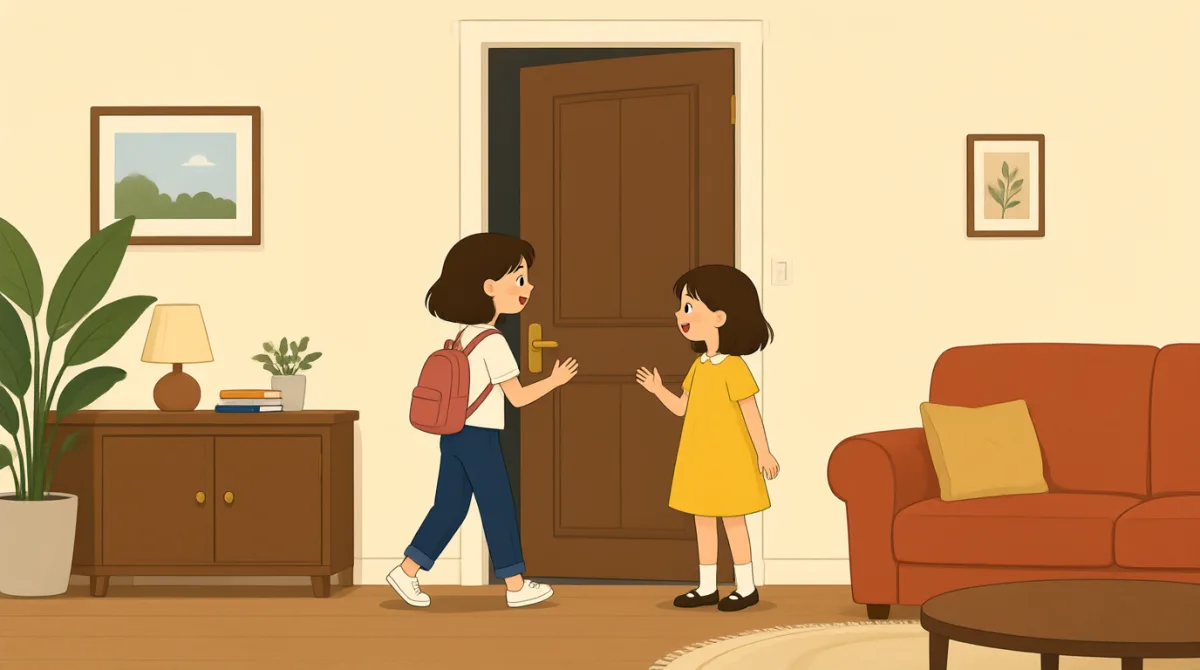

It was nice having you here, Mia.
C’était sympa de t’avoir à la maison, Mia.

Thank you. I had a lovely time.
Merci. J’ai passé un très bon moment.
Let me walk you to the door.
Je t’accompagne jusqu’à la porte.
Thanks. I’ll see you soon.
Merci. À bientôt !
How about next Saturday?
Et si on se voyait samedi prochain ?
That sounds great. See you then!
Ça me va très bien. À samedi !
Goodbye, Mia. Have a safe trip home.
Au revoir, Mia. Rentre bien.
Vocabulaire7
- It was nice having you here.C’était sympa de t’avoir à la maison.
Say this to show that you enjoyed having someone visit your home.
Dis cette phrase pour montrer que tu as apprécié recevoir quelqu’un chez toi.
- I had a lovely time.J’ai passé un très bon moment.
Say this to tell someone you enjoyed your visit.
Dis cette phrase pour faire savoir à quelqu’un que tu as apprécié ta visite.
- walk you to the dooraccompagner quelqu’un jusqu’à la porte
This means to go with someone to the door when they leave.
Cela signifie accompagner quelqu’un jusqu’à la porte au moment où il part.
- I’ll see you soon.À bientôt.
Say this when you expect to meet someone again soon.
Dis cette phrase quand tu penses revoir bientôt quelqu’un.
- How about next Saturday?Et si on se voyait samedi prochain ?
Use this to suggest meeting on a particular day.
Utilise cette phrase pour proposer de se voir un jour précis.
- That sounds great.Ça me va très bien.
Say this to show that you like someone’s idea or plan.
Dis cette phrase pour montrer que l’idée ou le projet de quelqu’un te plaît.
- Have a safe trip home.Rentre bien.
Say this to wish someone a safe journey home.
Dis cette phrase pour souhaiter à quelqu’un de bien rentrer chez lui.
Phrases clés7
- 1
It was nice having you here, Mia.
C’était sympa de t’avoir à la maison, Mia.
Use this to warmly thank a guest as they leave. You can change the name to speak to someone else.
Utilise cette phrase pour remercier chaleureusement un invité au moment de son départ. Tu peux remplacer le prénom par celui de quelqu’un d’autre.
- 2
Thank you. I had a lovely time.
Merci. J’ai passé un très bon moment.
Use this to thank your host and say you enjoyed your visit. You can say, “I had a lovely time” after a meal or event, too.
Utilise cette phrase pour remercier la personne qui t’a reçu et lui dire que tu as apprécié ta visite. Tu peux aussi dire “I had a lovely time” après un repas ou un événement.
- 3
Let me walk you to the door.
Je t’accompagne jusqu’à la porte.
Use this when you want to go with a guest as they leave. You can also say, “Let me walk you to the car.”
Utilise cette phrase quand tu veux accompagner un invité au moment où il part. Tu peux aussi dire “Let me walk you to the car.”
- 4
Thanks. I’ll see you soon.
Merci. À bientôt !
Use this to thank someone and say goodbye when you expect to meet again. Change “soon” to a time, such as “tomorrow.”
Utilise cette phrase pour remercier quelqu’un et lui dire au revoir quand tu penses le revoir. Remplace “soon” par un moment précis, comme “tomorrow.”
- 5
How about next Saturday?
Et si on se voyait samedi prochain ?
Use this to suggest a day to meet. Replace “next Saturday” with another day or time.
Utilise cette phrase pour proposer un jour où vous pourriez vous voir. Remplace “next Saturday” par un autre jour ou un autre moment.
- 6
That sounds great.
Ça me va très bien.
Use this to accept an idea or plan in a friendly way. You can also say, “That sounds good.”
Utilise cette phrase pour accepter une idée ou un projet de façon amicale. Tu peux aussi dire “That sounds good.”
- 7
Goodbye, Mia. Have a safe trip home.
Au revoir, Mia. Rentre bien.
Use this to say goodbye and wish someone well on the way home. Change the name to match the person you are speaking to.
Utilise cette phrase pour dire au revoir et souhaiter à quelqu’un de bien rentrer chez lui. Remplace le prénom par celui de la personne à qui tu parles.