Inviting a Friend to Visit
Inviter une amie à venir
Emma invites Mia to visit her apartment. They make a simple plan and talk about how to find the building.
Emma invite Mia à venir chez elle. Elles organisent une petite visite et parlent de la façon de trouver l’immeuble.
Dialogue8
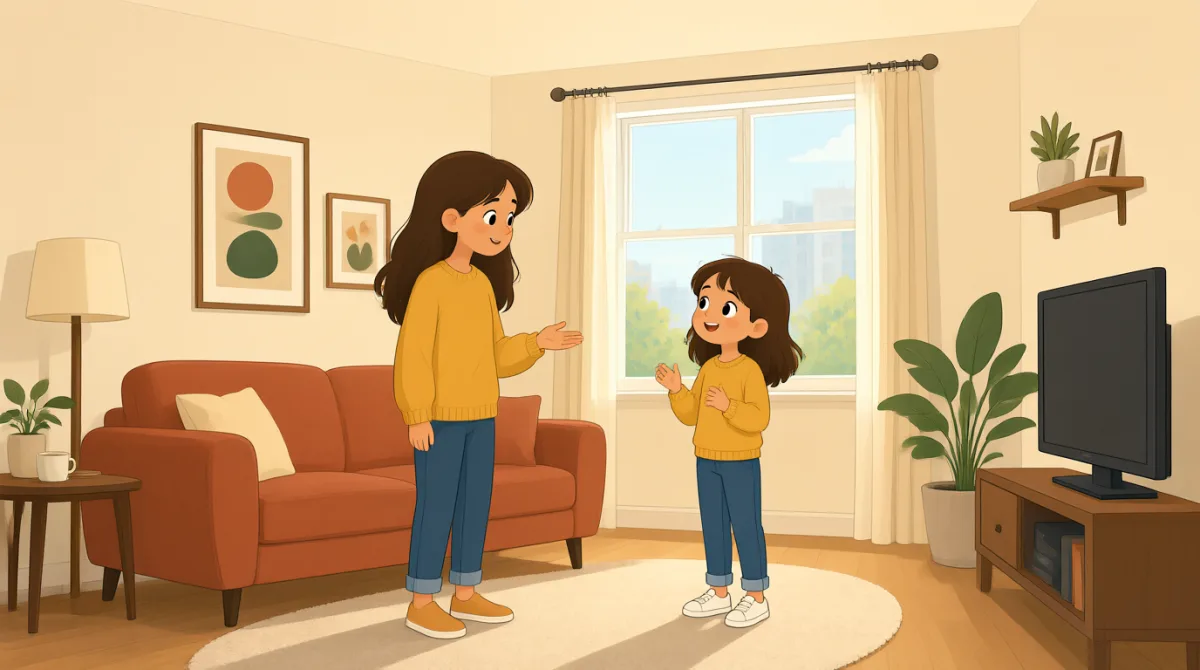

Mia, would you like to visit my apartment?
Mia, tu veux venir chez moi ?

Sure! When can I come?
Bien sûr ! Je peux venir quand ?
How about Saturday afternoon?
Et samedi après-midi ?
That works. How do I find your building?
Ça me va. Comment je trouve ton immeuble ?
It’s next to the blue bank on Pine Street.
Il est à côté de la banque bleue, dans Pine Street.
Great. What time should I come?
Super. Je viens à quelle heure ?
Come at two. I’ll meet you outside.
Viens à deux heures. Je t’attendrai dehors.
See you Saturday!
À samedi !
Vocabulaire7
- would you like towould you like to
This is a polite way to invite someone or offer something. You can say, “Would you like to come with me?”
Cette expression permet d’inviter poliment quelqu’un ou de lui proposer quelque chose. Tu peux dire : “Would you like to come with me?”
- Sure!Sure!
This means “yes” and shows that you are happy to agree. You can use it to accept an invitation.
Cela veut dire « oui » et montre que tu acceptes volontiers. Tu peux l’utiliser pour accepter une invitation.
- How about Saturday afternoon?How about Saturday afternoon?
Use this phrase to suggest a time. You can change the day or time, as in “How about Sunday morning?”
Utilise cette expression pour proposer un moment. Tu peux changer le jour ou l’heure, comme dans “How about Sunday morning?”
- That works.That works.
This means that a suggested time or plan is good for you. You can use it to agree with a plan.
Cela signifie qu’un horaire ou un projet proposé te convient. Tu peux l’utiliser pour accepter une proposition.
- next tonext to
This means beside or very close to something. You can use it to say where a place is.
Cela signifie « à côté de » ou « tout près de ». Tu peux l’utiliser pour indiquer où se trouve un endroit.
- on Pine Streeton Pine Street
This tells someone which street a place is on. Replace “Pine Street” with the name of another street.
Cette expression indique dans quelle rue se trouve un endroit. Remplace “Pine Street” par le nom d’une autre rue.
- outsideoutside
This means not inside a building. You can use it to say where you will wait for someone.
Cela signifie qu’on n’est pas à l’intérieur d’un bâtiment. Tu peux l’utiliser pour dire où tu attendras quelqu’un.
Phrases clés8
- 1
Mia, would you like to visit my apartment?
Mia, tu veux venir chez moi ?
This is a polite way to invite someone to your home. You can replace “my apartment” with another place.
C’est une façon polie d’inviter quelqu’un chez toi. Tu peux remplacer “my apartment” par un autre endroit.
- 2
Sure! When can I come?
Bien sûr ! Je peux venir quand ?
Use this to accept an invitation and ask about the time. You can also say, “When can I visit?”
Utilise cette phrase pour accepter une invitation et demander à quelle heure venir. Tu peux aussi dire : “When can I visit?”
- 3
How about Saturday afternoon?
Et samedi après-midi ?
This is a simple way to suggest a time. Replace “Saturday afternoon” with a day and time that work for you.
C’est une façon simple de proposer un moment. Remplace “Saturday afternoon” par un jour et une heure qui te conviennent.
- 4
How do I find your building?
Comment je trouve ton immeuble ?
Use this to ask for directions to a place. You can replace “your building” with a location, such as “the café.”
Utilise cette phrase pour demander son chemin vers un endroit. Tu peux remplacer “your building” par un lieu, comme “the café.”
- 5
It’s next to the blue bank on Pine Street.
Il est à côté de la banque bleue, dans Pine Street.
This sentence gives a location using a nearby place and a street name. Replace the details to help someone find another building.
Cette phrase indique où se trouve un endroit en mentionnant un lieu proche et le nom d’une rue. Tu peux modifier ces détails pour aider quelqu’un à trouver un autre bâtiment.
- 6
What time should I come?
Je viens à quelle heure ?
Use this to ask what time to arrive. You can use it when making plans to visit someone.
Utilise cette phrase pour demander à quelle heure arriver. Tu peux l’employer quand tu prévois d’aller chez quelqu’un.
- 7
I’ll meet you outside.
Je t’attendrai dehors.
This tells someone where you will meet them. Replace “outside” with another place, such as “at the front door.”
Cette phrase indique à quelqu’un où tu le retrouveras. Remplace “outside” par un autre endroit, comme “at the front door.”
- 8
See you Saturday!
À samedi !
This is a friendly way to say goodbye when you have plans to meet. Replace “Saturday” with the day you will see the person.
C’est une façon amicale de dire au revoir quand vous avez prévu de vous retrouver. Remplace “Saturday” par le jour où tu verras la personne.