Inviting a Friend to Visit
Eine Freundin zu Besuch einladen
Emma invites Mia to visit her apartment. They make a simple plan and talk about how to find the building.
Emma lädt Mia zu sich in die Wohnung ein. Sie machen einen einfachen Plan und sprechen darüber, wie Mia das Gebäude findet.
Dialog8
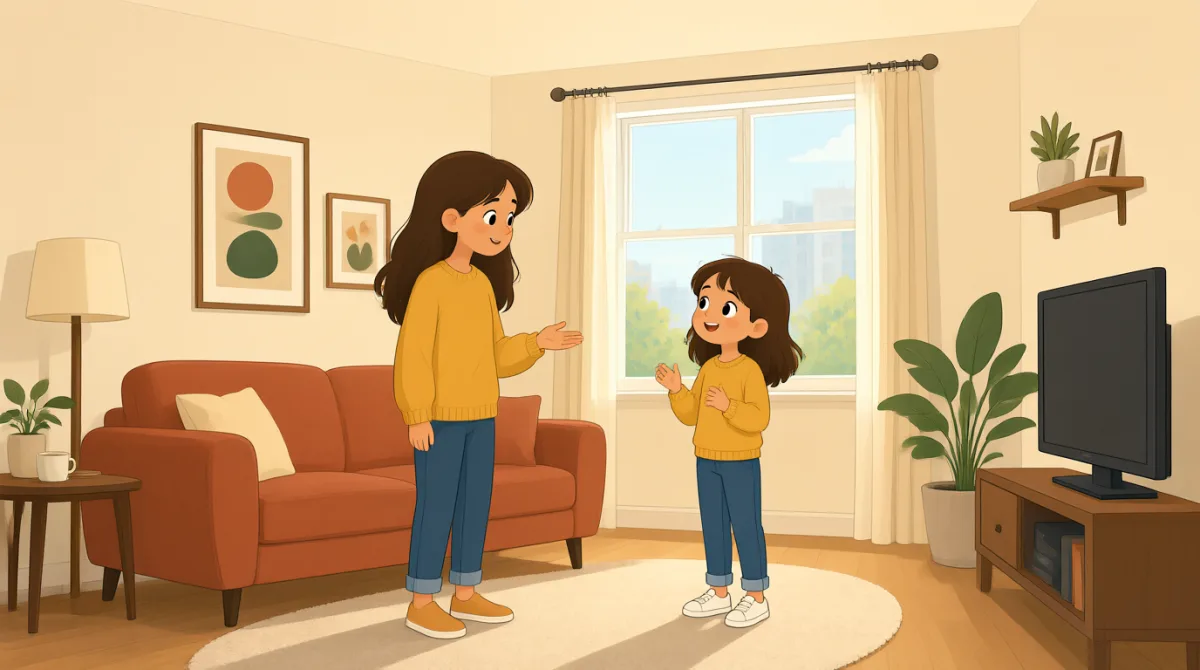

Mia, would you like to visit my apartment?
Mia, möchtest du mich in meiner Wohnung besuchen?

Sure! When can I come?
Klar! Wann kann ich kommen?
How about Saturday afternoon?
Wie wäre es mit Samstag Nachmittag?
That works. How do I find your building?
Das passt. Wie finde ich dein Gebäude?
It’s next to the blue bank on Pine Street.
Es ist neben der blauen Bank in der Pine Street.
Great. What time should I come?
Super. Um wie viel Uhr soll ich kommen?
Come at two. I’ll meet you outside.
Komm um zwei. Ich treffe dich draußen.
See you Saturday!
Bis Samstag!
Wortschatz7
- would you like tomöchtest du
This is a polite way to invite someone or offer something. You can say, “Would you like to come with me?”
Das ist eine höfliche Art, jemanden einzuladen oder etwas anzubieten. Du kannst sagen: “Would you like to come with me?” (Möchtest du mit mir kommen?)
- Sure!Klar!
This means “yes” and shows that you are happy to agree. You can use it to accept an invitation.
Das bedeutet „ja“ und zeigt, dass du gerne zustimmst. Du kannst es verwenden, um eine Einladung anzunehmen.
- How about Saturday afternoon?Wie wäre es mit Samstag Nachmittag?
Use this phrase to suggest a time. You can change the day or time, as in “How about Sunday morning?”
Mit dieser Wendung schlägst du eine Uhrzeit oder einen Zeitpunkt vor. Du kannst den Tag oder die Tageszeit ändern, zum Beispiel: “How about Sunday morning?” (Wie wäre es mit Sonntagmorgen?)
- That works.Das passt.
This means that a suggested time or plan is good for you. You can use it to agree with a plan.
Das bedeutet, dass ein vorgeschlagener Zeitpunkt oder Plan für dich gut ist. Du kannst es verwenden, um einem Plan zuzustimmen.
- next toneben
This means beside or very close to something. You can use it to say where a place is.
Das bedeutet, dass etwas direkt bei oder sehr nahe an etwas anderem ist. Du kannst damit sagen, wo sich ein Ort befindet.
- on Pine Streetin der Pine Street
This tells someone which street a place is on. Replace “Pine Street” with the name of another street.
Damit sagst du jemandem, in welcher Straße sich ein Ort befindet. Ersetze “Pine Street” durch den Namen einer anderen Straße.
- outsidedraußen
This means not inside a building. You can use it to say where you will wait for someone.
Das bedeutet, dass man sich nicht in einem Gebäude befindet. Du kannst damit sagen, wo du auf jemanden wartest.
Wichtige Sätze8
- 1
Mia, would you like to visit my apartment?
Mia, möchtest du mich in meiner Wohnung besuchen?
This is a polite way to invite someone to your home. You can replace “my apartment” with another place.
Das ist eine höfliche Art, jemanden zu sich nach Hause einzuladen. Du kannst “my apartment” durch einen anderen Ort ersetzen.
- 2
Sure! When can I come?
Klar! Wann kann ich kommen?
Use this to accept an invitation and ask about the time. You can also say, “When can I visit?”
Damit nimmst du eine Einladung an und fragst nach dem Zeitpunkt. Du kannst auch sagen: “When can I visit?” (Wann kann ich zu Besuch kommen?)
- 3
How about Saturday afternoon?
Wie wäre es mit Samstag Nachmittag?
This is a simple way to suggest a time. Replace “Saturday afternoon” with a day and time that work for you.
So kannst du ganz einfach einen Zeitpunkt vorschlagen. Ersetze “Saturday afternoon” durch einen Tag und eine Uhrzeit, die dir passen.
- 4
How do I find your building?
Wie finde ich dein Gebäude?
Use this to ask for directions to a place. You can replace “your building” with a location, such as “the café.”
Damit fragst du nach dem Weg zu einem Ort. Du kannst “your building” durch einen anderen Ort ersetzen, zum Beispiel durch “the café”.
- 5
It’s next to the blue bank on Pine Street.
Es ist neben der blauen Bank in der Pine Street.
This sentence gives a location using a nearby place and a street name. Replace the details to help someone find another building.
Dieser Satz beschreibt einen Ort mithilfe eines nahe gelegenen Orientierungspunkts und eines Straßennamens. Ändere die Angaben, damit jemand ein anderes Gebäude findet.
- 6
What time should I come?
Um wie viel Uhr soll ich kommen?
Use this to ask what time to arrive. You can use it when making plans to visit someone.
Damit fragst du, wann du ankommen sollst. Du kannst die Frage stellen, wenn du einen Besuch planst.
- 7
I’ll meet you outside.
Ich treffe dich draußen.
This tells someone where you will meet them. Replace “outside” with another place, such as “at the front door.”
Damit sagst du jemandem, wo du ihn oder sie triffst. Ersetze “outside” durch einen anderen Ort, zum Beispiel durch “at the front door”.
- 8
See you Saturday!
Bis Samstag!
This is a friendly way to say goodbye when you have plans to meet. Replace “Saturday” with the day you will see the person.
Das ist eine freundliche Art, sich zu verabschieden, wenn ihr verabredet seid. Ersetze “Saturday” durch den Tag, an dem ihr euch seht.