Borrowing a Pen
Emprunter un stylo
Emma asks Mia if she can borrow a pen. Mia lends her one.
Emma demande à Mia si elle peut lui emprunter un stylo. Mia lui en prête un.
Dialogue7
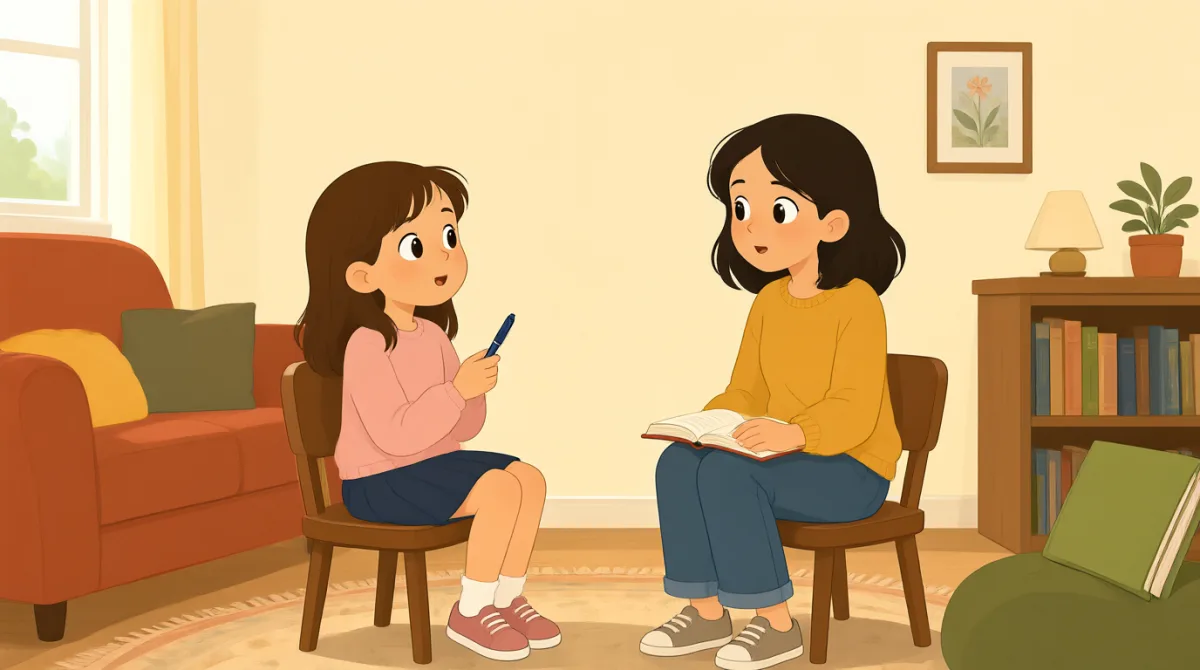

Mia, can I borrow a pen?
Mia, je peux t’emprunter un stylo ?

Sure. Here you go.
Bien sûr. Tiens.
Thanks. I need to write this down.
Merci. Je dois noter ça.
No problem. Do you need paper too?
Pas de problème. Tu as aussi besoin de papier ?
No, thanks. I have some.
Non, merci. J’en ai.
You can give the pen back after class.
Tu peux me rendre le stylo après le cours.
Okay. Thanks for helping me.
D’accord. Merci de m’aider.
Vocabulaire8
- borrow a penemprunter un stylo
To borrow a pen is to use someone else’s pen and return it later.
Emprunter un stylo, c’est utiliser le stylo de quelqu’un et le lui rendre plus tard.
- Sure.Bien sûr.
This is a friendly way to say yes when someone asks for help.
C’est une façon amicale de dire oui quand quelqu’un te demande de l’aide.
- Here you go.Tiens.
Say this when you hand something to someone.
Dis ça quand tu tends quelque chose à quelqu’un.
- write this downnoter ça
This means to put information on paper.
Cela signifie écrire une information sur du papier.
- No problem.Pas de problème.
This is a friendly way to say that helping is okay.
C’est une façon amicale de dire que ça ne te dérange pas d’aider.
- paperpapier
Paper is something you write on.
Le papier est une matière sur laquelle on écrit.
- give the pen backrendre le stylo
This means to return the pen to its owner.
Cela signifie rendre le stylo à la personne à qui il appartient.
- after classaprès le cours
This means when the class is over.
Cela signifie une fois que le cours est terminé.
Phrases clés7
- 1
Mia, can I borrow a pen?
Mia, je peux t’emprunter un stylo ?
Use this polite question to ask to use something that belongs to someone else. You can replace “a pen” with another item.
Utilise cette question polie pour demander si tu peux utiliser quelque chose qui appartient à quelqu’un d’autre. Tu peux remplacer “a pen” par un autre objet.
- 2
Sure. Here you go.
Bien sûr. Tiens.
Use these phrases to agree and hand someone an item. They work well together when lending something.
Utilise ces expressions pour accepter et tendre un objet à quelqu’un. Elles vont bien ensemble quand tu prêtes quelque chose.
- 3
Thanks. I need to write this down.
Merci. Je dois noter ça.
Use “I need to” to say what you have to do. You can replace “write this down” with another simple task.
Utilise “I need to” pour dire ce que tu dois faire. Tu peux remplacer “write this down” par une autre tâche simple.
- 4
Do you need paper too?
Tu as aussi besoin de papier ?
Use this question to offer one more helpful thing. Replace “paper” with another item.
Utilise cette question pour proposer une autre chose qui pourrait aider. Remplace “paper” par un autre objet.
- 5
No, thanks. I have some.
Non, merci. J’en ai.
Use this polite reply when you do not need an offer. “I have some” means you already have enough paper.
Utilise cette réponse polie quand tu n’as pas besoin de ce qu’on te propose. “I have some” signifie que tu as déjà assez de papier.
- 6
You can give the pen back after class.
Tu peux me rendre le stylo après le cours.
Use “You can” to tell someone when they may do something. Here, it gives a simple time to return an item.
Utilise “You can” pour dire à quelqu’un quand il peut faire quelque chose. Ici, tu indiques simplement quand rendre un objet.
- 7
Okay. Thanks for helping me.
D’accord. Merci de m’aider.
Use this to agree and thank someone for their help. You can also say “Thanks for helping me” after someone does you a favor.
Utilise cette phrase pour accepter et remercier quelqu’un de son aide. Tu peux aussi dire “Thanks for helping me” après que quelqu’un t’a rendu service.