Your Lunch Break
Tu pausa para comer
Mia asks Grace what she does at lunchtime. Grace talks about her lunch and where she eats.
Mia le pregunta a Grace qué hace a la hora del almuerzo. Grace habla de lo que come y de dónde come.
Diálogo8
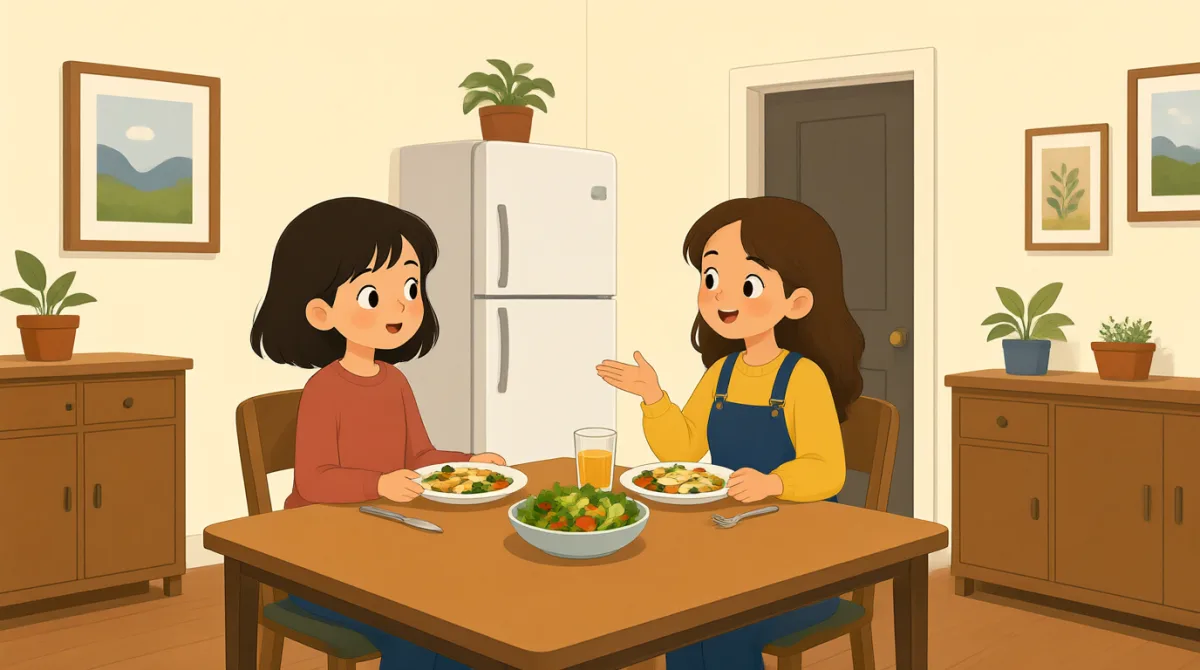

Grace, what do you do at lunchtime?
Grace, ¿qué haces a la hora del almuerzo?

I eat lunch at twelve every day.
Almuerzo a las doce todos los días.
What do you usually eat?
¿Qué sueles comer?
I usually eat a sandwich and some fruit.
Normalmente como un sándwich y algo de fruta.
Do you eat at your desk?
¿Comes en tu escritorio?
No, I eat in the break room.
No, como en la sala de descanso.
Do you talk with your coworkers there?
¿Hablas con tus compañeros de trabajo allí?
Yes, we talk and relax for thirty minutes.
Sí, hablamos y descansamos durante treinta minutos.
Vocabulario8
- at lunchtimea la hora del almuerzo
This means during the time when people eat lunch. You can ask, “What do you do at lunchtime?”
Se refiere al momento en que la gente almuerza. Puedes preguntar: “What do you do at lunchtime?” (¿Qué haces a la hora del almuerzo?).
- every daytodos los días
This means each day. Use it to talk about a regular routine.
Significa cada día. Úsalo para hablar de una rutina habitual.
- usuallynormalmente
This means something happens most of the time. Use it to describe what you often do.
Significa que algo sucede la mayor parte del tiempo. Úsalo para describir lo que haces a menudo.
- a sandwichun sándwich
A sandwich is food made with bread and a filling. You can use “a” before one sandwich.
Un sándwich se prepara con pan y un relleno. En inglés, puedes usar “a” antes de “sandwich” cuando hablas de uno.
- some fruitalgo de fruta
This means an amount of fruit, without saying exactly how much. Use “some” with food when the amount is not specific.
Se refiere a una cantidad de fruta sin decir exactamente cuánto. Usa “some” con alimentos cuando la cantidad no es específica.
- at your desken tu escritorio
This means sitting at the desk where you work. You can ask if someone eats there.
Significa sentado en el escritorio donde trabajas. Puedes preguntar si alguien come allí.
- break roomsala de descanso
A break room is a place at work where people can rest or eat. We say “in the break room.”
Es un lugar en el trabajo donde la gente puede descansar o comer. En inglés, se dice “in the break room”.
- coworkerscompañeros de trabajo
Coworkers are people who work with you. You can talk with your coworkers during a break.
Son las personas que trabajan contigo. Puedes hablar con tus compañeros de trabajo durante un descanso.
Frases clave8
- 1
Grace, what do you do at lunchtime?
Grace, ¿qué haces a la hora del almuerzo?
Use this question to ask about someone’s lunch routine. You can change “at lunchtime” to another time, such as “in the morning.”
Usa esta pregunta para preguntar por la rutina de almuerzo de alguien. Puedes cambiar “at lunchtime” por otro momento, como “in the morning”.
- 2
I eat lunch at twelve every day.
Almuerzo a las doce todos los días.
This is a simple way to say when you eat lunch and how often. Change “twelve” to your lunch time.
Es una forma sencilla de decir a qué hora almuerzas y con qué frecuencia. Cambia “twelve” por la hora a la que almuerzas.
- 3
What do you usually eat?
¿Qué sueles comer?
Use this question to ask what food someone often eats. You can replace “eat” with another action, such as “drink.”
Usa esta pregunta para saber qué comida suele comer alguien. Puedes cambiar “eat” por otra acción, como “drink”.
- 4
I usually eat a sandwich and some fruit.
Normalmente como un sándwich y algo de fruta.
This sentence tells someone what you often eat. You can replace the foods with your usual lunch.
Esta oración le dice a alguien qué sueles comer. Puedes cambiar los alimentos por lo que acostumbras almorzar.
- 5
Do you eat at your desk?
¿Comes en tu escritorio?
Use this yes-or-no question to ask where someone eats. Replace “at your desk” with a place, such as “in the kitchen.”
Usa esta pregunta de sí o no para preguntar dónde come alguien. Cambia “at your desk” por otro lugar, como “in the kitchen”.
- 6
No, I eat in the break room.
No, como en la sala de descanso.
This is a simple way to say no and explain where you eat. You can use “I eat in…” with another place.
Es una forma sencilla de decir que no y explicar dónde comes. Puedes usar “I eat in…” con otro lugar.
- 7
Do you talk with your coworkers there?
¿Hablas con tus compañeros de trabajo allí?
Use this question to ask whether someone talks with people they work with. “There” means the place mentioned before.
Usa esta pregunta para saber si alguien habla con las personas con las que trabaja. “There” se refiere al lugar que se mencionó antes.
- 8
Yes, we talk and relax for thirty minutes.
Sí, hablamos y descansamos durante treinta minutos.
This sentence describes what a group does and how long they do it. You can replace the actions or the time to talk about your own break.
Esta oración describe lo que hace un grupo y cuánto tiempo lo hace. Puedes cambiar las acciones o el tiempo para hablar de tu propio descanso.