Saying No, Thank You
Nein, danke sagen
Mia offers David her seat at the next stop. He says no, thank you, because he is getting off soon.
Mia bietet David an der nächsten Haltestelle ihren Sitzplatz an. Er lehnt dankend ab, weil er bald aussteigt.
Dialog7
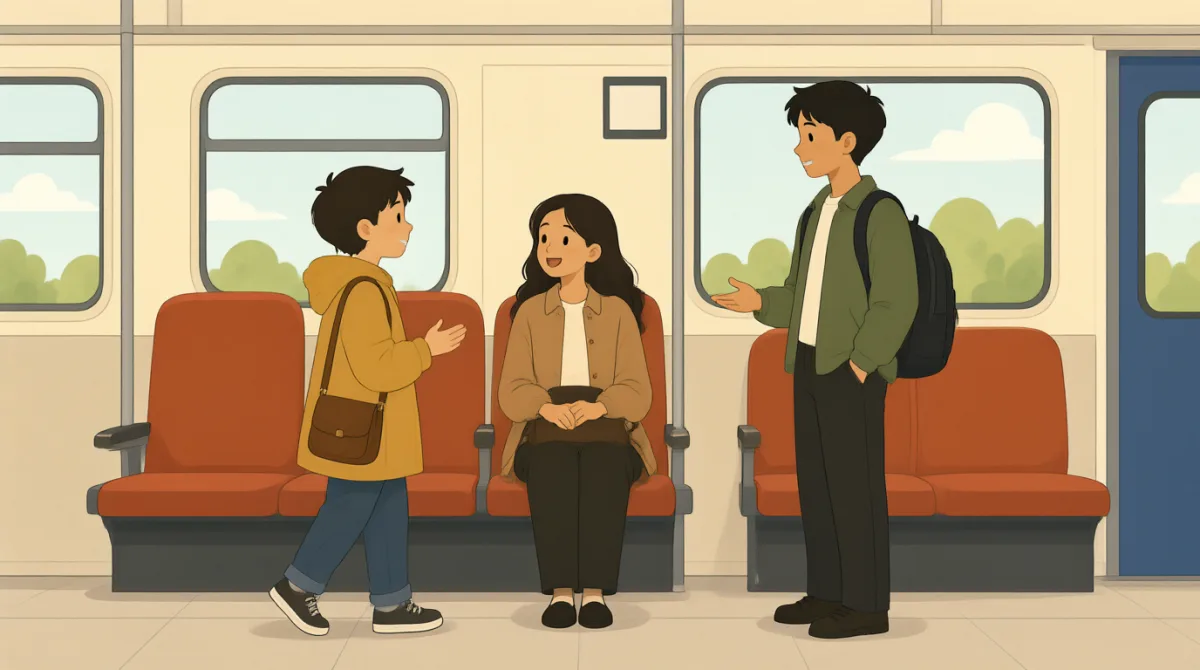

Would you like my seat, David?
Möchtest du meinen Sitzplatz, David?

No, thank you, Mia.
Nein, danke, Mia.
I’m getting off soon.
Ich steige gleich aus.
Are you sure?
Bist du sicher?
Yes, my stop is next.
Ja, meine Haltestelle kommt als Nächstes.
Okay. Have a nice day!
Okay. Schönen Tag noch!
Thank you. You too!
Danke. Dir auch!
Wortschatz8
- Would you like my seat?Would you like my seat?
This is a polite way to offer someone your seat. You can use “Would you like my ___?” to offer something else.
So bietest du jemandem höflich deinen Sitzplatz an. Mit “Would you like my ___?” kannst du auch etwas anderes anbieten.
- No, thank you.No, thank you.
This is a polite way to say no to an offer. You can use it when you do not need or want something.
So lehnst du ein Angebot höflich ab. Du kannst das sagen, wenn du etwas nicht brauchst oder möchtest.
- getting offgetting off
On a bus, “getting off” means leaving the bus. You can say “I’m getting off” when your stop is coming.
Im Bus bedeutet “getting off”, dass man aus dem Bus aussteigt. Du kannst “I’m getting off” sagen, wenn deine Haltestelle bald kommt.
- soonsoon
“Soon” means in a short time. You can use it to talk about something that will happen shortly.
“Soon” bedeutet, dass etwas in kurzer Zeit passiert. Du kannst es verwenden, wenn etwas bald geschehen wird.
- Are you sure?Are you sure?
This is a way to check if someone feels certain. You can say it after someone says no or makes a choice.
Mit dieser Frage prüfst du, ob sich jemand wirklich sicher ist. Du kannst sie stellen, nachdem jemand Nein gesagt oder eine Entscheidung getroffen hat.
- my stop is nextmy stop is next
This means the bus will reach your stop after the current one. You can say it to explain why you are getting ready to leave.
Das bedeutet, dass der Bus nach der aktuellen Haltestelle deine Haltestelle erreicht. Du kannst das sagen, um zu erklären, warum du dich auf den Ausstieg vorbereitest.
- Have a nice day!Have a nice day!
This is a friendly way to say goodbye. You can use it when you leave someone.
Das ist eine freundliche Verabschiedung. Du kannst sie sagen, wenn du dich von jemandem verabschiedest.
- You too!You too!
This means you wish the same thing to the other person. You can say it after someone says “Have a nice day!”
Damit wünschst du der anderen Person dasselbe. Du kannst es sagen, nachdem jemand “Have a nice day!” gesagt hat.
Wichtige Sätze8
- 1
Would you like my seat, David?
Möchtest du meinen Sitzplatz, David?
Use this polite question to offer someone your seat. You can replace “my seat” with another thing you want to offer.
Mit dieser höflichen Frage bietest du jemandem deinen Sitzplatz an. Du kannst “my seat” durch etwas anderes ersetzen, das du anbieten möchtest.
- 2
No, thank you, Mia.
Nein, danke, Mia.
This is a polite way to refuse an offer. Say “No, thank you” when you do not want something.
So lehnst du ein Angebot höflich ab. Sag “No, thank you”, wenn du etwas nicht möchtest.
- 3
I’m getting off soon.
Ich steige gleich aus.
Use this sentence to explain that you will leave the bus shortly. You can also use “I’m getting off soon” in other situations where you are leaving a vehicle.
Mit diesem Satz erklärst du, dass du den Bus bald verlässt. “I’m getting off soon” kannst du auch in anderen Situationen verwenden, wenn du bald aus einem Fahrzeug aussteigst.
- 4
Are you sure?
Bist du sicher?
Use this short question to check that someone really means what they said. It is useful when you want to offer help again.
Mit dieser kurzen Frage prüfst du, ob jemand wirklich meint, was er gesagt hat. Sie ist nützlich, wenn du noch einmal Hilfe anbieten möchtest.
- 5
Yes, my stop is next.
Ja, meine Haltestelle kommt als Nächstes.
This sentence explains that your bus stop is coming up. You can use “My stop is next” to tell someone why you are getting ready to leave.
Mit diesem Satz erklärst du, dass deine Haltestelle bald kommt. Du kannst “My stop is next” sagen, um jemandem mitzuteilen, warum du dich auf den Ausstieg vorbereitest.
- 6
Okay.
Okay.
Use this simple word to show that you understand or accept what someone said. It works in many everyday conversations.
Mit diesem einfachen Wort zeigst du, dass du verstanden hast oder mit dem Gesagten einverstanden bist. Es passt in viele alltägliche Gespräche.
- 7
Have a nice day!
Schönen Tag noch!
This is a friendly way to say goodbye. You can use it when ending a conversation during the day.
Das ist eine freundliche Verabschiedung. Du kannst sie verwenden, wenn du dich tagsüber von jemandem verabschiedest.
- 8
Thank you. You too!
Danke. Dir auch!
Use “Thank you” to show appreciation, and “You too” to return a kind wish. It is a natural response to “Have a nice day!”
Mit “Thank you” zeigst du deine Wertschätzung und mit “You too” erwiderst du einen netten Wunsch. Das ist eine natürliche Antwort auf “Have a nice day!”.