Locating a Common Item
尋找常見商品
A customer asks an employee where to find a commonly stocked item like milk, bread, or fresh produce, which might be in a less obvious section.
顧客向店員詢問牛奶、麵包或新鮮農產品等常見商品的位置,這些商品可能在不太顯眼的區域。
對話8
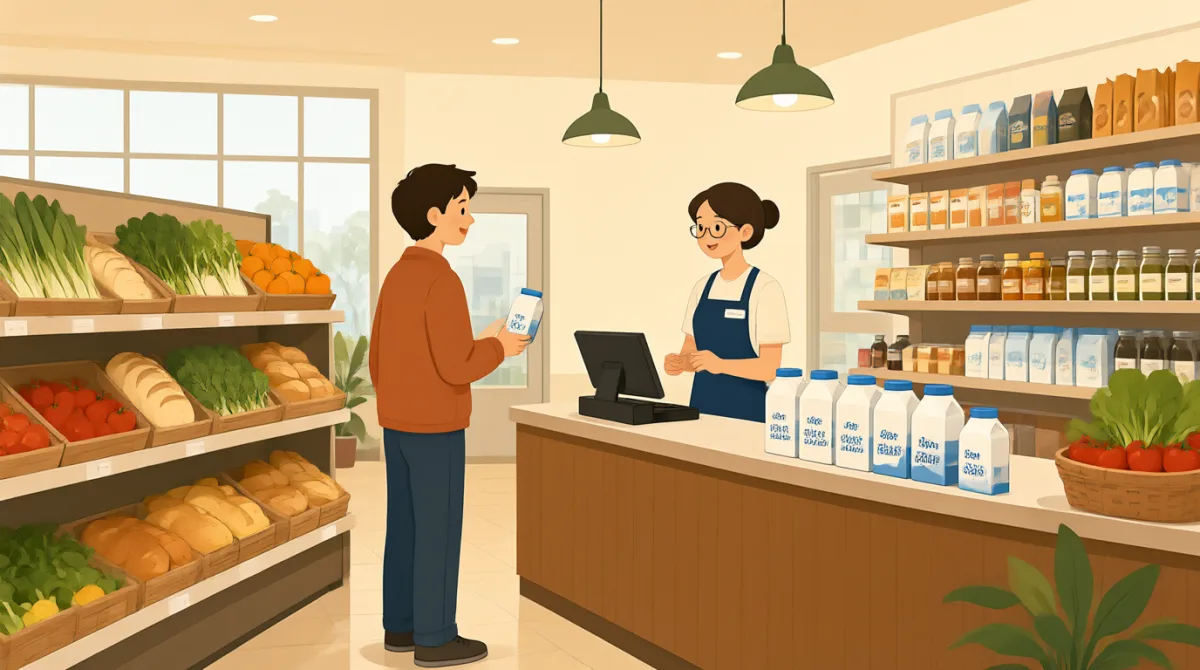

Excuse me, I'm trying to find the fresh produce section. Could you point me in the right direction?
打擾一下,我正在找新鮮農產品區。您能告訴我怎麼走嗎?

Certainly! The fresh produce is actually right around the corner, just past the dairy section. You'll see all the fruits and vegetables there.
當然!新鮮農產品區就在拐角處,剛過奶製品區。你會看到那裡所有的水果和蔬菜。
Oh, perfect! I thought it might be closer to the entrance. So, just past dairy, you said?
哦,太好了!我以為它會離入口更近。所以,您說是在奶製品區後面?
That's right. If you follow this main aisle, you'll see the dairy on your left, and then just take a quick right at the end of that aisle. Can't miss it!
沒錯。如果你沿著這條主通道走,你會看到奶製品區在你的左手邊,然後在那條通道的盡頭向右轉一下。肯定不會錯過的!
Great, thanks so much for your help! I really appreciate it.
太棒了,非常感謝您的幫助!我真的很感激。
No problem at all! Is there anything else I can help you find today?
不客氣!今天還有其他我可以幫您找到的東西嗎?
Not at the moment, but thank you. You've been very helpful!
暫時沒有了,不過謝謝您。您真是幫了大忙!
You're welcome. Have a good day of shopping!
不客氣。祝您購物愉快!
詞彙8
- fresh produce新鮮農產品
Refers to fruits and vegetables that are freshly picked and sold in the supermarket. Use this when asking for the section with healthy, raw foods like apples or lettuce.
指超市裡新鮮採摘並出售的水果和蔬菜。詢問蘋果、生菜等健康的生鮮食品所在的區域時,可以使用這個詞。
- dairy section奶製品區
The area in a store where milk, cheese, yogurt, and other milk-based products are kept. It's often cool to keep items fresh.
指商店裡存放牛奶、乳酪、酸奶及其他乳製品的區域。為了保持商品新鮮,這裡通常比較涼爽。
- around the corner在拐角處附近
Means very close by, just after turning at a bend. Use this to describe something nearby in a store or building.
意思是離這裡很近,轉過一個彎就到了。在商店或建築物內描述附近的位置時,可以使用這個短語。
- aisle通道
A long pathway between shelves in a supermarket where products are displayed. Common in stores for walking and shopping.
指超市貨架之間用於陳列商品的長通道。購物者通常會沿著這種通道行走和購物。
- on your left在你的左手邊
Indicates the direction to the left side as you face forward. Helpful for giving or following directions in places like stores.
表示面朝前方時左側的方向。在商店等場所指路或跟隨路線時,這個短語很有用。
- take a right向右轉
Means to turn to the right. A basic direction word used when guiding someone, like in a supermarket layout.
意思是轉向右邊。在超市佈局中為別人指路時,這是一個常用的基本方向表達。
- appreciate感激
To feel grateful for help or kindness. Use it to politely thank someone, showing good manners in English-speaking situations.
表示因他人的幫助或好意而心懷感謝。在英語交流中禮貌地道謝、表達良好禮貌時,可以使用這個詞。
- can't miss it肯定不會錯過
Means it's very easy to find and obvious. Use this to reassure someone that a location is clear and simple to spot.
意思是很容易找到,位置非常明顯。用來讓對方放心,表示地點清楚、很容易發現。
關鍵句7
- 1
Excuse me, I'm trying to find the fresh produce section. Could you point me in the right direction?
打擾一下,我正在找新鮮農產品區。您能告訴我怎麼走嗎?
This is a polite way to start asking for help in a store. 'Excuse me' gets attention, and 'point me in the right direction' idiomatically means 'tell me where to go.' Useful for beginners asking locations; practice the question form for directions.
這是在商店裡禮貌地開口尋求幫助的方式。'Excuse me' 用來引起對方注意,而 'point me in the right direction' 是習慣表達,意思是“告訴我該往哪裡走”。初學者詢問地點時很實用,也可以練習這種問路句型。
- 2
The fresh produce is actually right around the corner, just past the dairy section.
新鮮農產品區其實就在拐角處,剛過奶製品區。
Gives clear directions using location words like 'around the corner' and 'past.' 'Actually' adds emphasis or correction. Great for responding to questions; helps learners describe nearby places relative to landmarks.
這句話使用了 'around the corner' 和 'past' 等位置表達來清楚地指路。'Actually' 用來加強語氣或糾正之前的想法。回答地點問題時很實用,也能幫助學習者根據地標描述附近的位置。
- 3
If you follow this main aisle, you'll see the dairy on your left, and then just take a quick right at the end of that aisle.
如果您沿著這條主通道走,您會看到奶製品區在您的左手邊,然後在那條通道的盡頭向右快速轉彎。
Uses imperative verbs like 'follow' and 'take' for step-by-step directions. 'You'll see' predicts what happens next. Essential pattern for guiding; intermediate learners can use it to give or follow multi-step instructions.
這句話使用 'follow' 和 'take' 等祈使動詞,一步一步地說明路線。'You'll see' 用來預測接下來會看到的情況。這是引導別人時非常重要的句型,中級學習者可以用它來說明或理解多步驟指示。
- 4
Can't miss it!
肯定不會錯過的!
A short, reassuring phrase meaning it's impossible to overlook. Informal and friendly; use at the end of directions to build confidence. No complex grammar, but shows contraction for natural speech.
這是一個簡短、讓人放心的表達,意思是“絕對不會看漏”。它語氣非正式而友好,適合在指路結束時使用,讓對方更有信心。語法並不複雜,但體現了自然口語中的縮寫形式。
- 5
Great, thanks so much for your help! I really appreciate it.
太棒了,非常感謝您的幫助!我真的很感激。
Expresses thanks politely. 'Thanks so much' is emphatic gratitude, and 'I really appreciate it' shows deeper thanks. Useful closing sentence after receiving help; teaches polite expressions for service interactions.
這句話禮貌地表達感謝。'Thanks so much' 表示非常感謝,而 'I really appreciate it' 表示更深的感激。接受幫助後用這句話結束對話很合適,也能學習服務場景中的禮貌表達。
- 6
No problem at all! Is there anything else I can help you find today?
完全沒問題!今天還有什麼我可以幫您找到的嗎?
Responds to thanks casually ('No problem at all') and offers more help with a question. Shows customer service politeness; learners can use this in roles like shop assistant to keep conversations open.
這句話用 'No problem at all' 輕鬆地回應感謝,同時用問題主動提供更多幫助。它體現了客服人員的禮貌,店員可以使用這種說法來延續對話。
- 7
You're welcome. Have a good day of shopping!
不客氣。祝您購物愉快!
Standard reply to 'thank you' ('You're welcome') followed by a friendly wish. 'Have a good day' is a common farewell; adapt to context like 'shopping' for specificity. Teaches ending conversations positively.
這是對 'thank you' 的標準回應 'You're welcome',後面接一句友好的祝願。'Have a good day' 是常見的告別語,也可以根據語境加入 'shopping' 這樣的具體內容。這個表達能幫助學習者以積極的方式結束對話。