Deciphering the Instructions - The Language Barrier (of pictograms)
解讀說明書——(象形圖)語言障礙
The couple struggles to understand a particularly confusing step in the purely pictorial IKEA instruction manual. They might argue over the interpretation of an illustration, leading to a discussion about what each symbol or arrow means, possibly having to re-read or look ahead for clues.
情侶費力地理解宜家純象形圖說明書中一個特別令人困惑的步驟。他們可能會為了一個插圖的解釋而爭論不休,討論每個符號或箭頭的含義,甚至可能需要反覆閱讀或提前檢視下一步的圖示以尋找線索。
對話8
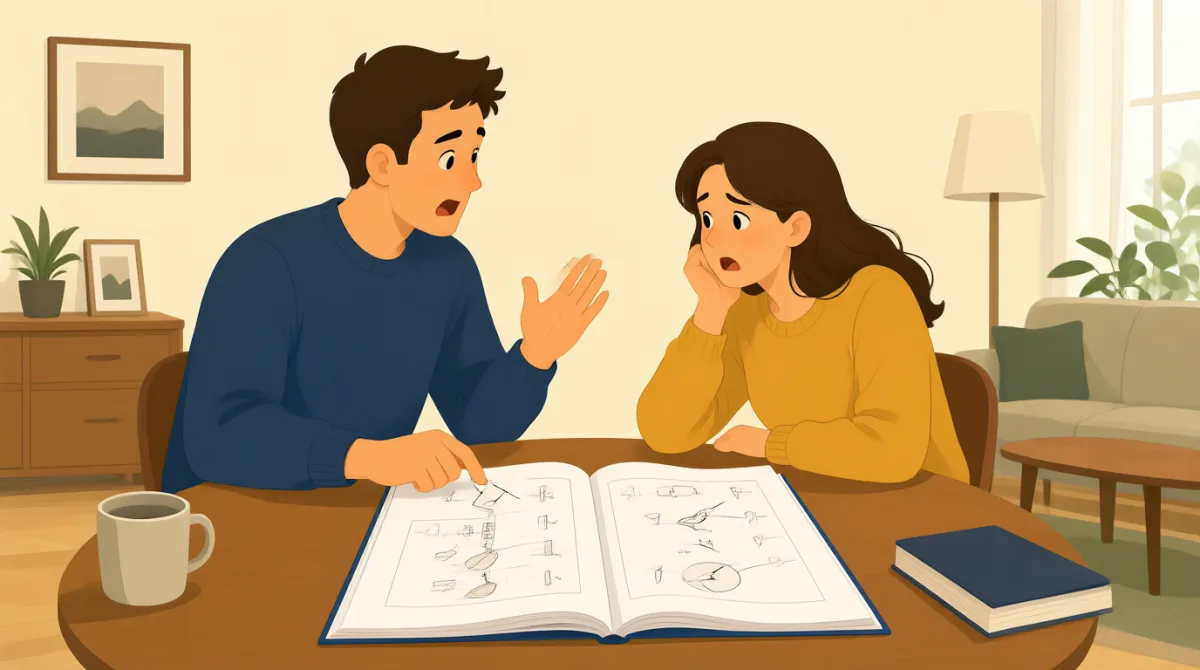

Okay, so we've got the side panels on, but this next step... I'm really scratching my head here.
好了,側板我們都裝好了,但下一步……我真是摸不著頭腦。

Let me see. Is that an arrow pointing *through* the wood? Or is it showing us where to drill a hole?
我看看。那是個箭頭直接穿過木頭嗎?還是它在指示我們鑽孔的位置?
Exactly! It looks like it's going straight through. But there's no pre-drilled hole there. And this little symbol next to it... a circle with a cross?
就是啊!看起來它直接穿過去了。但那裡沒有預鑽的孔。它旁邊那個小符號……一個帶叉的圓圈?
Usually, that means 'don't do this' or 'not applicable'. But then what IS applicable? Maybe we need to look ahead to the next page for context.
通常,那意味著“不要這樣做”或“不適用”。但那到底什麼是適用的呢?也許我們需要翻到下一頁看看上下文。
Good idea. Let's flip the page... Ah, wait! Look at this detail here on step seven. It shows a different type of screw going into *that* same spot.
好主意。我們翻頁……啊,等一下!看這裡,第七步的這個細節。它顯示了另一種螺絲要擰進同一個位置。
So, the first illustration was a 'wrong way' example? That's so misleading! They should put a big 'X' over it or something.
所以,第一個插圖是個“錯誤方式”的例子?那也太誤導人了!他們應該在上面畫個大大的“X”才對。
Tell me about it. IKEA instructions, always an adventure. So, we're definitely using the 'cam lock and bolt' here, not the long screw.
可不是嘛。宜家說明書,總是一場冒險。所以,我們這裡肯定是用“偏心鎖和螺栓”,而不是長螺絲。
Right. Okay, that makes so much more sense. This pictogram language is a real test of our decoding skills, isn't it?
對。好吧,這樣就說得通多了。這種象形文字真是對我們解讀能力的一大考驗,不是嗎?
詞彙9
- scratching my head摸不著頭腦
An idiom meaning to be confused or puzzled about something, like trying to solve a difficult problem.
一個習語,表示對某件事感到困惑或不解,就像在努力解決一道難題。
- arrow箭頭
A straight line with a pointed end that shows direction, often used in diagrams or instructions to guide actions.
一種末端帶尖的直線,用來表示方向,常見於圖表或說明書中,用來指引操作。
- drill a hole鑽孔
To use a tool called a drill to make a small opening in wood or another material, common in DIY tasks like furniture assembly.
用電鑽等工具在木頭或其他材料上鑽出一個小孔,常見於傢俱組裝等 DIY 活動。
- pre-drilled預先鑽好的
Describes a hole that has already been made in advance with a drill, so you don't need to make it yourself.
形容已經提前鑽好的孔,因此你不必自己動手鑽。
- symbol符號
A simple picture or sign that represents an idea or instruction, like in manuals where words are not used.
用來表示某種含義或指示的簡單圖畫或標記,例如不用文字的說明書中的圖示。
- misleading容易讓人誤解的
Something that causes confusion or leads you to the wrong conclusion, often used when instructions are unclear.
指讓人感到困惑或得出錯誤結論的事物,常用來形容不清楚的說明。
- Tell me about it可不是嘛
An informal expression to strongly agree with someone and show you share their frustration or experience.
一種非正式表達,用來強烈表示贊同,也說明你和對方有同樣的煩惱或經歷。
- pictogram象形圖
A visual symbol or picture that communicates information without words, like icons in IKEA instructions.
一種不用文字傳遞資訊的圖形符號或圖畫,例如宜家說明書裡的圖示。
- decoding解讀
The process of figuring out or interpreting the meaning of something complex, like symbols or codes.
弄清或解釋複雜事物含義的過程,例如解讀符號或密碼。
關鍵句7
- 1
I'm really scratching my head here.
我真是摸不著頭腦。
This is an idiomatic expression using 'scratching my head' to show confusion. It's useful for everyday situations when you're puzzled, and the adverb 'really' adds emphasis. Use it casually with friends or partners.
這裡用習語 'scratching my head' 來表達困惑。日常生活中遇到難題、感到不解時可以這麼說;副詞 'really' 則加強了語氣。和朋友或伴侶聊天時可以隨意使用。
- 2
Is that an arrow pointing through the wood?
那是個箭頭指向木頭裡面嗎?
A yes/no question using 'is that' to seek clarification on a visual detail. The present continuous 'pointing' describes the action shown. Useful for describing diagrams or instructions in collaborative tasks.
這是一個用 'is that' 提出的是非疑問句,用來確認圖示中的視覺細節。現在進行時 'pointing' 描述圖中所示的動作。在一起做事時,可以用這句話來討論圖表或說明書。
- 3
Usually, that means 'don't do this' or 'not applicable'.
通常,那意味著“不要這樣做”或“不適用”。
This sentence explains the meaning of a symbol with 'usually' for general cases and quotes for examples. 'Not applicable' is a common phrase meaning something doesn't apply. Great for interpreting signs or rules.
這句話用 'usually' 表示一般情況下的含義,並用引號舉例說明。'Not applicable' 是常見表達,意思是某事不適用。解讀標誌或規則時,這句話很實用。
- 4
Maybe we need to look ahead to the next page for context.
也許我們得翻到下一頁看看,瞭解一下上下文。
A suggestion starting with 'maybe' for possibility, using 'look ahead' meaning to check future parts. 'Context' refers to surrounding information for better understanding. Use this when instructions are unclear.
這是以 'maybe' 開頭的建議,表示一種可能性。'Look ahead' 的意思是檢視後面的內容;'context' 指有助於理解的資訊背景。說明不清楚時,可以這樣說。
- 5
That's so misleading!
這也太容易讓人誤解了!
An exclamation expressing frustration, with 'so' intensifying 'misleading' (causing confusion). Informal and emotional; use it to complain about confusing information like manuals or ads.
這是表達惱火的感嘆句,'so' 用來加強 'misleading'(容易讓人誤解)的語氣。語氣隨意又帶情緒,可以用來吐槽說明書或廣告等令人困惑的資訊。
- 6
Tell me about it.
可不是嘛。
A short idiomatic response to agree emphatically, often with sarcasm or shared annoyance. No grammar complexity, but very common in casual conversations to show empathy.
這是一個簡短的習語回應,用來強烈表示贊同,常帶有諷刺或共同煩惱的意味。語法上很簡單,但在日常對話中很常見,可以用來表示感同身受。
- 7
This pictogram language is a real test of our decoding skills, isn't it?
這種象形圖語言真是對我們解讀能力的一大考驗,不是嗎?
A statement with a tag question 'isn't it?' to seek agreement. 'Real test' means a true challenge. Useful for discussing difficulties and involving the listener in reflective talks.
這是一個帶有附加疑問句 'isn't it?' 的陳述句,用來尋求對方認同。'Real test' 意思是真正的考驗。談論困難、邀請對方一起回想或發表看法時,這句話很有用。