Sharing an Umbrella
Wspólny parasol
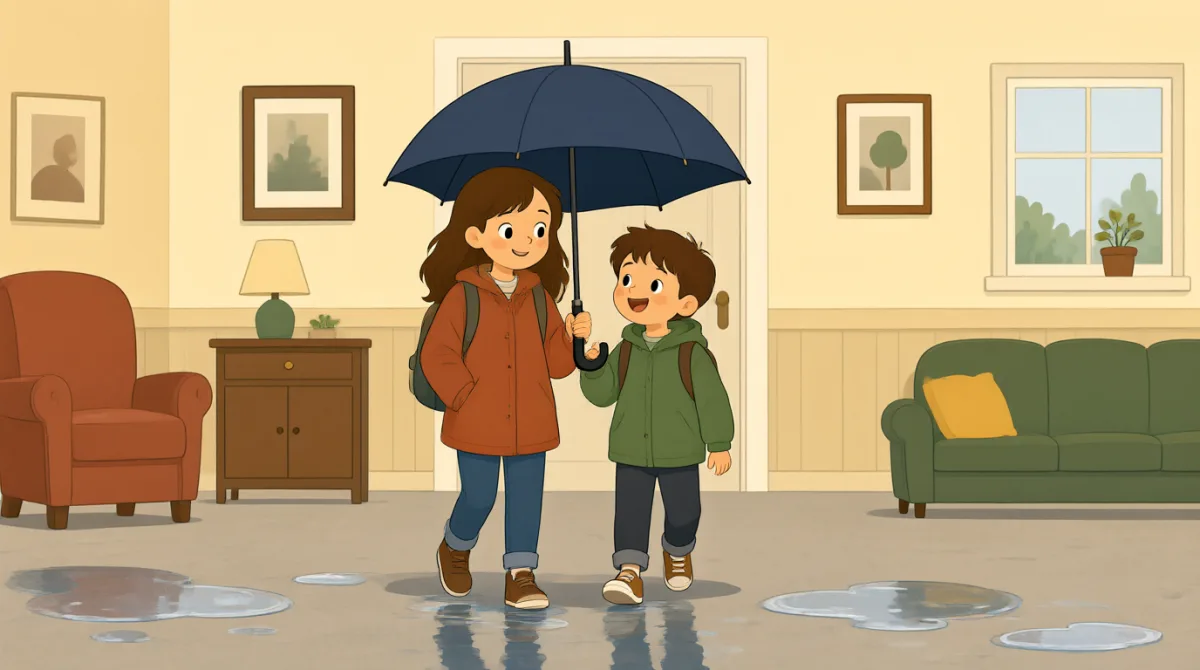
Emma and Leo walk together under the umbrella. They take care not to step in puddles.
Emma i Leo idą razem pod parasolem. Uważają, żeby nie wchodzić w kałuże.
Dialog7

This umbrella is big enough for both of us.
Ten parasol jest wystarczająco duży dla nas obojga.

Come close, Emma. We can walk together.
Podejdź bliżej, Emma. Możemy iść razem.
Okay. Watch out for that puddle!
Dobrze. Uważaj na tę kałużę!
I see it. Let’s walk around it.
Widzę ją. Omińmy ją.
Good idea. My shoes are already wet.
Dobry pomysł. Moje buty już są mokre.
The rain is slowing down now.
Deszcz teraz słabnie.
Great! Let’s keep sharing the umbrella.
Świetnie! Dalej chodźmy pod jednym parasolem.
Słownictwo8
- big enough for both of uswystarczająco duży dla nas obojga
It means the umbrella has enough space for two people. Use this phrase to say something can fit or serve two people.
To znaczy, że pod parasolem jest dość miejsca dla dwóch osób. Użyj tego wyrażenia, żeby powiedzieć, że coś pomieści lub wystarczy dla dwóch osób.
- Come closePodejdź bliżej
This means move nearer to me. You can use it to ask someone to come closer.
To znaczy: przesuń się bliżej mnie. Możesz tak poprosić kogoś, żeby podszedł bliżej.
- walk togetheriść razem
This means walk with another person. You can use it when you want to go somewhere with someone.
To znaczy iść z drugą osobą. Możesz użyć tego wyrażenia, gdy chcesz gdzieś pójść z kimś.
- Watch outUważaj
This is a warning to be careful. Use it when you see something that could cause a problem.
To ostrzeżenie, żeby zachować ostrożność. Użyj go, gdy widzisz coś, co może spowodować problem.
- puddlekałuża
A puddle is a small pool of water on the ground, often after rain.
Kałuża to niewielka ilość wody na ziemi, często powstała po deszczu.
- walk around itominąć ją
This means go around something instead of stepping on or over it. Use it to avoid an obstacle.
To znaczy przejść obok czegoś, zamiast na to nadepnąć albo przez to przejść. Użyj tego wyrażenia, żeby ominąć przeszkodę.
- slowing downsłabnie
Here, it means the rain is getting less strong. You can use “slowing down” when something is becoming slower or less intense.
W tym przypadku oznacza, że deszcz staje się mniej intensywny. Wyrażenia “slowing down” używa się, gdy coś zwalnia albo traci na intensywności.
- keep sharingdalej dzielić się
This means continue to use or enjoy something together. You can use “keep” before an action to say that it should continue.
To znaczy nadal używać czegoś lub cieszyć się tym razem. Możesz postawić “keep” przed czasownikiem, żeby powiedzieć, że dana czynność ma być kontynuowana.
Kluczowe zdania8
- 1
This umbrella is big enough for both of us.
Ten parasol jest wystarczająco duży dla nas obojga.
Use this sentence to say something has enough space or capacity for two people. You can replace “umbrella” with another thing, such as “This table is big enough for both of us.”
Użyj tego zdania, żeby powiedzieć, że coś ma dość miejsca lub pojemności dla dwóch osób. Zamiast “umbrella” możesz wstawić inną rzecz, na przykład “This table is big enough for both of us.”
- 2
Come close, Emma.
Podejdź bliżej, Emma.
This is a simple way to ask someone to move nearer. Replace “Emma” with the person’s name, or say “Come close to me.”
To prosty sposób, by poprosić kogoś, żeby podszedł bliżej. Zamiast “Emma” wstaw imię tej osoby albo powiedz “Come close to me.”
- 3
We can walk together.
Możemy iść razem.
Use this sentence to suggest doing an activity with someone. Replace “walk” with another simple action, such as “We can eat together.”
Użyj tego zdania, żeby zaproponować komuś wspólne zrobienie czegoś. Zamiast “walk” możesz wstawić inną prostą czynność, na przykład “We can eat together.”
- 4
Watch out for that puddle!
Uważaj na tę kałużę!
Use this sentence to warn someone about a nearby danger. Replace “puddle” with something else to avoid, such as “Watch out for that car!”
Użyj tego zdania, żeby ostrzec kogoś przed niebezpieczeństwem w pobliżu. Zamiast “puddle” możesz wstawić coś innego, czego należy unikać, na przykład “Watch out for that car!”
- 5
Let’s walk around it.
Omińmy ją.
Use “Let’s” to suggest doing something together. Replace “walk around” with another action, and “it” with the thing you mean.
Użyj “Let’s”, żeby zaproponować wspólne zrobienie czegoś. Zamiast “walk around” wstaw inną czynność, a zamiast “it” — rzecz, o którą chodzi.
- 6
My shoes are already wet.
Moje buty już są mokre.
This sentence describes the current condition of something. You can replace “My shoes” with another thing, such as “My coat is already wet.”
To zdanie opisuje obecny stan czegoś. Zamiast “My shoes” możesz wstawić inną rzecz, na przykład “My coat is already wet.”
- 7
The rain is slowing down now.
Deszcz teraz słabnie.
Use this sentence to say that the rain is getting lighter. You can use “is slowing down” for something that is becoming less fast or intense.
Użyj tego zdania, żeby powiedzieć, że deszcz staje się lżejszy. “is slowing down” można użyć w odniesieniu do czegoś, co staje się wolniejsze lub mniej intensywne.
- 8
Let’s keep sharing the umbrella.
Dalej chodźmy pod jednym parasolem.
Use “Let’s keep” to suggest continuing an activity together. Replace “sharing the umbrella” with another activity, such as “Let’s keep walking.”
Użyj “Let’s keep”, żeby zaproponować kontynuowanie wspólnej czynności. Zamiast “sharing the umbrella” wstaw inną czynność, na przykład “Let’s keep walking.”