A Relaxed Day Together
After several busy days, Emma and her relatives decide to slow down and spend time at home. They share stories, prepare a meal together, and adjust their plans to suit everyone.
Dialogue9
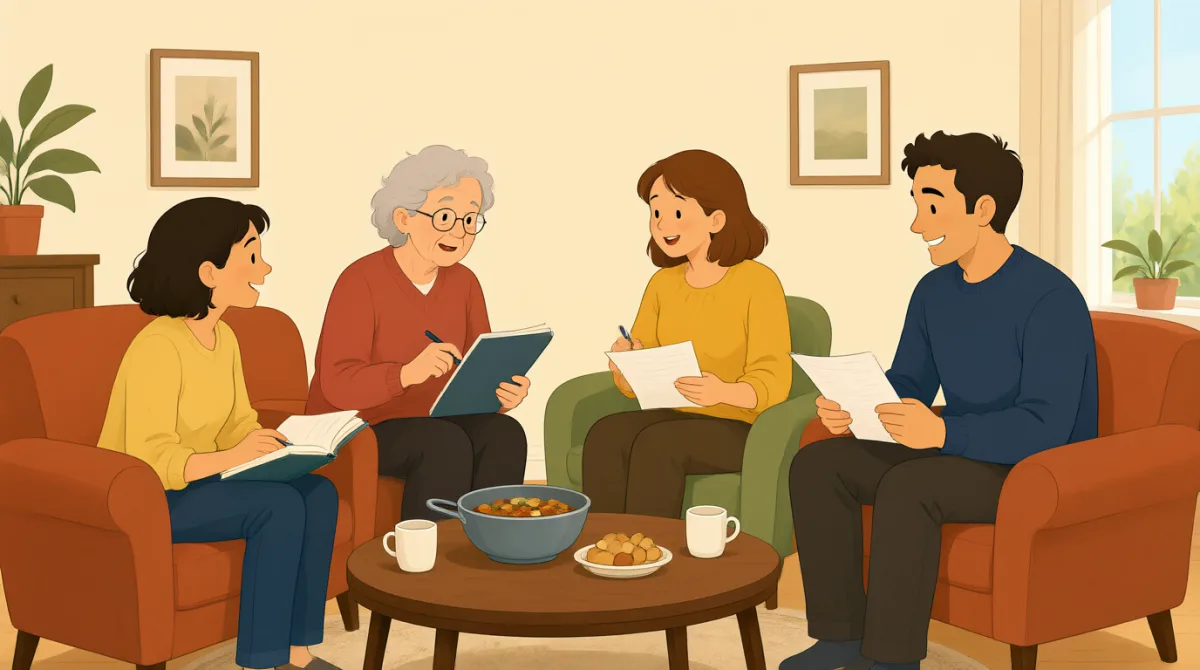

We’ve been running around all week. How about a quiet day at home instead of another sightseeing trip?

That sounds perfect. We can make lunch together, share some family stories, and let everyone recharge.

I’d love that. I’m still a little tired from all the walking, and I’d like to hear more about your childhood.
Great! We could make those vegetable dumplings you mentioned. They sound fun, and everyone can help with something.
Sure. I’ll prepare the filling, and Mia can show us how to fold them. Emma, would you set the table?
Of course. We don’t have to make a huge meal, though. A few dumplings and some salad will be plenty.
Good point. We can eat whenever they’re ready, then spend the afternoon looking through old photos.
And if anyone wants a nap, that’s fine too. There’s no need to stick to a schedule today.
This is just what I needed. A relaxed day together feels much better than trying to fit in one more attraction.
Vocabulary7
- running around all week
This means being busy with many activities all week. It often suggests that someone has had little time to rest.
- recharge
To recharge is to rest and get your energy back. Here, the family wants a quiet day after being busy.
- I’d love that
This is a friendly way to say that an idea sounds very appealing. You can use it to show enthusiasm when someone suggests a plan.
- Good point
This means that someone has said something sensible or worth considering. It’s a natural way to agree with a suggestion.
- plenty
Plenty means enough, or more than enough. Here, a few dumplings and some salad will be enough for the meal.
- stick to a schedule
To stick to a schedule means to follow a planned timetable. You can use this phrase when talking about whether plans need to happen at set times.
- fit in
To fit something in means to find time or space for it among other plans. Here, it refers to trying to add one more attraction to a busy trip.
Key Sentences7
- 1
How about a quiet day at home instead of another sightseeing trip?
Use “How about…?” to suggest an activity or plan. The phrase “instead of” helps you offer one choice as an alternative to another.
- 2
We can make lunch together, share some family stories, and let everyone recharge.
This sentence suggests several relaxed activities in a natural list. You can reuse the pattern “We can…, …, and …” to propose a group plan.
- 3
I’m still a little tired from all the walking, and I’d like to hear more about your childhood.
This is a useful way to give a reason for your preference and add something you would enjoy. You can replace the reason and activity to explain what you want to do.
- 4
We don’t have to make a huge meal, though.
“Don’t have to” means something is not necessary. “Though” adds a gentle contrast to what was said before.
- 5
We can eat whenever they’re ready, then spend the afternoon looking through old photos.
This offers a flexible plan without setting an exact time. “Looking through” means examining or browsing a collection, such as photos.
- 6
There’s no need to stick to a schedule today.
Use “There’s no need to…” to reassure someone that something is not required. This sentence is helpful when you want to make plans feel relaxed and flexible.
- 7
A relaxed day together feels much better than trying to fit in one more attraction.
This sentence compares two options and gives a clear opinion. You can use “feels much better than…” to explain why one choice suits you more.