Interpreting Anomalous Data
असामान्य डेटा की व्याख्या
Scientists analyze data that deviates from expected outcomes or previous theories, discussing potential reasons for the anomalies and their implications for the research hypothesis.
वैज्ञानिक ऐसे डेटा का विश्लेषण करते हैं जो अपेक्षित नतीजों या पुराने सिद्धांतों से अलग होता है। वे इन विसंगतियों के संभावित कारणों और शोध की परिकल्पना पर उनके प्रभावों पर चर्चा करते हैं।
संवाद10
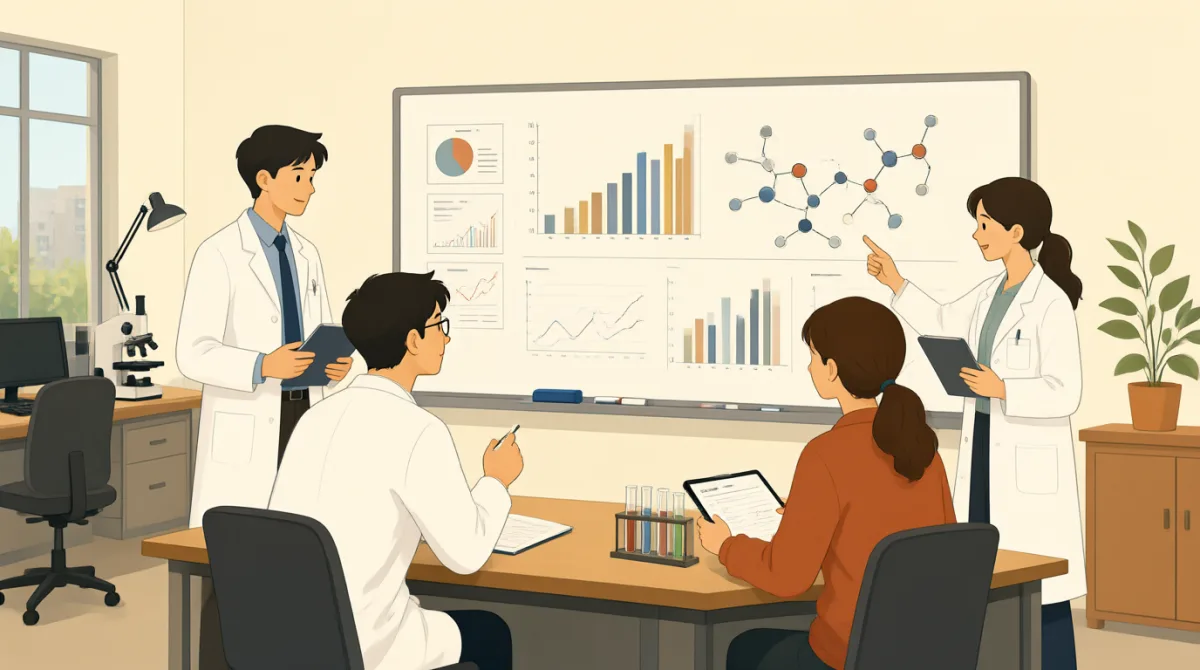

Alright team, let's discuss these latest spectroscopy results. I'm seeing some significant deviations in the 500-600 nm range, especially in samples C and D. It's quite unexpected given our previous runs.
ठीक है, टीम, आइए स्पेक्ट्रोस्कोपी के इन ताज़ा नतीजों पर चर्चा करें। मुझे 500-600 nm की सीमा में काफ़ी बड़े विचलन दिख रहे हैं, खासकर C और D नमूनों में। हमारे पिछले परीक्षणों को देखते हुए, यह काफ़ी अप्रत्याशित है।

Yes, Dr. Miller, I noticed that too. I've re-run the analysis twice on those specific samples, and the pattern persists. Could it be an artifact of the sample preparation, perhaps some contamination?
जी, डॉ. Miller, मैंने भी यह देखा। मैंने उन खास नमूनों का विश्लेषण दोबारा किया है, और यह पैटर्न अब भी बना हुआ है। क्या यह नमूने तैयार करने की प्रक्रिया से पैदा हुई कोई कृत्रिम गड़बड़ी हो सकती है—शायद किसी तरह का संदूषण?

Good point, Emma. We meticulously cleaned the cuvettes and used fresh reagents. However, the magnitude of the anomaly suggests it might be more than just a minor contamination; it's almost indicating a different compound entirely.
अच्छी बात कही, Emma। हमने क्यूवेट को बहुत ध्यान से साफ़ किया था और ताज़ा अभिकर्मक इस्तेमाल किए थे। लेकिन इस विसंगति का परिमाण बताता है कि यह मामूली संदूषण से कहीं ज़्यादा हो सकता है; ऐसा लग रहा है मानो यह कोई बिल्कुल अलग यौगिक हो।
My thoughts exactly, Jack. Could our original hypothesis about the reaction pathway be incomplete then? This data challenges our current understanding of the intermediate products.
मैं भी यही सोच रहा था, Jack। तो क्या अभिक्रिया के मार्ग को लेकर हमारी मूल परिकल्पना अधूरी हो सकती है? यह डेटा मध्यवर्ती उत्पादों के बारे में हमारी मौजूदा समझ को चुनौती देता है।
What if it's a transient species that only forms under specific conditions that we hadn't accounted for in the initial model? Perhaps a minor shift in temperature or pressure during the reaction phase?
क्या ऐसा हो सकता है कि यह कोई क्षणिक प्रजाति हो, जो सिर्फ़ कुछ खास परिस्थितियों में बनती हो—ऐसी परिस्थितियाँ जिन्हें हमने शुरुआती मॉडल में शामिल नहीं किया था? शायद अभिक्रिया के दौरान तापमान या दबाव में थोड़ा बदलाव हुआ हो?
That's a plausible explanation, Emma. We did observe a slight fluctuation in reactor temperature during the runs for samples C and D, though it was within what we considered the acceptable range.
यह एक तर्कसंगत व्याख्या है, Emma। नमूनों C और D के परीक्षणों के दौरान रिएक्टर के तापमान में हल्का उतार-चढ़ाव हमने देखा था, हालाँकि वह हमारी मानी हुई स्वीकार्य सीमा के भीतर था।
So, the next step should be to design an experiment that specifically isolates the impact of temperature fluctuations within that 'acceptable' range. We need to see if we can intentionally reproduce these anomalous peaks.
तो अगला कदम ऐसा प्रयोग तैयार करना होना चाहिए जो उस ‘स्वीकार्य’ सीमा के भीतर तापमान के उतार-चढ़ाव के असर को अलग से जाँचे। हमें देखना होगा कि क्या हम जान-बूझकर इन असामान्य शिखरों को फिर से पैदा कर सकते हैं।
Agreed. We could set up parallel runs, one with tight temperature control and another with controlled slight variations. That would provide strong evidence either way.
सहमत। हम समानांतर परीक्षण कर सकते हैं—एक में तापमान पर कड़ा नियंत्रण रखेंगे और दूसरे में उसे नियंत्रित रूप से थोड़ा बदलने देंगे। इससे दोनों में से किसी एक संभावना के पक्ष में मज़बूत सबूत मिलेगा।
I can start drafting the new experimental protocol this afternoon. It's exciting, really; this anomaly might actually lead us to a more complete understanding of the reaction.
मैं आज दोपहर नया प्रयोगात्मक प्रोटोकॉल लिखना शुरू कर सकती हूँ। सच में, यह रोमांचक है; इस विसंगति से हमें अभिक्रिया को और बेहतर ढंग से समझने में मदद मिल सकती है।
That's the spirit, Emma! Anomalies aren't failures; they're opportunities for discovery. Let's aim to get those new runs started by the end of the week.
यही जज़्बा चाहिए, Emma! विसंगतियाँ असफलताएँ नहीं होतीं; वे खोज के अवसर होती हैं। कोशिश करते हैं कि नए परीक्षण हफ़्ते के अंत तक शुरू कर दें।
शब्दावली10
- deviationsविचलन
Differences or changes from what is expected or normal. In science, it often means data that doesn't match predictions. Use it when discussing unexpected results, like 'There are deviations in the measurements.'
अपेक्षित या सामान्य स्थिति से कोई अंतर या बदलाव। विज्ञान में इसका मतलब अक्सर ऐसा डेटा होता है जो अनुमान से मेल न खाए। अनपेक्षित नतीजों पर बात करते समय इसका इस्तेमाल करें, जैसे: 'There are deviations in the measurements.' (मापों में विचलन हैं।)
- artifactकृत्रिम गड़बड़ी
Something that appears in data or results but is caused by error or method, not the real phenomenon. Common in research; say 'It might be an artifact from the equipment' to suggest it's not genuine.
डेटा या नतीजों में दिखने वाली ऐसी चीज़ जो असली घटना के बजाय किसी त्रुटि या तरीके के कारण हो। शोध में यह शब्द आम है। यह बताने के लिए कि नतीजा वास्तविक नहीं हो सकता, कहें: 'It might be an artifact from the equipment' (यह उपकरण की वजह से आई कृत्रिम गड़बड़ी हो सकती है)।
- contaminationसंदूषण
The presence of unwanted substances that can affect results. In experiments, it means pollution; useful in lab talk, e.g., 'Check for contamination in the samples.'
ऐसे अवांछित पदार्थों की मौजूदगी जो नतीजों पर असर डाल सकते हैं। प्रयोगों में इसका मतलब है बाहरी पदार्थों से दूषित होना। प्रयोगशाला में यह शब्द उपयोगी है, जैसे: 'Check for contamination in the samples.' (नमूनों में संदूषण की जाँच करें।)
- anomalyविसंगति
An unusual or unexpected event or result. In science, it highlights something odd; use it like 'This anomaly needs further investigation' to point out surprises.
कोई असामान्य या अप्रत्याशित घटना अथवा नतीजा। विज्ञान में यह किसी अजीब बात को बताता है। किसी चौंकाने वाली बात की ओर ध्यान दिलाने के लिए कहें: 'This anomaly needs further investigation' (इस विसंगति की और जाँच करने की ज़रूरत है)।
- hypothesisपरिकल्पना
An educated guess or proposed explanation for a phenomenon. Key in research; say 'Our hypothesis was that...' when stating a theory to test.
किसी घटना के बारे में सोच-समझकर लगाया गया अनुमान या उसकी प्रस्तावित व्याख्या। शोध में यह एक अहम शब्द है। जाँचे जाने वाले विचार को बताते हुए कहें: 'Our hypothesis was that...' (हमारी परिकल्पना थी कि...)।
- transientक्षणिक
Something temporary or short-lived that doesn't last. In chemistry, it refers to short-term compounds; use 'a transient effect' for things that appear briefly.
ऐसी चीज़ जो अस्थायी हो या थोड़े समय तक ही रहे। रसायन विज्ञान में यह कम समय तक मौजूद रहने वाले यौगिकों के लिए इस्तेमाल होता है। थोड़ी देर के लिए दिखाई देने वाली चीज़ के लिए कहें: 'a transient effect' (एक क्षणिक प्रभाव)।
- plausibleतर्कसंगत
Seeming reasonable or believable. Use in discussions to agree, like 'That's a plausible idea' when something makes sense but isn't proven.
जो उचित या विश्वास करने योग्य लगे। चर्चा में किसी ऐसी बात से सहमत होने के लिए इसका इस्तेमाल करें जो समझ में तो आती हो, लेकिन साबित न हुई हो: 'That's a plausible idea' (यह एक तर्कसंगत विचार है)।
- fluctuationउतार-चढ़ाव
A small, irregular change or variation. Common for measurements; say 'There was a fluctuation in temperature' to describe ups and downs.
कोई छोटा, अनियमित बदलाव या भिन्नता। मापों के लिए यह शब्द आम है। तापमान में ऊपर-नीचे होने वाले बदलाव का वर्णन करने के लिए कहें: 'There was a fluctuation in temperature' (तापमान में उतार-चढ़ाव था)।
- isolateअलग करके जाँचना
To separate or examine one factor alone. In experiments, it means controlling variables; use 'We need to isolate the effect' in planning tests.
किसी एक कारक को बाकी से अलग करके देखना या जाँचना। प्रयोगों में इसका मतलब है चरों को नियंत्रित करना। परीक्षण की योजना बनाते हुए कहें: 'We need to isolate the effect' (हमें इस प्रभाव को अलग करके जाँचना होगा)।
- reproduceदोहराकर प्राप्त करना
To make something happen again, especially results. Essential in science for verification; say 'Can we reproduce this result?' to check reliability.
किसी चीज़, खासकर किसी नतीजे, को फिर से हासिल करना। विज्ञान में नतीजे की पुष्टि के लिए यह बहुत ज़रूरी है। उसकी विश्वसनीयता जाँचने के लिए पूछें: 'Can we reproduce this result?' (क्या हम यह नतीजा दोबारा प्राप्त कर सकते हैं?)
मुख्य वाक्य9
- 1
I'm seeing some significant deviations in the 500-600 nm range.
मुझे 500-600 nm की सीमा में काफ़ी बड़े विचलन दिख रहे हैं।
This sentence uses present continuous ('I'm seeing') to describe current observations in data. It's useful for reporting findings in meetings; the structure helps focus on what's happening now. Practice it when sharing results to sound professional.
इस वाक्य में 'I'm seeing' का इस्तेमाल वर्तमान में डेटा देखते समय मिल रहे नतीजों के बारे में बताने के लिए किया गया है। बैठकों में अपने निष्कर्ष बताते समय यह वाक्य उपयोगी है। यह ढाँचा इस बात पर ध्यान देता है कि अभी क्या हो रहा है। नतीजे साझा करते समय इसका अभ्यास करें, ताकि आपकी बात पेशेवर लगे।
- 2
Could it be an artifact of the sample preparation?
क्या यह नमूना तैयार करने की प्रक्रिया से पैदा हुई कोई कृत्रिम गड़बड़ी हो सकती है?
A polite question suggesting a possible cause using 'Could it be...?' for speculation. Great for scientific discussions to propose ideas without certainty. The modal 'could' softens the suggestion, making it collaborative.
'Could it be...?' का इस्तेमाल करके यह विनम्रता से किसी संभावित कारण के बारे में पूछा जाता है। वैज्ञानिक चर्चाओं में बिना पक्के दावे के कोई विचार रखने के लिए यह बहुत उपयोगी है। 'Could' सुझाव को नरम बनाता है और बातचीत को सहयोगपूर्ण रखता है।
- 3
Good point.
अच्छी बात कही।
A short phrase to acknowledge someone's idea positively. Useful in team talks to show agreement and encourage discussion. It's simple and common in professional English to build rapport.
किसी के विचार को सकारात्मक ढंग से स्वीकार करने का यह छोटा-सा वाक्यांश है। टीम की बातचीत में सहमति जताने और चर्चा को आगे बढ़ाने के लिए इसका इस्तेमाल करें। पेशेवर अंग्रेज़ी में तालमेल बनाने का यह सरल और आम तरीका है।
- 4
My thoughts exactly.
मैं भी बिल्कुल यही सोच रहा था।
An idiomatic expression for strong agreement, meaning 'That's what I was thinking.' Use it in conversations to show alignment without repeating ideas. It's natural in collaborative settings like research teams.
यह ज़ोरदार सहमति जताने वाला मुहावरेदार वाक्यांश है, जिसका मतलब है 'मेरे मन में भी यही बात थी।' विचार दोहराए बिना यह दिखाने के लिए इसका इस्तेमाल करें कि आप सहमत हैं। शोध दल जैसी सहयोगपूर्ण जगहों पर यह स्वाभाविक लगता है।
- 5
What if it's a transient species?
क्या ऐसा हो सकता है कि यह कोई क्षणिक प्रजाति हो?
A hypothetical question starting with 'What if...' to explore possibilities. Helpful for brainstorming in science; it invites discussion on alternatives. The structure uses conditional for 'suppose' scenarios.
'What if...' से शुरू होने वाला यह काल्पनिक सवाल अलग-अलग संभावनाओं पर विचार करने के लिए है। विज्ञान में नए विचार सोचते समय यह उपयोगी है, क्योंकि इससे वैकल्पिक संभावनाओं पर चर्चा शुरू होती है। यह ढाँचा किसी ‘मान लीजिए’ वाली स्थिति की बात करता है।
- 6
That's a plausible explanation.
यह एक तर्कसंगत व्याख्या है।
This agrees with an idea by calling it reasonable. Use in debates or analyses to validate suggestions. The adjective 'plausible' adds a scientific tone, and it's a pattern for polite responses.
इस वाक्य में किसी विचार को उचित बताकर उससे सहमति जताई जाती है। सुझावों को सही मानने के लिए बहस या विश्लेषण के दौरान इसका इस्तेमाल करें। 'Plausible' विशेषण वाक्य को वैज्ञानिक लहजा देता है और विनम्रता से जवाब देने का यह एक उपयोगी तरीका है।
- 7
So, the next step should be to design an experiment.
तो अगला कदम एक प्रयोग तैयार करना होना चाहिए।
Uses 'should be' for suggestions on actions, common for planning. Useful after discussions to propose next moves. The modal 'should' indicates recommendation, helping structure team decisions.
यहाँ 'should be' का इस्तेमाल अगला कदम सुझाने के लिए किया गया है। योजना बनाते समय यह आम है। चर्चा के बाद आगे क्या करना है, यह बताने के लिए यह उपयोगी है। 'Should' सुझाव को दर्शाता है और टीम के फ़ैसलों को व्यवस्थित करने में मदद करता है।
- 8
Agreed.
सहमत।
A concise way to show full agreement. Simple and direct, use it in meetings to confirm plans quickly. It's formal yet efficient in professional English.
पूरी सहमति जताने का यह संक्षिप्त तरीका है। बैठकों में किसी योजना की तुरंत पुष्टि करने के लिए इसका इस्तेमाल करें। पेशेवर अंग्रेज़ी में यह औपचारिक होने के साथ-साथ असरदार भी है।
- 9
Anomalies aren't failures; they're opportunities for discovery.
विसंगतियाँ असफलताएँ नहीं होतीं; वे खोज के अवसर होती हैं।
This uses a contrast with semicolon ('aren't...; they're...') to reframe negative ideas positively. Valuable for motivation in research; teach it as a mindset shift, useful when encouraging teams facing unexpected results.
इस वाक्य में सेमीकोलन ('aren't...; they're...') के ज़रिए विरोध दिखाकर नकारात्मक विचार को सकारात्मक रूप दिया गया है। शोध में टीम का हौसला बढ़ाने के लिए यह उपयोगी है। इसे सोच का नज़रिया बदलने वाले वाक्य के रूप में सीखें—अनपेक्षित नतीजों का सामना कर रही टीम को प्रोत्साहित करने के लिए यह काम आता है।