Talking After the Movie
Parler après le film
After the movie, Emma and Jack talk about what they liked. Emma says she enjoyed her popcorn, too.
Après le film, Emma et Jack parlent de ce qu’ils ont aimé. Emma dit qu’elle a aussi apprécié son pop-corn.
Dialogue6
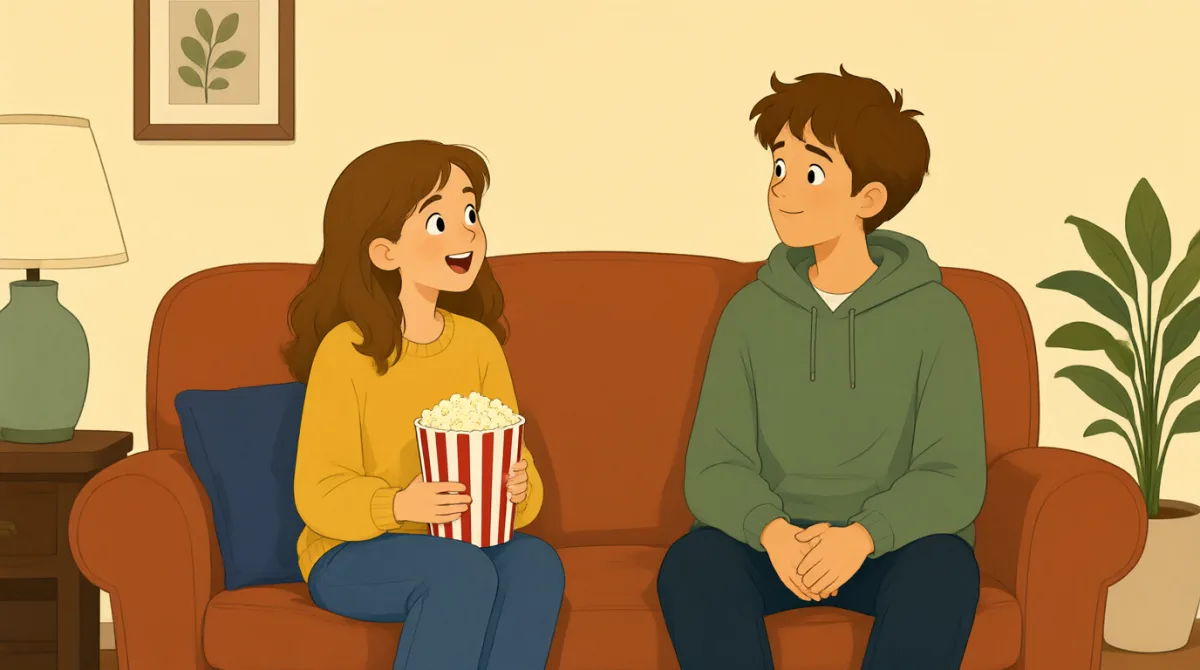

That was a fun movie. I liked the funny parts.
C’était un film sympa. J’ai aimé les passages drôles.

Me too. The ending was really good.
Moi aussi. La fin était vraiment bien.
I enjoyed my popcorn, too. It was warm and tasty.
J’ai aussi apprécié mon pop-corn. Il était chaud et bon.
Did you finish the whole bag?
Tu as fini tout le paquet ?
Yes! I was hungry after the movie started.
Oui ! J’avais faim après le début du film.
Next time, let’s get a bigger one.
La prochaine fois, prenons-en un plus grand.
Vocabulaire8
- fun moviefilm sympa
A movie that is enjoyable. You can say “That was a fun movie” after watching something you liked.
Un film qu’on trouve agréable. Tu peux dire “That was a fun movie” après avoir vu un film qui t’a plu.
- funny partspassages drôles
The parts of a movie that make you laugh. You can use “funny parts” to talk about what made you laugh.
Les passages d’un film qui te font rire. Tu peux employer “funny parts” pour parler de ce qui t’a fait rire.
- the endingla fin
The last part of a story or movie. You can say “The ending was good” to share what you thought of it.
La dernière partie d’une histoire ou d’un film. Tu peux dire “The ending was good” pour donner ton avis.
- enjoyeda apprécié
Liked something and had a good time with it. You can say “I enjoyed the movie” or “I enjoyed my food.”
Avoir aimé quelque chose et avoir passé un bon moment. Tu peux dire “I enjoyed the movie” ou “I enjoyed my food.”
- warm and tastychaud et bon
Warm means not cold, and tasty means good to eat. Use these words to describe food.
« Warm » signifie « chaud », et « tasty » signifie « bon ». Utilise ces mots pour décrire de la nourriture.
- the whole bagtout le paquet
All of the bag and everything inside it. You can use “the whole” before a thing to ask if someone finished all of it.
Le paquet entier et tout ce qu’il contient. Tu peux mettre “the whole” devant un nom pour demander si quelqu’un a tout fini.
- I was hungryj’avais faim
This means you wanted food. You can say “I was hungry” to explain why you ate something.
Cela signifie que tu voulais manger. Tu peux dire “I was hungry” pour expliquer pourquoi tu as mangé quelque chose.
- Next timela prochaine fois
This means the next time you do something. You can use it to make a plan or suggestion.
Cela signifie la prochaine fois que tu feras quelque chose. Tu peux employer cette expression pour faire une proposition ou prévoir quelque chose.
Phrases clés8
- 1
That was a fun movie.
C’était un film sympa.
This is a simple way to share a positive opinion after a movie. You can replace “fun movie” with another description, such as “good movie.”
C’est une façon simple de donner un avis positif après un film. Tu peux remplacer “fun movie” par une autre description, comme “good movie.”
- 2
I liked the funny parts.
J’ai aimé les passages drôles.
Use this sentence to say which parts you enjoyed. Replace “the funny parts” with another part or thing you liked.
Utilise cette phrase pour dire quelles parties tu as aimées. Remplace “the funny parts” par une autre partie ou chose qui t’a plu.
- 3
The ending was really good.
La fin était vraiment bien.
This is a useful way to give an opinion about the end of a movie or story. You can say “The ending was really [adjective].”
C’est une façon pratique de donner ton avis sur la fin d’un film ou d’une histoire. Tu peux dire “The ending was really [adjective].”
- 4
I enjoyed my popcorn, too.
J’ai aussi apprécié mon pop-corn.
Use this sentence to say you liked something, and “too” shows that you are adding another point. You can replace “my popcorn” with another food or activity.
Utilise cette phrase pour dire que tu as aimé quelque chose. “Too” indique que tu ajoutes un autre point. Tu peux remplacer “my popcorn” par un autre aliment ou une activité.
- 5
It was warm and tasty.
Il était chaud et bon.
This sentence describes food with two simple adjectives. Replace “warm and tasty” with words that describe something you ate.
Cette phrase décrit un aliment avec deux adjectifs simples. Remplace “warm and tasty” par des mots qui décrivent quelque chose que tu as mangé.
- 6
Did you finish the whole bag?
Tu as fini tout le paquet ?
Use this question to ask if someone ate or used all of something. Replace “the whole bag” with “the whole meal” or another thing.
Utilise cette question pour demander si quelqu’un a tout mangé ou utilisé. Remplace “the whole bag” par “the whole meal” ou par autre chose.
- 7
I was hungry after the movie started.
J’avais faim après le début du film.
This sentence explains when you felt hungry. You can use “after” plus an event to say when something happened.
Cette phrase précise quand tu as eu faim. Tu peux utiliser “after” suivi d’un événement pour indiquer quand quelque chose s’est passé.
- 8
Next time, let’s get a bigger one.
La prochaine fois, prenons-en un plus grand.
Use this friendly suggestion to make a plan for another time. Replace “a bigger one” with something that fits your plan.
Utilise cette suggestion amicale pour prévoir quelque chose une autre fois. Remplace “a bigger one” par quelque chose qui convient à ton projet.