Finding the Classroom
Trouver la salle de classe
Emma arrives for her first class and asks Grace where the classroom is. Grace gives her simple directions.
Emma arrive pour son premier cours et demande à Grace où se trouve la salle de classe. Grace lui indique le chemin simplement.
Dialogue6
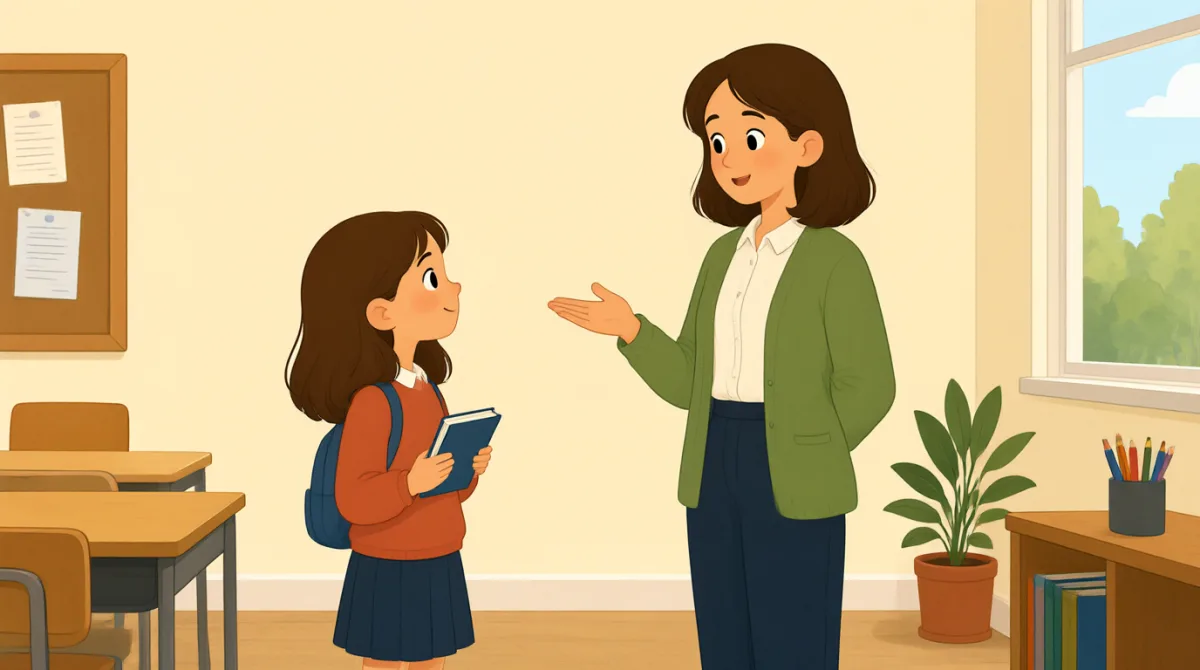

Excuse me, where is the classroom?
Excusez-moi, où se trouve la salle de classe ?

It’s down the hall, on the left.
Au bout du couloir, à gauche.
Is it near the big window?
C’est près de la grande fenêtre ?
Yes. It’s the room next to it.
Oui. C’est la salle juste à côté.
Thank you. Is this my first class?
Merci. C’est bien mon premier cours ?
Yes, come in. You’re in the right place.
Oui, entre. Tu es au bon endroit.
Vocabulaire8
- Excuse meExcuse me
Use this polite phrase to get someone’s attention before asking a question.
Utilisez cette formule polie pour attirer l’attention de quelqu’un avant de lui poser une question.
- where is the classroom?where is the classroom?
Use this question to ask for the location of a classroom. You can replace “the classroom” with another place.
Utilisez cette question pour demander où se trouve une salle de classe. Vous pouvez remplacer “the classroom” par un autre lieu.
- down the halldown the hall
This means farther along the hallway. You can use it to give simple directions.
Cela signifie plus loin dans le couloir. Vous pouvez employer cette expression pour donner une indication simple.
- on the lefton the left
This tells someone which side to look at. You can also say “on the right.”
Cette expression indique de quel côté regarder. Vous pouvez aussi dire “on the right.”
- near the big windownear the big window
Use “near” to ask if a place is close to something. Replace “the big window” with another landmark.
Utilisez “near” pour demander si un endroit est proche de quelque chose. Remplacez “the big window” par un autre repère.
- next to itnext to it
This means beside the thing you just mentioned. Use it to explain where something is.
Cela signifie à côté de la chose que vous venez de mentionner. Utilisez cette expression pour indiquer où se trouve quelque chose.
- come income in
Use this phrase to invite someone to enter a room or building.
Utilisez cette expression pour inviter quelqu’un à entrer dans une pièce ou un bâtiment.
- the right placethe right place
This means the correct place. You can use it to reassure someone that they are where they should be.
Cela signifie le bon endroit. Vous pouvez employer cette expression pour rassurer quelqu’un en lui disant qu’il est bien là où il doit être.
Phrases clés8
- 1
Excuse me, where is the classroom?
Excusez-moi, où se trouve la salle de classe ?
This is a polite way to ask where a place is. Replace “the classroom” with another place to ask for directions.
C’est une façon polie de demander où se trouve un lieu. Remplacez “the classroom” par un autre lieu pour demander votre chemin.
- 2
It’s down the hall, on the left.
C’est au bout du couloir, à gauche.
Use this sentence to give simple directions. You can change “down the hall” or “on the left” to match the location.
Utilisez cette phrase pour donner une indication simple. Vous pouvez changer “down the hall” ou “on the left” selon l’endroit.
- 3
Is it near the big window?
C’est près de la grande fenêtre ?
Use this yes-or-no question to check if a place is close to a landmark. Replace “the big window” with something easy to see.
Utilisez cette question fermée pour vérifier si un endroit est proche d’un repère. Remplacez “the big window” par quelque chose de facile à repérer.
- 4
Yes. It’s the room next to it.
Oui. C’est la salle juste à côté.
This gives a simple location using a nearby place as a guide. Replace “the room” and “it” with the places you mean.
Cette phrase indique simplement un endroit en prenant un lieu voisin comme repère. Remplacez “the room” et “it” par les lieux dont vous parlez.
- 5
Thank you.
Merci.
Use this short, polite phrase after someone helps you. You can also say it when someone gives you directions.
Utilisez cette formule courte et polie après que quelqu’un vous a aidé. Vous pouvez aussi la dire quand quelqu’un vous indique le chemin.
- 6
Is this my first class?
C’est bien mon premier cours ?
Use this question to check if you are in the correct class. Replace “my first class” with another class or activity.
Utilisez cette question pour vérifier si vous êtes dans le bon cours. Remplacez “my first class” par un autre cours ou une autre activité.
- 7
Yes, come in.
Oui, entre.
Use this phrase to confirm something and invite someone inside. You can say it when a person is waiting at a door.
Utilisez cette expression pour confirmer quelque chose et inviter quelqu’un à entrer. Vous pouvez la dire quand une personne attend à la porte.
- 8
You’re in the right place.
Tu es au bon endroit.
Use this sentence to reassure someone that they are where they need to be. It is useful when giving directions or helping a new student.
Utilisez cette phrase pour rassurer quelqu’un en lui disant qu’il est là où il doit être. Elle est utile pour indiquer le chemin ou aider un nouvel élève.