Finding the Classroom
Das Klassenzimmer finden
Emma arrives for her first class and asks Grace where the classroom is. Grace gives her simple directions.
Emma kommt zu ihrer ersten Unterrichtsstunde und fragt Grace, wo das Klassenzimmer ist. Grace gibt ihr eine einfache Wegbeschreibung.
Dialog6
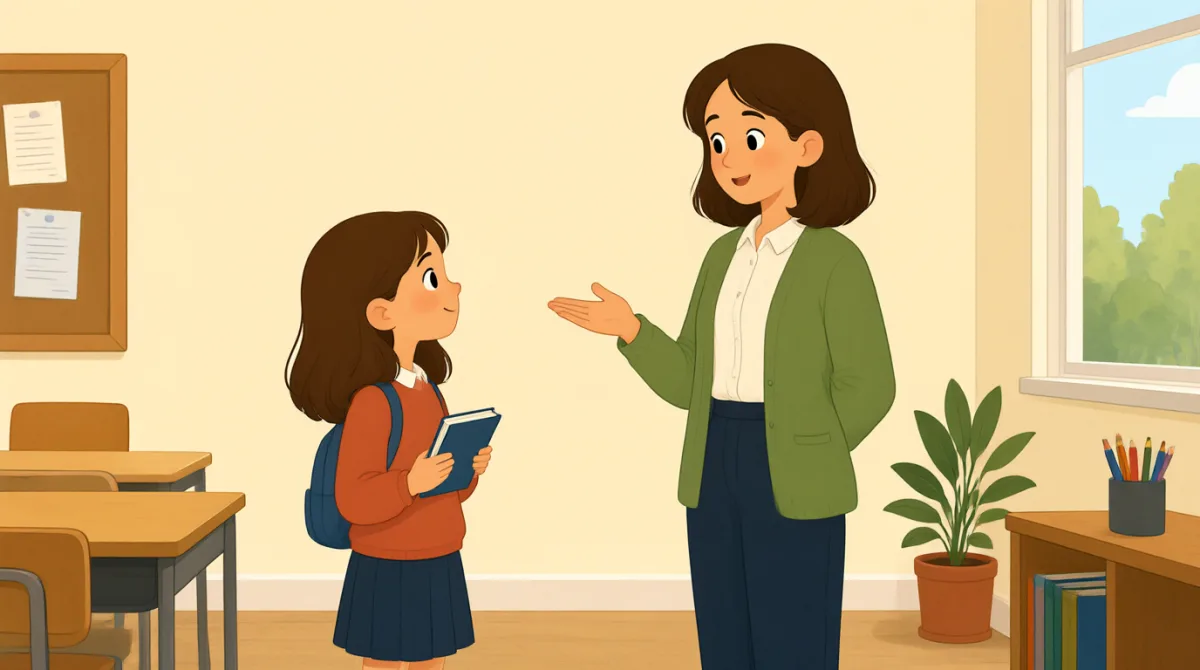

Excuse me, where is the classroom?
Entschuldigung, wo ist das Klassenzimmer?

It’s down the hall, on the left.
Den Flur entlang, auf der linken Seite.
Is it near the big window?
Ist es in der Nähe des großen Fensters?
Yes. It’s the room next to it.
Ja. Es ist der Raum daneben.
Thank you. Is this my first class?
Danke. Ist das mein erster Kurs?
Yes, come in. You’re in the right place.
Ja, komm rein. Du bist hier richtig.
Wortschatz8
- Excuse meExcuse me
Use this polite phrase to get someone’s attention before asking a question.
Mit dieser höflichen Wendung machst du jemanden auf dich aufmerksam, bevor du eine Frage stellst.
- where is the classroom?where is the classroom?
Use this question to ask for the location of a classroom. You can replace “the classroom” with another place.
Mit dieser Frage erkundigst du dich, wo ein Klassenzimmer ist. Du kannst „the classroom“ durch einen anderen Ort ersetzen.
- down the halldown the hall
This means farther along the hallway. You can use it to give simple directions.
Das bedeutet, dass du den Flur weiter entlanggehen sollst. Die Wendung eignet sich für eine einfache Wegbeschreibung.
- on the lefton the left
This tells someone which side to look at. You can also say “on the right.”
Damit sagst du jemandem, auf welcher Seite er suchen soll. Du kannst auch „on the right“ sagen.
- near the big windownear the big window
Use “near” to ask if a place is close to something. Replace “the big window” with another landmark.
Mit „near“ fragst du, ob sich ein Ort in der Nähe von etwas befindet. Ersetze „the big window“ durch einen anderen Orientierungspunkt.
- next to itnext to it
This means beside the thing you just mentioned. Use it to explain where something is.
Das bedeutet, dass etwas direkt neben dem gerade erwähnten Ort oder Gegenstand liegt. Damit kannst du erklären, wo sich etwas befindet.
- come income in
Use this phrase to invite someone to enter a room or building.
Mit dieser Wendung lädst du jemanden ein, einen Raum oder ein Gebäude zu betreten.
- the right placethe right place
This means the correct place. You can use it to reassure someone that they are where they should be.
Das bedeutet, dass es der richtige Ort ist. Damit kannst du jemandem versichern, dass er dort ist, wo er sein soll.
Wichtige Sätze8
- 1
Excuse me, where is the classroom?
Entschuldigung, wo ist das Klassenzimmer?
This is a polite way to ask where a place is. Replace “the classroom” with another place to ask for directions.
So kannst du höflich fragen, wo sich ein Ort befindet. Ersetze „the classroom“ durch einen anderen Ort, wenn du nach dem Weg fragen möchtest.
- 2
It’s down the hall, on the left.
Den Flur entlang, auf der linken Seite.
Use this sentence to give simple directions. You can change “down the hall” or “on the left” to match the location.
Mit diesem Satz gibst du eine einfache Wegbeschreibung. Du kannst „down the hall“ oder „on the left“ ändern, damit die Beschreibung zum Ort passt.
- 3
Is it near the big window?
Ist es in der Nähe des großen Fensters?
Use this yes-or-no question to check if a place is close to a landmark. Replace “the big window” with something easy to see.
Mit dieser Ja-oder-Nein-Frage kannst du überprüfen, ob ein Ort in der Nähe eines Orientierungspunkts ist. Ersetze „the big window“ durch etwas, das leicht zu erkennen ist.
- 4
Yes. It’s the room next to it.
Ja. Es ist der Raum daneben.
This gives a simple location using a nearby place as a guide. Replace “the room” and “it” with the places you mean.
Damit beschreibst du einen Ort ganz einfach und nutzt einen nahe gelegenen Ort als Orientierung. Ersetze „the room“ und „it“ durch die Orte, die du meinst.
- 5
Thank you.
Danke.
Use this short, polite phrase after someone helps you. You can also say it when someone gives you directions.
Diese kurze, höfliche Wendung verwendest du, nachdem dir jemand geholfen hat. Du kannst sie auch sagen, wenn dir jemand den Weg erklärt.
- 6
Is this my first class?
Ist das mein erster Kurs?
Use this question to check if you are in the correct class. Replace “my first class” with another class or activity.
Mit dieser Frage überprüfst du, ob du im richtigen Kurs bist. Ersetze „my first class“ durch einen anderen Kurs oder eine andere Aktivität.
- 7
Yes, come in.
Ja, komm rein.
Use this phrase to confirm something and invite someone inside. You can say it when a person is waiting at a door.
Mit dieser Wendung bestätigst du etwas und bittest jemanden herein. Du kannst sie sagen, wenn jemand vor einer Tür wartet.
- 8
You’re in the right place.
Du bist hier richtig.
Use this sentence to reassure someone that they are where they need to be. It is useful when giving directions or helping a new student.
Mit diesem Satz versicherst du jemandem, dass er dort ist, wo er sein soll. Er ist nützlich, wenn du jemandem den Weg erklärst oder einem neuen Schüler hilfst.