Finding the Classroom
Encontrando a sala de aula
Emma arrives for her first class and asks Grace where the classroom is. Grace gives her simple directions.
Emma chega para sua primeira aula e pergunta a Grace onde fica a sala. Grace dá instruções simples.
Diálogo6
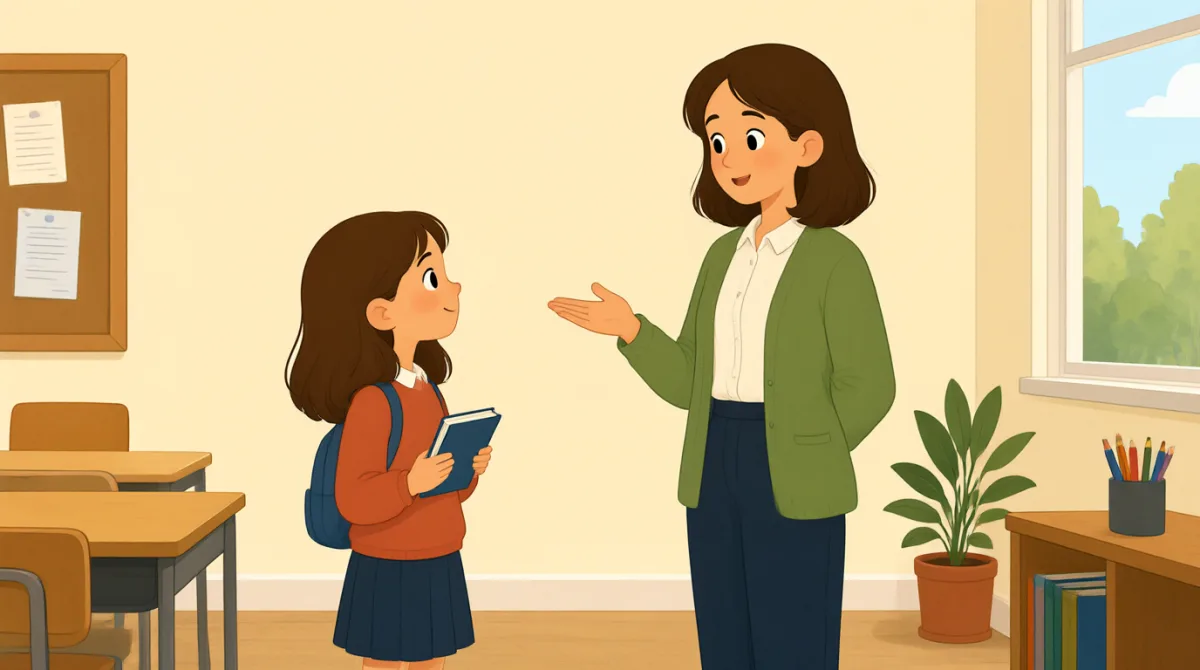

Excuse me, where is the classroom?
Com licença, onde fica a sala de aula?

It’s down the hall, on the left.
É lá no fim do corredor, à esquerda.
Is it near the big window?
Fica perto da janela grande?
Yes. It’s the room next to it.
Sim. É a sala ao lado dela.
Thank you. Is this my first class?
Obrigada. Esta é a minha primeira aula?
Yes, come in. You’re in the right place.
Sim, pode entrar. Você está no lugar certo.
Vocabulário8
- Excuse meCom licença
Use this polite phrase to get someone’s attention before asking a question.
Use essa expressão educada para chamar a atenção de alguém antes de fazer uma pergunta.
- where is the classroom?onde fica a sala de aula?
Use this question to ask for the location of a classroom. You can replace “the classroom” with another place.
Use essa pergunta para perguntar onde fica uma sala de aula. Você pode substituir “the classroom” por outro lugar.
- down the halllá no fim do corredor
This means farther along the hallway. You can use it to give simple directions.
Isso significa mais adiante pelo corredor. Você pode usar essa expressão para dar instruções simples.
- on the leftà esquerda
This tells someone which side to look at. You can also say “on the right.”
Isso indica de que lado a pessoa deve olhar. Você também pode dizer “on the right”.
- near the big windowperto da janela grande
Use “near” to ask if a place is close to something. Replace “the big window” with another landmark.
Use “near” para perguntar se um lugar fica perto de alguma coisa. Substitua “the big window” por outro ponto de referência.
- next to itao lado dela
This means beside the thing you just mentioned. Use it to explain where something is.
Isso significa ao lado da coisa que você acabou de mencionar. Use essa expressão para explicar onde algo fica.
- come inpode entrar
Use this phrase to invite someone to enter a room or building.
Use essa expressão para convidar alguém a entrar em uma sala ou edifício.
- the right placeo lugar certo
This means the correct place. You can use it to reassure someone that they are where they should be.
Isso significa o lugar correto. Você pode usar essa expressão para tranquilizar alguém e dizer que está onde deveria estar.
Frases-chave8
- 1
Excuse me, where is the classroom?
Com licença, onde fica a sala de aula?
This is a polite way to ask where a place is. Replace “the classroom” with another place to ask for directions.
Essa é uma forma educada de perguntar onde fica um lugar. Substitua “the classroom” por outro lugar para pedir informações sobre como chegar.
- 2
It’s down the hall, on the left.
É lá no fim do corredor, à esquerda.
Use this sentence to give simple directions. You can change “down the hall” or “on the left” to match the location.
Use esta frase para dar instruções simples. Você pode mudar “down the hall” ou “on the left” para indicar o local correto.
- 3
Is it near the big window?
Fica perto da janela grande?
Use this yes-or-no question to check if a place is close to a landmark. Replace “the big window” with something easy to see.
Use esta pergunta, que pode ser respondida com sim ou não, para confirmar se um lugar fica perto de um ponto de referência. Substitua “the big window” por algo fácil de identificar.
- 4
Yes. It’s the room next to it.
Sim. É a sala ao lado dela.
This gives a simple location using a nearby place as a guide. Replace “the room” and “it” with the places you mean.
Esta frase indica um lugar usando como referência algo que fica perto. Substitua “the room” e “it” pelos lugares que você quer indicar.
- 5
Thank you.
Obrigada.
Use this short, polite phrase after someone helps you. You can also say it when someone gives you directions.
Use esta expressão curta e educada depois que alguém ajudar você. Você também pode dizê-la quando alguém lhe der instruções.
- 6
Is this my first class?
Esta é a minha primeira aula?
Use this question to check if you are in the correct class. Replace “my first class” with another class or activity.
Use esta pergunta para confirmar se você está na aula certa. Substitua “my first class” por outra aula ou atividade.
- 7
Yes, come in.
Sim, pode entrar.
Use this phrase to confirm something and invite someone inside. You can say it when a person is waiting at a door.
Use esta expressão para confirmar algo e convidar alguém a entrar. Você pode dizê-la quando uma pessoa estiver esperando à porta.
- 8
You’re in the right place.
Você está no lugar certo.
Use this sentence to reassure someone that they are where they need to be. It is useful when giving directions or helping a new student.
Use esta frase para tranquilizar alguém e dizer que está onde precisa estar. Ela é útil para dar instruções ou ajudar um aluno novo.