Finding the Classroom
교실 찾기
Emma arrives for her first class and asks Grace where the classroom is. Grace gives her simple directions.
에마는 첫 수업에 도착해 그레이스에게 교실이 어디인지 물어봐요. 그레이스는 간단하게 길을 알려줘요.
대화6
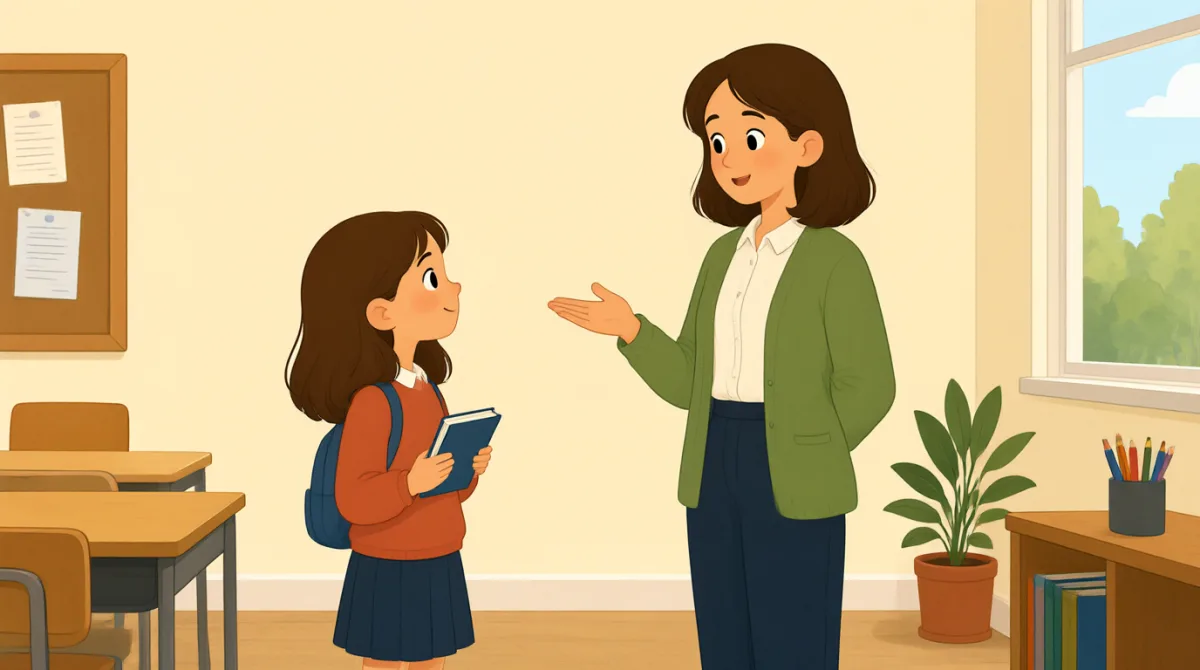

Excuse me, where is the classroom?
실례합니다, 교실이 어디예요?

It’s down the hall, on the left.
복도를 따라가면 왼쪽에 있어요.
Is it near the big window?
큰 창문 근처에 있어요?
Yes. It’s the room next to it.
네. 그 옆에 있는 교실이에요.
Thank you. Is this my first class?
고마워요. 여기가 제 첫 수업 맞나요?
Yes, come in. You’re in the right place.
네, 들어오세요. 잘 찾아오셨어요.
어휘8
- Excuse me실례합니다
Use this polite phrase to get someone’s attention before asking a question.
질문하기 전에 상대방의 주의를 끌 때 쓰는 공손한 표현이에요.
- where is the classroom?교실이 어디예요?
Use this question to ask for the location of a classroom. You can replace “the classroom” with another place.
교실이 어디 있는지 물을 때 쓰는 질문이에요. “the classroom” 대신 다른 장소를 넣어 말할 수도 있어요.
- down the hall복도를 따라가면
This means farther along the hallway. You can use it to give simple directions.
복도를 따라 더 가면 된다는 뜻이에요. 간단하게 길을 알려줄 때 쓸 수 있어요.
- on the left왼쪽에
This tells someone which side to look at. You can also say “on the right.”
어느 쪽을 봐야 하는지 알려주는 표현이에요. “on the right”라고 하면 오른쪽이라는 뜻이에요.
- near the big window큰 창문 근처에
Use “near” to ask if a place is close to something. Replace “the big window” with another landmark.
“near”는 장소가 어떤 것과 가까운지 물을 때 써요. “the big window” 대신 다른 눈에 띄는 것을 넣어 말할 수 있어요.
- next to it그 옆에
This means beside the thing you just mentioned. Use it to explain where something is.
방금 말한 것 바로 옆이라는 뜻이에요. 어떤 것이 어디 있는지 설명할 때 써요.
- come in들어오세요
Use this phrase to invite someone to enter a room or building.
누군가에게 방이나 건물 안으로 들어오라고 할 때 쓰는 표현이에요.
- the right place맞는 장소
This means the correct place. You can use it to reassure someone that they are where they should be.
올바른 장소라는 뜻이에요. 상대방이 와야 할 곳에 잘 도착했다고 안심시킬 때 쓸 수 있어요.
핵심 문장8
- 1
Excuse me, where is the classroom?
실례합니다, 교실이 어디예요?
This is a polite way to ask where a place is. Replace “the classroom” with another place to ask for directions.
장소가 어디 있는지 공손하게 물어보는 표현이에요. 길을 물을 때 “the classroom” 대신 다른 장소를 넣어 말해 보세요.
- 2
It’s down the hall, on the left.
복도를 따라가면 왼쪽에 있어요.
Use this sentence to give simple directions. You can change “down the hall” or “on the left” to match the location.
간단하게 길을 알려줄 때 쓰는 문장이에요. 위치에 맞게 “down the hall”이나 “on the left”를 바꿔 말할 수 있어요.
- 3
Is it near the big window?
큰 창문 근처에 있어요?
Use this yes-or-no question to check if a place is close to a landmark. Replace “the big window” with something easy to see.
장소가 눈에 띄는 곳 가까이에 있는지 확인할 때 쓰는 예·아니요 질문이에요. “the big window” 대신 쉽게 알아볼 수 있는 것을 넣어 보세요.
- 4
Yes. It’s the room next to it.
네. 그 옆에 있는 교실이에요.
This gives a simple location using a nearby place as a guide. Replace “the room” and “it” with the places you mean.
근처에 있는 장소를 기준으로 위치를 간단히 알려주는 표현이에요. 말하려는 장소에 맞게 “the room”과 “it”을 바꿔 보세요.
- 5
Thank you.
고마워요.
Use this short, polite phrase after someone helps you. You can also say it when someone gives you directions.
누군가 도움을 줬을 때 쓰는 짧고 공손한 표현이에요. 길을 알려줬을 때도 말할 수 있어요.
- 6
Is this my first class?
여기가 제 첫 수업 맞나요?
Use this question to check if you are in the correct class. Replace “my first class” with another class or activity.
수업 장소를 제대로 찾아왔는지 확인할 때 쓰는 질문이에요. “my first class” 대신 다른 수업이나 활동을 넣어 말할 수 있어요.
- 7
Yes, come in.
네, 들어오세요.
Use this phrase to confirm something and invite someone inside. You can say it when a person is waiting at a door.
맞다고 확인해 주면서 안으로 들어오라고 할 때 쓰는 표현이에요. 누군가 문 앞에서 기다리고 있을 때 말할 수 있어요.
- 8
You’re in the right place.
잘 찾아오셨어요.
Use this sentence to reassure someone that they are where they need to be. It is useful when giving directions or helping a new student.
상대방이 가야 할 곳에 도착했다고 안심시킬 때 쓰는 문장이에요. 길을 알려주거나 새 학생을 도울 때 유용해요.