Making Toast and Eggs
Robienie tostów i jajek
They make toast and cook eggs together. Emma asks Mia where to find the butter and a pan.
Przygotowują razem tosty i smażą jajka. Emma pyta Mię, gdzie znaleźć masło i patelnię.
Dialog8
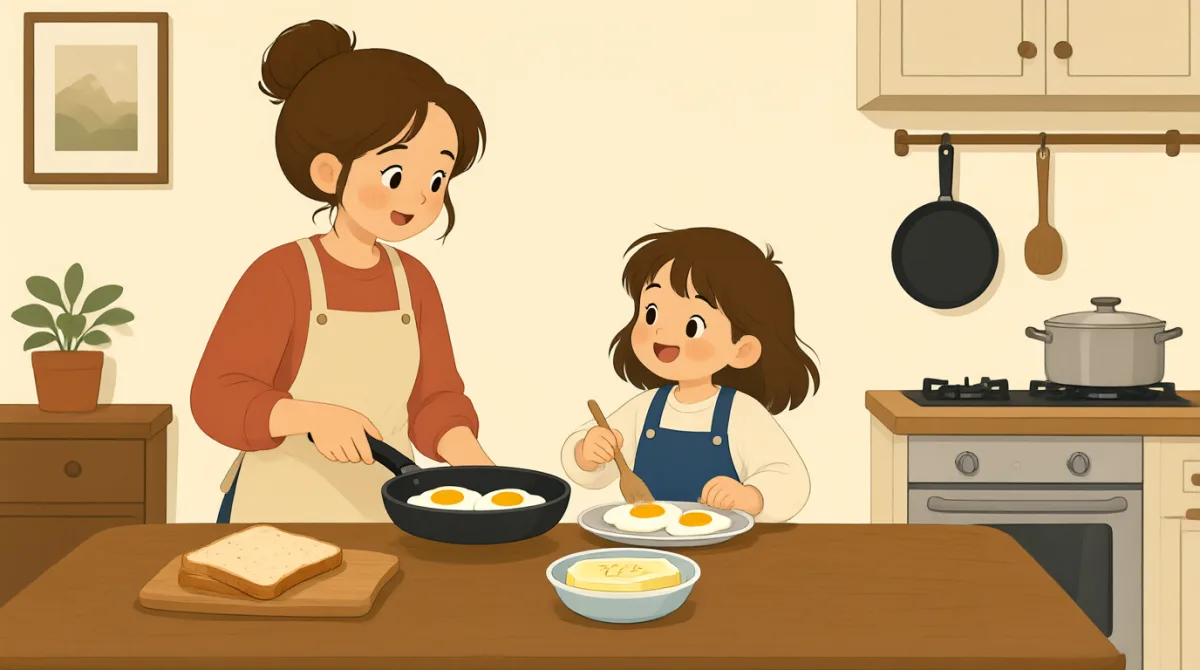

Where is the butter, Mia?
Gdzie jest masło, Mia?

It’s in the fridge, next to the milk.
W lodówce, obok mleka.
Thanks. Where is the pan?
Dzięki. Gdzie jest patelnia?
It’s on the shelf. I’ll get it.
Na półce. Przyniosę ją.
I’ll put the bread in the toaster.
Włożę chleb do tostera.
Great. I’ll cook the eggs in the pan.
Super. Usmażę jajka na patelni.
Do you need some butter?
Potrzebujesz masła?
Yes, please. Then our breakfast is ready.
Tak, poproszę. Wtedy śniadanie będzie gotowe.
Słownictwo8
- in the fridgew lodówce
This means inside the refrigerator. Use it to say where food is kept.
To znaczy, że coś znajduje się wewnątrz lodówki. Użyj tego wyrażenia, żeby powiedzieć, gdzie przechowuje się jedzenie.
- next toobok
This means beside something. Use it to describe where one thing is in relation to another.
To znaczy, że coś znajduje się przy czymś innym. Użyj tego wyrażenia, żeby opisać położenie jednej rzeczy względem drugiej.
- on the shelfna półce
This means resting on a shelf. Use it to say where an item is.
To znaczy, że coś leży na półce. Użyj tego wyrażenia, żeby powiedzieć, gdzie znajduje się jakiś przedmiot.
- I’ll get it.Przyniosę to.
This means “I will go and bring it.” Use it when you offer to fetch something.
To znaczy: „Pójdę po to i przyniosę”. Użyj tego wyrażenia, gdy proponujesz, że coś przyniesiesz.
- put the bread in the toasterwłożyć chleb do tostera
This means to place bread inside a toaster so it can become toast. You can use “put [something] in [place]” to describe where you place things.
To znaczy umieścić chleb w tosterze, żeby zrobić tosty. Możesz użyć wzoru “put [something] in [place]”, żeby opisać, gdzie coś wkładasz.
- cook the eggsusmażyć jajka
This means to prepare the eggs with heat. Use “cook” with the name of a food you are preparing.
To znaczy przygotować jajka na ogniu lub na gorącej powierzchni. Użyj “cook” z nazwą jedzenia, które przygotowujesz.
- some buttertrochę masła
This means an unspecified amount of butter. Use “some” when asking for or offering an amount of food.
To znaczy nieokreśloną ilość masła. Użyj “some”, gdy prosisz o jedzenie lub proponujesz komuś jego porcję.
- breakfast is readyśniadanie jest gotowe
This means breakfast is prepared and ready to eat. Use “[meal] is ready” when food is finished.
To znaczy, że śniadanie jest już przygotowane i można jeść. Użyj wzoru “[meal] is ready”, gdy posiłek jest gotowy.
Kluczowe zdania8
- 1
Where is the butter, Mia?
Gdzie jest masło, Mia?
Use this simple question to ask where something is. Replace “the butter” with another item, such as “the pan.”
Użyj tego prostego pytania, żeby zapytać, gdzie coś jest. Zamiast “the butter” wstaw nazwę innej rzeczy, na przykład “the pan”.
- 2
It’s in the fridge, next to the milk.
W lodówce, obok mleka.
This sentence gives an item’s location. Use “It’s in…” and “next to…” to explain where something is.
To zdanie podaje, gdzie znajduje się dana rzecz. Użyj “It’s in…” i “next to…”, żeby wyjaśnić, gdzie coś jest.
- 3
Where is the pan?
Gdzie jest patelnia?
Use “Where is the…?” to ask where a single item is. Replace “the pan” with the thing you are looking for.
Użyj “Where is the…?”, żeby zapytać, gdzie znajduje się jeden przedmiot. Zamiast “the pan” wstaw nazwę rzeczy, której szukasz.
- 4
I’ll put the bread in the toaster.
Włożę chleb do tostera.
Use “I’ll put…” to say what you will place somewhere. Replace “the bread” and “the toaster” with other items and places.
Użyj “I’ll put…”, żeby powiedzieć, co gdzieś położysz lub włożysz. Zamiast “the bread” i “the toaster” wstaw inne rzeczy i miejsca.
- 5
I’ll cook the eggs in the pan.
Usmażę jajka na patelni.
Use “I’ll cook…” to say what you plan to prepare and where you will cook it. Replace “the eggs” and “the pan” as needed.
Użyj “I’ll cook…”, żeby powiedzieć, co zamierzasz przygotować i gdzie to ugotujesz lub usmażysz. W razie potrzeby zastąp “the eggs” i “the pan” innymi wyrażeniami.
- 6
Do you need some butter?
Potrzebujesz masła?
Use this question to offer something someone may need. Replace “some butter” with another food or item.
Użyj tego pytania, żeby zaproponować komuś coś, czego może potrzebować. Zamiast “some butter” wstaw inne jedzenie lub przedmiot.
- 7
Yes, please.
Tak, poproszę.
This is a polite way to accept an offer. You can use it when someone asks if you would like or need something.
To uprzejmy sposób na przyjęcie oferty. Możesz tak powiedzieć, gdy ktoś pyta, czy masz ochotę na coś lub czy czegoś potrzebujesz.
- 8
Then our breakfast is ready.
Wtedy śniadanie będzie gotowe.
Use “Then…” to describe what happens next, and “is ready” to say something is prepared. Replace “our breakfast” with another meal or activity.
Użyj “Then…”, żeby opisać, co wydarzy się potem, a “is ready”, żeby powiedzieć, że coś jest przygotowane. Zamiast “our breakfast” wstaw inny posiłek lub czynność.