Do You Have Your Phone?
Tu as ton téléphone ?
As they get ready to leave, Mia asks Emma if she has her phone. Emma checks her bag.
Alors qu’elles se préparent à partir, Mia demande à Emma si elle a son téléphone. Emma vérifie son sac.
Dialogue6
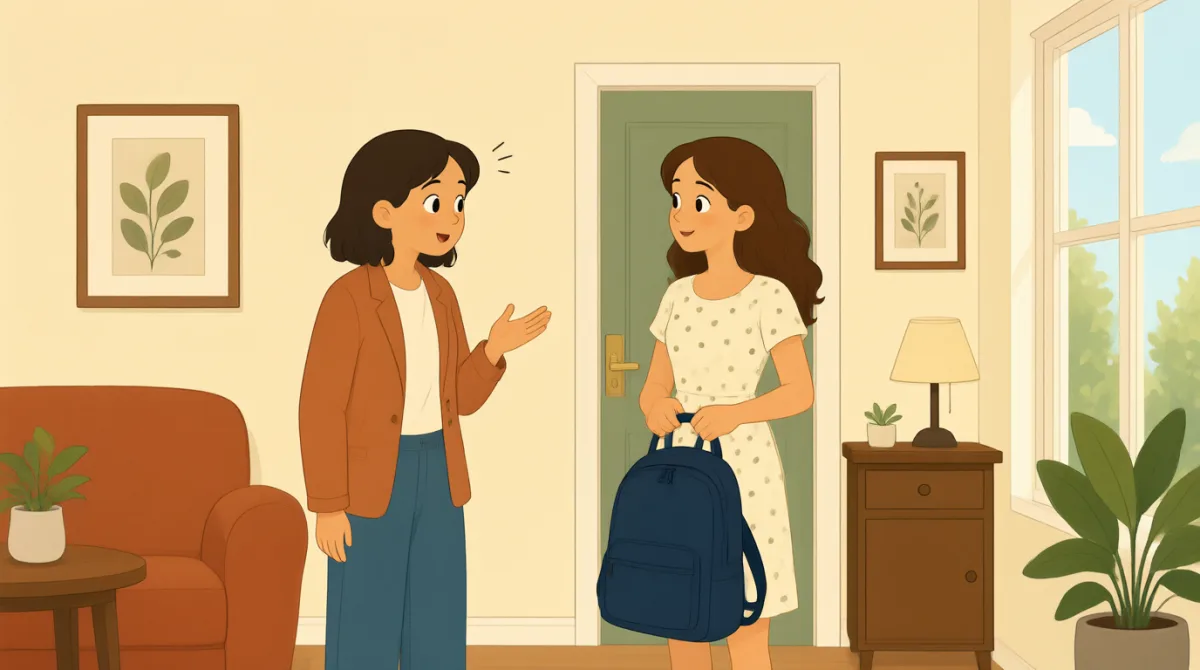

Emma, do you have your phone?
Emma, tu as ton téléphone ?

I think so. Let me check my bag.
Je crois que oui. Je vais vérifier dans mon sac.
It’s not here. Oh, it’s in my pocket!
Il n’est pas là. Ah, il est dans ma poche !
Great. Is it charged?
Super. Il est chargé ?
Yes, it is. I’m ready to go.
Oui. Je suis prête à partir.
Good. Let’s go!
Super. On y va !
Vocabulaire7
- I think so.Je crois que oui.
This means you believe something is true, but you are not completely sure. Use it to answer when you need to check.
Cette expression signifie que tu penses que quelque chose est vrai, sans en être tout à fait sûre. Utilise-la quand tu veux vérifier.
- Let me check my bag.Je vais vérifier dans mon sac.
Say this when you want to look in your bag for something. “Let me check” is a useful way to say you will find out.
Dis cette phrase quand tu veux chercher quelque chose dans ton sac. “Let me check” (je vais vérifier) est une façon pratique de dire que tu vas te renseigner.
- It’s not here.Il n’est pas là.
Use this when you cannot find something in the place you are looking. You can replace “it” with another thing.
Utilise cette phrase quand tu ne trouves pas quelque chose à l’endroit où tu cherches. Tu peux remplacer “it” par le nom d’un autre objet.
- in my pocketdans ma poche
This means something is inside the pocket of your clothes. You can say “in my pocket” to tell someone where an item is.
Cette expression signifie que quelque chose se trouve à l’intérieur d’une poche de tes vêtements. Tu peux dire “in my pocket” pour indiquer à quelqu’un où se trouve un objet.
- Is it charged?Il est chargé ?
Ask this to find out if a phone or other device has enough battery power. You can use “Is it charged?” for other devices, too.
Pose cette question pour savoir si un téléphone ou un autre appareil a assez de batterie. Tu peux aussi utiliser “Is it charged?” pour parler d’autres appareils.
- I’m ready to go.Je suis prête à partir.
Say this when you have finished getting ready and can leave. You can use it before going out with someone.
Dis cette phrase quand tu as fini de te préparer et que tu peux partir. Tu peux l’utiliser avant de sortir avec quelqu’un.
- Let’s go!On y va !
This means “Let us go” and tells someone it is time to leave. It is a common, friendly phrase.
Cette expression signifie “Let us go” et indique à quelqu’un que c’est le moment de partir. C’est une formule courante et amicale.
Phrases clés8
- 1
Emma, do you have your phone?
Emma, tu as ton téléphone ?
Use this question to check whether someone has an important item with them. You can replace “your phone” with another item, such as “your keys.”
Utilise cette question pour vérifier si quelqu’un a un objet important avec lui. Tu peux remplacer “your phone” par un autre objet, comme “your keys.”
- 2
I think so.
Je crois que oui.
This is a short answer when you believe something is true but want to check first. You can use it in many everyday situations.
C’est une réponse courte quand tu penses que quelque chose est vrai, mais que tu veux d’abord vérifier. Tu peux l’utiliser dans de nombreuses situations du quotidien.
- 3
Let me check my bag.
Je vais vérifier dans mon sac.
Use this sentence when you want to look in your bag for something. Replace “my bag” with another place you want to check.
Utilise cette phrase quand tu veux chercher quelque chose dans ton sac. Remplace “my bag” par un autre endroit que tu veux vérifier.
- 4
It’s not here.
Il n’est pas là.
Say this when you cannot find something where you expected it to be. You can replace “here” with a place, such as “in my bag.”
Dis cette phrase quand tu ne trouves pas quelque chose là où tu pensais le trouver. Tu peux remplacer “here” par un endroit, comme “in my bag.”
- 5
Oh, it’s in my pocket!
Ah, il est dans ma poche !
This sentence tells someone where you found an item. Use “It’s in my...” followed by a place, such as “my bag” or “my room.”
Cette phrase indique à quelqu’un où tu as trouvé un objet. Utilise “It’s in my...” suivi d’un endroit, comme “my bag” ou “my room.”
- 6
Is it charged?
Il est chargé ?
Use this question to ask whether a phone or device has enough battery power. The short answer can be “Yes, it is” or “No, it isn’t.”
Utilise cette question pour savoir si un téléphone ou un appareil a assez de batterie. Tu peux répondre brièvement “Yes, it is” ou “No, it isn’t.”
- 7
I’m ready to go.
Je suis prête à partir.
Say this when you have finished getting ready and can leave. You can also say it when you are ready to start an activity.
Dis cette phrase quand tu as fini de te préparer et que tu peux partir. Tu peux aussi la dire quand tu es prête à commencer une activité.
- 8
Good. Let’s go!
Super. On y va !
This is a friendly way to say it is time to leave together. Use “Let’s go!” with friends or family.
C’est une façon amicale de dire que c’est le moment de partir ensemble. Utilise “Let’s go!” avec tes amis ou ta famille.