Looking for Your Keys
À la recherche de tes clés
Emma cannot find her keys. Mia helps her look by the door and on the table.
Emma ne trouve pas ses clés. Mia l’aide à chercher près de la porte et sur la table.
Dialogue6
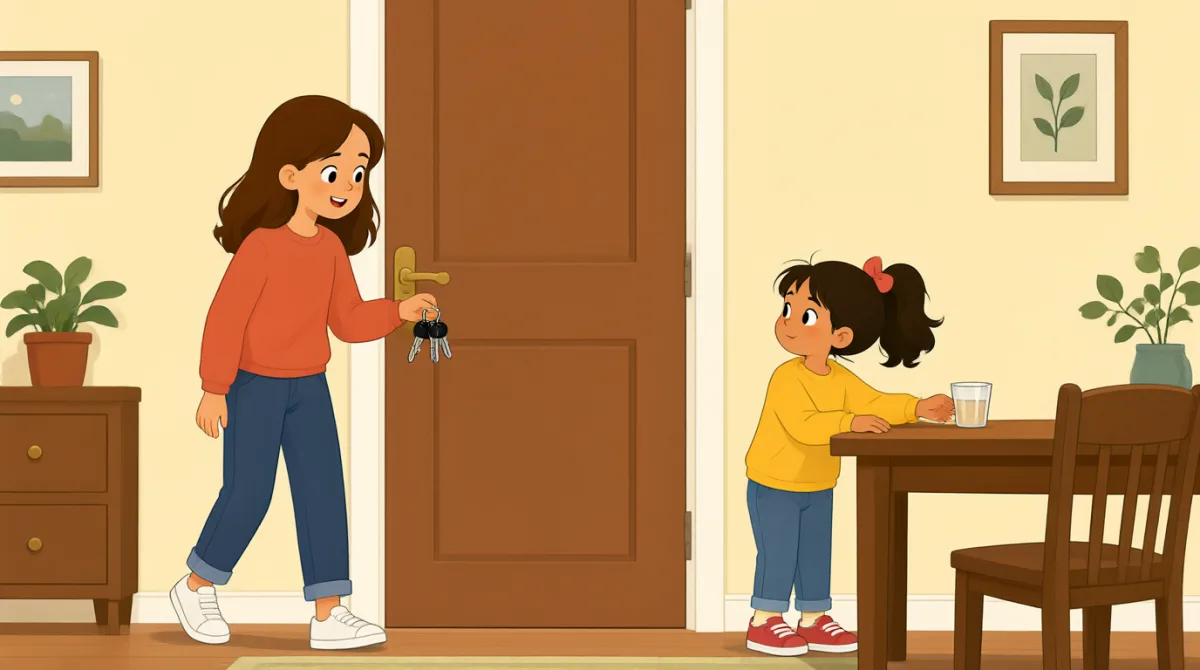

Mia, I can't find my keys.
Mia, je ne trouve pas mes clés.

Look by the door.
Regarde près de la porte.
They're not here. I see my bag.
Elles ne sont pas là. Je vois mon sac.
Check the table, too.
Regarde aussi sur la table.
Oh, here they are! On the table.
Ah, les voilà ! Sur la table.
Good. You have your keys now.
Super. Tu as tes clés, maintenant.
Vocabulaire8
- can't findne pas trouver
This means you do not know where something is. Use it to say that something is missing.
Cette expression signifie que tu ne sais pas où se trouve quelque chose. Utilise-la pour dire qu’un objet manque.
- keysclés
Keys open locks, such as the lock on a door. Here, Emma is looking for her keys.
Les clés servent à ouvrir des serrures, par exemple celle d’une porte. Ici, Emma cherche ses clés.
- by the doorprès de la porte
This means next to the door. Use it to say where something is or where to look.
Cela signifie « à côté de la porte ». Utilise cette expression pour dire où se trouve quelque chose ou où chercher.
- Look by the door.Regarde près de la porte.
This is a simple way to tell someone where to search. You can use “Look by…” with another place, such as “Look by the window.”
C’est une façon simple d’indiquer à quelqu’un où chercher. Tu peux utiliser “Look by…” avec un autre endroit, comme “Look by the window.”
- not herepas ici
This means something is not in this place. You can use it when you look for something and do not see it.
Cela signifie que quelque chose ne se trouve pas à cet endroit. Tu peux utiliser cette expression quand tu cherches quelque chose sans le voir.
- Check the table, too.Regarde aussi sur la table.
This asks someone to look at the table as well. You can use “Check…” to suggest another place to search.
Cette phrase demande à quelqu’un de regarder aussi sur la table. Tu peux utiliser “Check…” pour suggérer un autre endroit où chercher.
- here they areles voilà
This is what you say when you find the things you were looking for. Use “Here it is” for one thing and “Here they are” for more than one.
C’est ce qu’on dit quand on trouve les choses qu’on cherchait. Utilise “Here it is” pour une seule chose et “Here they are” pour plusieurs.
- on the tablesur la table
This means on top of the table. Use “on” to say where something is resting.
Cela signifie qu’une chose se trouve sur le dessus de la table. Utilise “on” pour indiquer où quelque chose est posé.
Phrases clés8
- 1
Mia, I can't find my keys.
Mia, je ne trouve pas mes clés.
Use this sentence to tell someone you have lost or cannot locate something. Replace “my keys” with another item, such as “my phone.”
Utilise cette phrase pour dire à quelqu’un que tu as perdu quelque chose ou que tu ne sais pas où le trouver. Remplace “my keys” par un autre objet, comme “my phone.”
- 2
Look by the door.
Regarde près de la porte.
This is a short instruction that suggests a place to search. Replace “the door” with another place, such as “the bed.”
C’est une courte consigne qui indique un endroit où chercher. Remplace “the door” par un autre endroit, comme “the bed.”
- 3
They're not here.
Elles ne sont pas là.
Use this to say that more than one thing is not in the place you checked. “They're” means “they are.”
Utilise cette phrase pour dire que plusieurs choses ne se trouvent pas à l’endroit où tu as regardé. “They're” signifie “they are.”
- 4
I see my bag.
Je vois mon sac.
This is a simple way to say that something is visible to you. Replace “my bag” with another thing you can see.
C’est une façon simple de dire que tu vois quelque chose. Remplace “my bag” par un autre objet que tu peux voir.
- 5
Check the table, too.
Regarde aussi sur la table.
Use this to suggest looking in one more place. “Too” means “also.”
Utilise cette phrase pour suggérer de chercher à un autre endroit. “Too” signifie “also.”
- 6
Oh, here they are!
Ah, les voilà !
Say this when you find two or more things you were looking for. For one thing, say “Oh, here it is!”
Dis cela quand tu trouves deux choses ou plus que tu cherchais. Pour une seule chose, dis “Oh, here it is!”
- 7
On the table.
Sur la table.
This phrase tells someone where something is. You can use it to answer a question like “Where are my keys?”
Cette expression indique à quelqu’un où se trouve quelque chose. Tu peux l’utiliser pour répondre à une question comme “Where are my keys?”
- 8
You have your keys now.
Tu as tes clés, maintenant.
Use this to tell someone they have something again or that they have found it. Replace “your keys” with another item.
Utilise cette phrase pour dire à quelqu’un qu’il a de nouveau quelque chose ou qu’il l’a retrouvé. Remplace “your keys” par un autre objet.