Do You Have Your Phone?
Você está com o celular?
As they get ready to leave, Mia asks Emma if she has her phone. Emma checks her bag.
Enquanto se preparam para sair, Mia pergunta a Emma se ela está com o celular. Emma procura na bolsa.
Diálogo6
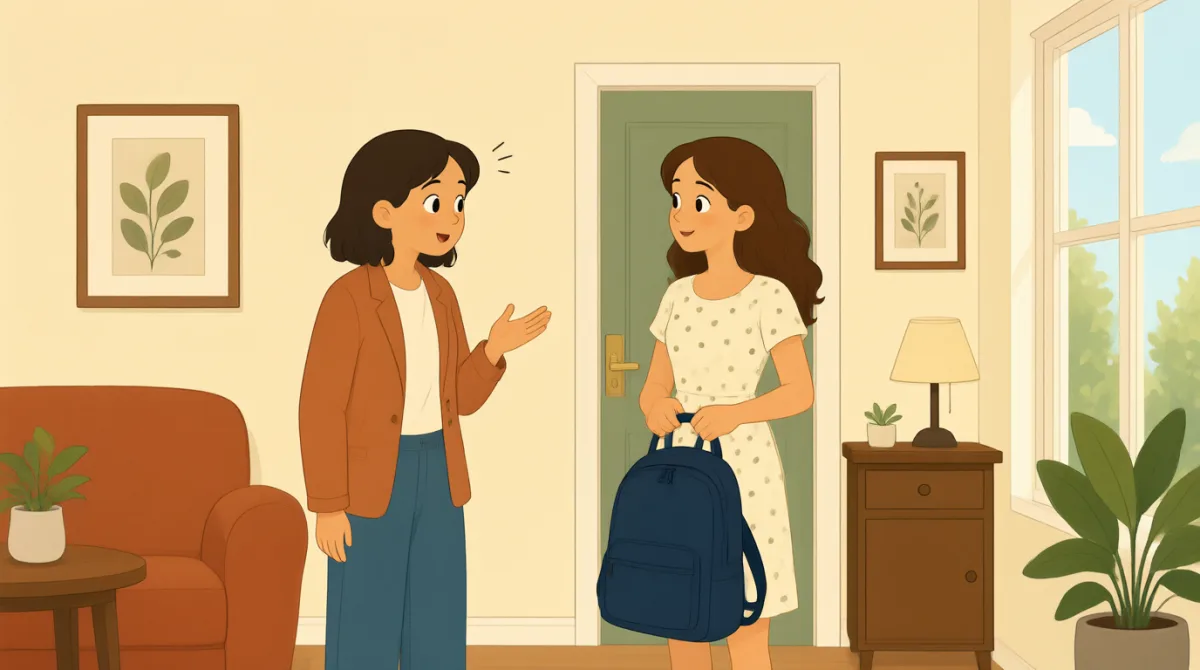

Emma, do you have your phone?
Emma, você está com o celular?

I think so. Let me check my bag.
Acho que sim. Deixa eu olhar na minha bolsa.
It’s not here. Oh, it’s in my pocket!
Não está aqui. Ah, está no meu bolso!
Great. Is it charged?
Ótimo. Está carregado?
Yes, it is. I’m ready to go.
Sim. Estou pronta para ir.
Good. Let’s go!
Ótimo. Vamos!
Vocabulário7
- I think so.Acho que sim.
This means you believe something is true, but you are not completely sure. Use it to answer when you need to check.
Isso significa que você acredita que algo é verdade, mas não tem certeza absoluta. Use essa expressão para responder quando ainda precisa conferir.
- Let me check my bag.Deixa eu olhar na minha bolsa.
Say this when you want to look in your bag for something. “Let me check” is a useful way to say you will find out.
Diga isso quando quiser procurar alguma coisa na bolsa. “Let me check” é uma maneira útil de dizer que você vai conferir.
- It’s not here.Não está aqui.
Use this when you cannot find something in the place you are looking. You can replace “it” with another thing.
Use essa expressão quando não conseguir encontrar algo no lugar onde está procurando. Você pode substituir “it” por outra coisa.
- in my pocketno meu bolso
This means something is inside the pocket of your clothes. You can say “in my pocket” to tell someone where an item is.
Isso significa que algo está dentro do bolso da sua roupa. Você pode dizer “in my pocket” para contar a alguém onde está um objeto.
- Is it charged?Está carregado?
Ask this to find out if a phone or other device has enough battery power. You can use “Is it charged?” for other devices, too.
Pergunte isso para saber se um celular ou outro aparelho tem bateria suficiente. Você também pode usar “Is it charged?” para falar de outros aparelhos.
- I’m ready to go.Estou pronta para ir.
Say this when you have finished getting ready and can leave. You can use it before going out with someone.
Diga isso quando terminar de se arrumar e puder sair. Você pode usar essa frase antes de sair com alguém.
- Let’s go!Vamos!
This means “Let us go” and tells someone it is time to leave. It is a common, friendly phrase.
Isso significa “Let us go” e avisa a alguém que está na hora de sair. É uma expressão comum e amigável.
Frases-chave8
- 1
Emma, do you have your phone?
Emma, você está com o celular?
Use this question to check whether someone has an important item with them. You can replace “your phone” with another item, such as “your keys.”
Use essa pergunta para confirmar se alguém está com um objeto importante. Você pode substituir “your phone” por outro objeto, como “your keys.”
- 2
I think so.
Acho que sim.
This is a short answer when you believe something is true but want to check first. You can use it in many everyday situations.
Esta é uma resposta curta para quando você acredita que algo é verdade, mas quer conferir primeiro. Você pode usá-la em muitas situações do dia a dia.
- 3
Let me check my bag.
Deixa eu olhar na minha bolsa.
Use this sentence when you want to look in your bag for something. Replace “my bag” with another place you want to check.
Use essa frase quando quiser procurar alguma coisa na bolsa. Substitua “my bag” por outro lugar que queira conferir.
- 4
It’s not here.
Não está aqui.
Say this when you cannot find something where you expected it to be. You can replace “here” with a place, such as “in my bag.”
Diga isso quando não conseguir encontrar algo onde esperava que estivesse. Você pode substituir “here” por um lugar, como “in my bag.”
- 5
Oh, it’s in my pocket!
Ah, está no meu bolso!
This sentence tells someone where you found an item. Use “It’s in my...” followed by a place, such as “my bag” or “my room.”
Esta frase conta a alguém onde você encontrou um objeto. Use “It’s in my...” seguido de um lugar, como “my bag” ou “my room.”
- 6
Is it charged?
Está carregado?
Use this question to ask whether a phone or device has enough battery power. The short answer can be “Yes, it is” or “No, it isn’t.”
Use essa pergunta para saber se um celular ou aparelho tem bateria suficiente. As respostas curtas podem ser “Yes, it is” ou “No, it isn’t.”
- 7
I’m ready to go.
Estou pronta para ir.
Say this when you have finished getting ready and can leave. You can also say it when you are ready to start an activity.
Diga isso quando terminar de se arrumar e puder sair. Você também pode dizer isso quando estiver pronta para começar uma atividade.
- 8
Good. Let’s go!
Ótimo. Vamos!
This is a friendly way to say it is time to leave together. Use “Let’s go!” with friends or family.
Esta é uma maneira amigável de dizer que está na hora de saírem juntos. Use “Let’s go!” com amigos ou familiares.