Looking for Your Keys
Szukamy kluczy
Emma cannot find her keys. Mia helps her look by the door and on the table.
Emma nie może znaleźć kluczy. Mia pomaga jej szukać przy drzwiach i na stole.
Dialog6
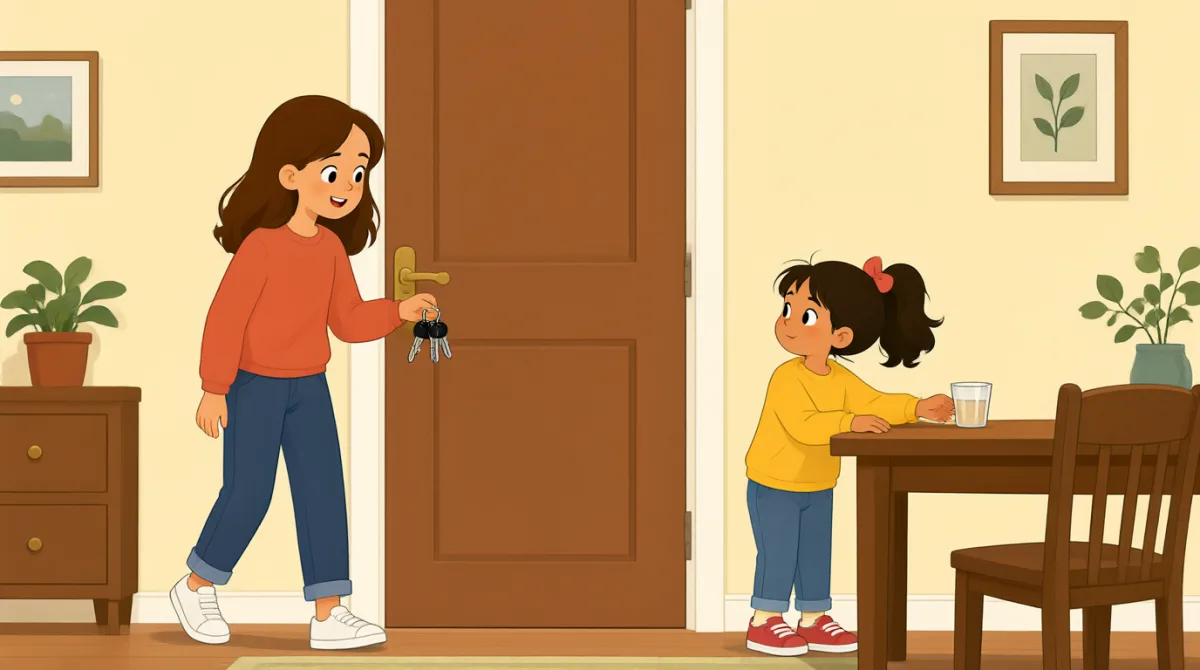

Mia, I can't find my keys.
Mia, nie mogę znaleźć kluczy.

Look by the door.
Sprawdź przy drzwiach.
They're not here. I see my bag.
Nie ma ich tutaj. Widzę swoją torbę.
Check the table, too.
Sprawdź też stół.
Oh, here they are! On the table.
O, są tutaj! Na stole.
Good. You have your keys now.
Dobrze. Masz już klucze.
Słownictwo8
- can't findnie móc znaleźć
This means you do not know where something is. Use it to say that something is missing.
To znaczy, że nie wiesz, gdzie coś jest. Użyj tego wyrażenia, gdy czegoś nie możesz znaleźć.
- keysklucze
Keys open locks, such as the lock on a door. Here, Emma is looking for her keys.
Klucze otwierają zamki, na przykład zamek w drzwiach. W tej rozmowie Emma szuka swoich kluczy.
- by the doorprzy drzwiach
This means next to the door. Use it to say where something is or where to look.
To znaczy obok drzwi. Użyj tego wyrażenia, by powiedzieć, gdzie coś jest albo gdzie szukać.
- Look by the door.Spójrz przy drzwiach.
This is a simple way to tell someone where to search. You can use “Look by…” with another place, such as “Look by the window.”
To prosty sposób, by powiedzieć komuś, gdzie ma szukać. Możesz użyć „Look by…” i dodać inne miejsce, na przykład „Look by the window.”
- not herenie tutaj
This means something is not in this place. You can use it when you look for something and do not see it.
To znaczy, że czegoś nie ma w tym miejscu. Możesz tak powiedzieć, gdy czegoś szukasz i tego nie widzisz.
- Check the table, too.Sprawdź też stół.
This asks someone to look at the table as well. You can use “Check…” to suggest another place to search.
To prośba, by ktoś sprawdził również stół. Możesz użyć „Check…”, by zasugerować inne miejsce do przeszukania.
- here they areO, są tutaj!
This is what you say when you find the things you were looking for. Use “Here it is” for one thing and “Here they are” for more than one.
Tak mówisz, gdy znajdujesz szukane rzeczy. O jednej rzeczy powiedz „Here it is”, a o kilku „Here they are”.
- on the tablena stole
This means on top of the table. Use “on” to say where something is resting.
To znaczy, że coś znajduje się na powierzchni stołu. Używaj „on”, by powiedzieć, że coś na czymś leży.
Kluczowe zdania8
- 1
Mia, I can't find my keys.
Mia, nie mogę znaleźć kluczy.
Use this sentence to tell someone you have lost or cannot locate something. Replace “my keys” with another item, such as “my phone.”
Użyj tego zdania, by powiedzieć komuś, że coś zgubiłaś albo nie możesz tego znaleźć. Zamiast „my keys” możesz powiedzieć nazwę innej rzeczy, na przykład „my phone.”
- 2
Look by the door.
Spójrz przy drzwiach.
This is a short instruction that suggests a place to search. Replace “the door” with another place, such as “the bed.”
To krótkie polecenie, które wskazuje miejsce, w którym można szukać. Zamiast „the door” możesz podać inne miejsce, na przykład „the bed.”
- 3
They're not here.
Nie ma ich tutaj.
Use this to say that more than one thing is not in the place you checked. “They're” means “they are.”
Użyj tego zdania, by powiedzieć, że kilku rzeczy nie ma w sprawdzonym miejscu. „They're” to skrócona forma „they are”.
- 4
I see my bag.
Widzę swoją torbę.
This is a simple way to say that something is visible to you. Replace “my bag” with another thing you can see.
To prosty sposób, by powiedzieć, że coś widzisz. Zamiast „my bag” możesz wymienić inną rzecz, którą widzisz.
- 5
Check the table, too.
Sprawdź też stół.
Use this to suggest looking in one more place. “Too” means “also.”
Użyj tego zdania, by zasugerować sprawdzenie jeszcze jednego miejsca. „Too” znaczy „również”.
- 6
Oh, here they are!
O, są tutaj!
Say this when you find two or more things you were looking for. For one thing, say “Oh, here it is!”
Powiedz tak, gdy znajdziesz dwie lub więcej szukanych rzeczy. O jednej rzeczy powiedz „Oh, here it is!”
- 7
On the table.
Na stole.
This phrase tells someone where something is. You can use it to answer a question like “Where are my keys?”
To wyrażenie mówi komuś, gdzie coś się znajduje. Możesz tak odpowiedzieć na pytanie „Where are my keys?”
- 8
You have your keys now.
Masz już klucze.
Use this to tell someone they have something again or that they have found it. Replace “your keys” with another item.
Użyj tego zdania, by powiedzieć komuś, że znów coś ma albo że to znalazł. Zamiast „your keys” możesz wymienić inną rzecz.