Looking for Your Keys
找鑰匙
Emma cannot find her keys. Mia helps her look by the door and on the table.
艾瑪找不到鑰匙。米婭幫她在門邊和桌子上找。
對話6
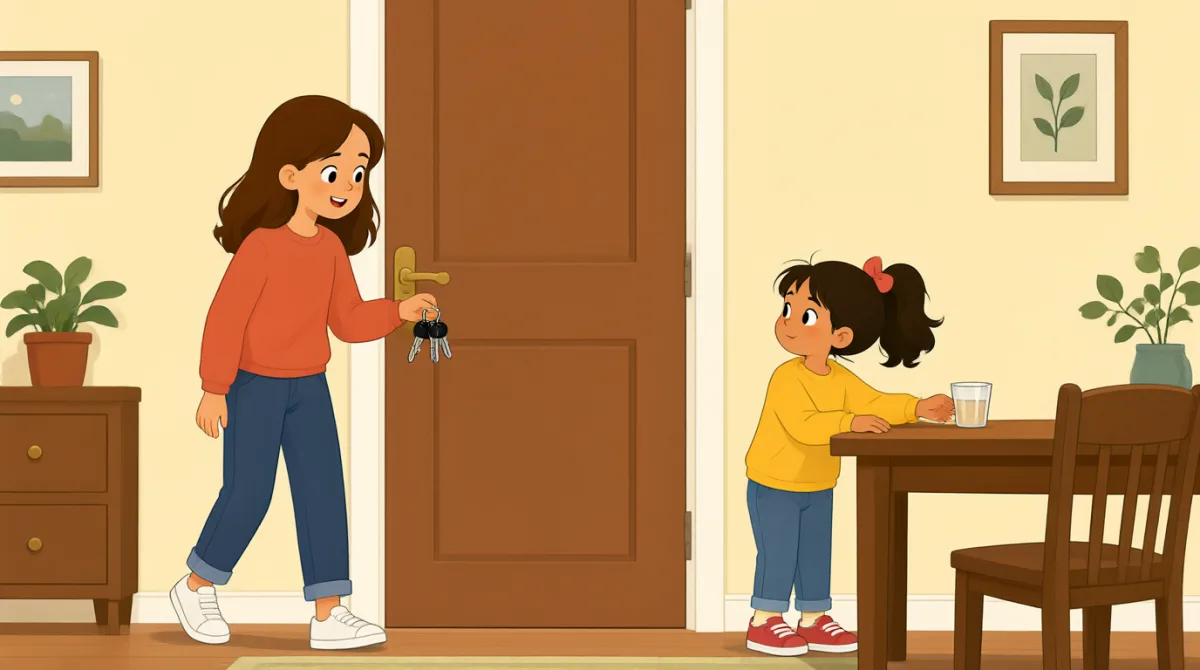

Mia, I can't find my keys.
Mia,我找不到我的鑰匙了。

Look by the door.
看看門邊。
They're not here. I see my bag.
不在這兒。我看到我的包了。
Check the table, too.
也看看桌子上。
Oh, here they are! On the table.
哦,在這兒!在桌子上。
Good. You have your keys now.
太好了。你現在拿到鑰匙了。
詞彙8
- can't find找不到
This means you do not know where something is. Use it to say that something is missing.
意思是你不知道某樣東西在哪裡。找不到東西時,可以用這個說法。
- keys鑰匙
Keys open locks, such as the lock on a door. Here, Emma is looking for her keys.
鑰匙可以開啟鎖,比如門鎖。這裡,艾瑪正在找她的鑰匙。
- by the door在門邊
This means next to the door. Use it to say where something is or where to look.
意思是靠著門邊。可以用來說明東西在哪裡,或告訴別人去哪裡找。
- Look by the door.看看門邊。
This is a simple way to tell someone where to search. You can use “Look by…” with another place, such as “Look by the window.”
這是告訴別人去哪裡找東西的一種簡單說法。你可以把另一個地點放在“Look by…”後面,比如“Look by the window.”
- not here不在這兒
This means something is not in this place. You can use it when you look for something and do not see it.
意思是某樣東西不在這個地方。找東西時,如果沒看到它,就可以這樣說。
- Check the table, too.也看看桌子上。
This asks someone to look at the table as well. You can use “Check…” to suggest another place to search.
這是請別人也看看桌子上。你可以用“Check…”來建議對方再去一個地方找找。
- here they are找到了!
This is what you say when you find the things you were looking for. Use “Here it is” for one thing and “Here they are” for more than one.
找到正在找的東西時,可以這樣說。找到一樣東西時說“Here it is”,找到多樣東西時說“Here they are”。
- on the table在桌子上
This means on top of the table. Use “on” to say where something is resting.
意思是在桌面上。可以用“on”說明某樣東西放在哪裡。
關鍵句8
- 1
Mia, I can't find my keys.
米婭,我找不到我的鑰匙了。
Use this sentence to tell someone you have lost or cannot locate something. Replace “my keys” with another item, such as “my phone.”
用這句話告訴別人你丟了某樣東西,或者找不到它。你可以把“my keys”換成其他東西,比如“my phone”。
- 2
Look by the door.
看看門邊。
This is a short instruction that suggests a place to search. Replace “the door” with another place, such as “the bed.”
這是一個簡短的指示,建議去某個地方找找。你可以把“the door”換成另一個地方,比如“the bed”。
- 3
They're not here.
它們不在這兒。
Use this to say that more than one thing is not in the place you checked. “They're” means “they are.”
檢查過某個地方後,如果不止一樣東西不在那兒,可以這樣說。“They're”是“they are”的縮寫。
- 4
I see my bag.
我看到我的包了。
This is a simple way to say that something is visible to you. Replace “my bag” with another thing you can see.
這是簡單地說你看得到某樣東西。你可以把“my bag”換成其他你看得到的東西。
- 5
Check the table, too.
也看看桌子上。
Use this to suggest looking in one more place. “Too” means “also.”
用這句話建議再去一個地方找找。“Too”意思是“也”。
- 6
Oh, here they are!
哦,找到了!
Say this when you find two or more things you were looking for. For one thing, say “Oh, here it is!”
找到正在找的兩樣或更多東西時,可以這樣說。只找到一樣東西時,說“Oh, here it is!”
- 7
On the table.
在桌子上。
This phrase tells someone where something is. You can use it to answer a question like “Where are my keys?”
這個短語用來告訴別人東西在哪裡。別人問“Where are my keys?”時,你可以用它來回答。
- 8
You have your keys now.
你現在拿到鑰匙了。
Use this to tell someone they have something again or that they have found it. Replace “your keys” with another item.
用這句話告訴別人他們又有某樣東西了,或者已經找到了它。你可以把“your keys”換成其他東西。