Looking for Your Keys
Auf der Suche nach deinen Schlüsseln
Emma cannot find her keys. Mia helps her look by the door and on the table.
Emma kann ihre Schlüssel nicht finden. Mia hilft ihr, bei der Tür und auf dem Tisch zu suchen.
Dialog6
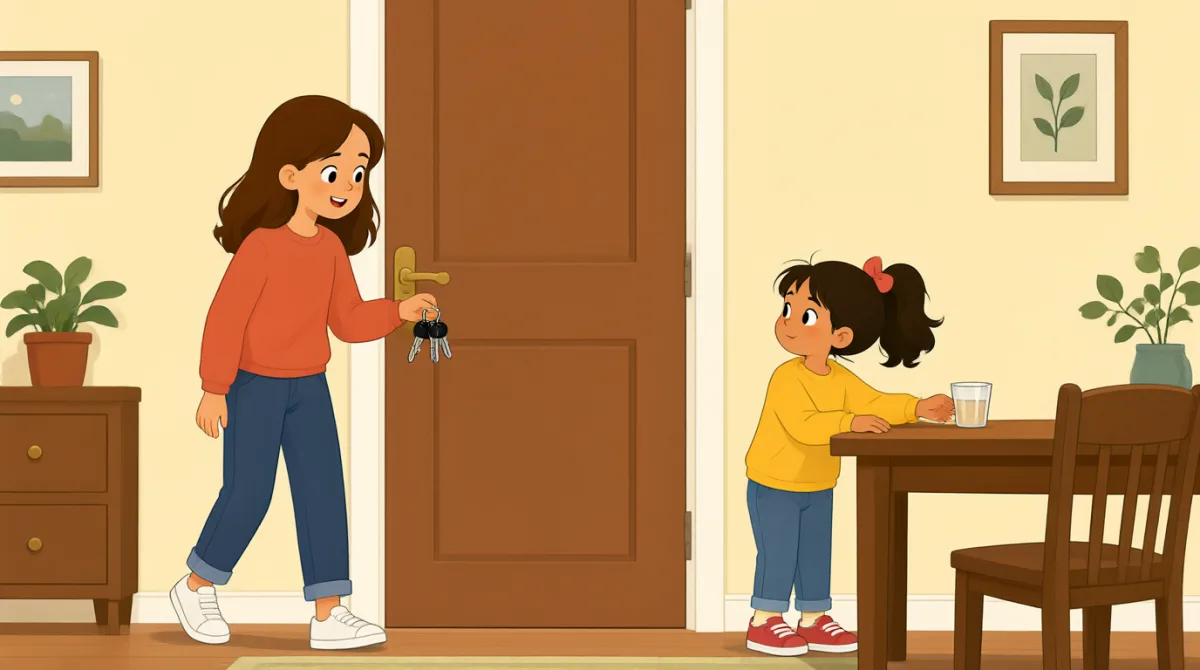

Mia, I can't find my keys.
Mia, ich kann meine Schlüssel nicht finden.

Look by the door.
Schau bei der Tür nach.
They're not here. I see my bag.
Sie sind nicht hier. Ich sehe meine Tasche.
Check the table, too.
Schau auch auf dem Tisch nach.
Oh, here they are! On the table.
Oh, da sind sie ja! Auf dem Tisch.
Good. You have your keys now.
Gut. Jetzt hast du deine Schlüssel.
Wortschatz8
- can't findnicht finden können
This means you do not know where something is. Use it to say that something is missing.
Das bedeutet, dass du nicht weißt, wo etwas ist. Damit kannst du sagen, dass etwas fehlt.
- keysSchlüssel
Keys open locks, such as the lock on a door. Here, Emma is looking for her keys.
Mit Schlüsseln kann man Schlösser öffnen, zum Beispiel das Schloss an einer Tür. Hier sucht Emma ihre Schlüssel.
- by the doorbei der Tür
This means next to the door. Use it to say where something is or where to look.
Das bedeutet: neben der Tür. Damit kannst du sagen, wo etwas ist oder wo man suchen soll.
- Look by the door.Look by the door.
This is a simple way to tell someone where to search. You can use “Look by…” with another place, such as “Look by the window.”
So kannst du jemandem einfach sagen, wo die Person suchen soll. Du kannst „Look by…“ auch mit einem anderen Ort verwenden, zum Beispiel „Look by the window.“
- not herenicht hier
This means something is not in this place. You can use it when you look for something and do not see it.
Das bedeutet, dass etwas nicht an diesem Ort ist. Du kannst das sagen, wenn du etwas suchst und es nicht siehst.
- Check the table, too.Check the table, too.
This asks someone to look at the table as well. You can use “Check…” to suggest another place to search.
Damit bittest du jemanden, auch auf dem Tisch nachzusehen. Mit „Check…“ kannst du einen weiteren Ort zum Suchen vorschlagen.
- here they areda sind sie ja
This is what you say when you find the things you were looking for. Use “Here it is” for one thing and “Here they are” for more than one.
Das sagst du, wenn du die Dinge findest, nach denen du gesucht hast. Für eine Sache sagst du „Here it is“, für mehrere „Here they are“.
- on the tableauf dem Tisch
This means on top of the table. Use “on” to say where something is resting.
Das bedeutet, dass etwas oben auf dem Tisch liegt. Mit „on“ sagst du, wo etwas liegt.
Wichtige Sätze8
- 1
Mia, I can't find my keys.
Mia, ich kann meine Schlüssel nicht finden.
Use this sentence to tell someone you have lost or cannot locate something. Replace “my keys” with another item, such as “my phone.”
Mit diesem Satz sagst du jemandem, dass du etwas verloren hast oder nicht findest. Ersetze „my keys“ durch einen anderen Gegenstand, zum Beispiel „my phone“.
- 2
Look by the door.
Schau bei der Tür nach.
This is a short instruction that suggests a place to search. Replace “the door” with another place, such as “the bed.”
Das ist eine kurze Anweisung, die einen Ort zum Suchen vorschlägt. Ersetze „the door“ durch einen anderen Ort, zum Beispiel „the bed“.
- 3
They're not here.
Sie sind nicht hier.
Use this to say that more than one thing is not in the place you checked. “They're” means “they are.”
Damit sagst du, dass mehrere Dinge nicht an dem Ort sind, an dem du nachgesehen hast. „They're“ bedeutet „they are“.
- 4
I see my bag.
Ich sehe meine Tasche.
This is a simple way to say that something is visible to you. Replace “my bag” with another thing you can see.
So kannst du einfach sagen, dass du etwas sehen kannst. Ersetze „my bag“ durch etwas anderes, das du sehen kannst.
- 5
Check the table, too.
Schau auch auf dem Tisch nach.
Use this to suggest looking in one more place. “Too” means “also.”
Damit schlägst du vor, noch an einem weiteren Ort zu suchen. „Too“ bedeutet „auch“.
- 6
Oh, here they are!
Oh, da sind sie ja!
Say this when you find two or more things you were looking for. For one thing, say “Oh, here it is!”
Das sagst du, wenn du zwei oder mehr Dinge findest, nach denen du gesucht hast. Bei einer Sache sagst du „Oh, here it is!“.
- 7
On the table.
Auf dem Tisch.
This phrase tells someone where something is. You can use it to answer a question like “Where are my keys?”
Mit dieser Wendung sagst du jemandem, wo etwas ist. Du kannst damit eine Frage wie „Where are my keys?“ beantworten.
- 8
You have your keys now.
Jetzt hast du deine Schlüssel.
Use this to tell someone they have something again or that they have found it. Replace “your keys” with another item.
Damit sagst du jemandem, dass die Person etwas wiederhat oder gefunden hat. Ersetze „your keys“ durch einen anderen Gegenstand.