Paying at the Counter
Payer à la caisse
Emma takes her items to the counter and pays. Jack asks if she needs a bag and gives her the receipt.
Emma apporte ses articles à la caisse et paie. Jack lui demande si elle a besoin d’un sac et lui donne le reçu.
Dialogue7
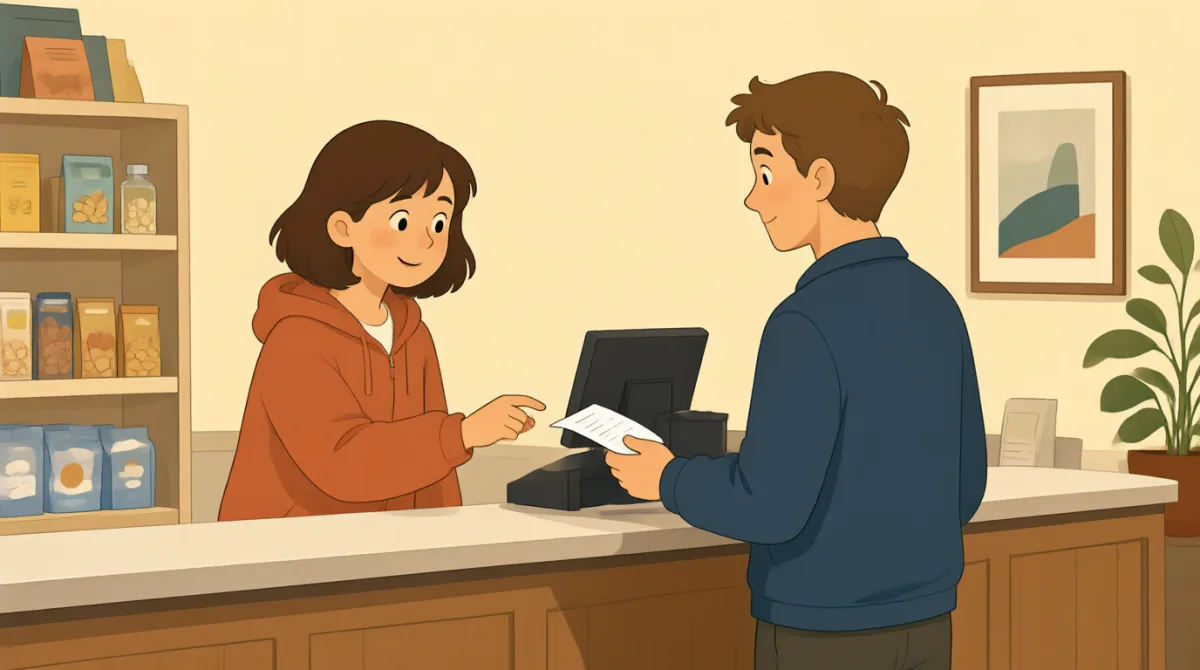

Hi. I'd like to pay for these, please.
Bonjour. Je voudrais payer ces articles, s’il vous plaît.

Sure. Do you need a bag?
Bien sûr. Vous avez besoin d’un sac ?
Yes, please. How much is it?
Oui, s’il vous plaît. Ça coûte combien ?
The bag is ten cents. Your total is five dollars.
Le sac coûte dix cents. Le total est de cinq dollars.
Here you go. I'm paying with cash.
Tenez. Je paie en espèces.
Thanks. Here's your change and receipt.
Merci. Voici votre monnaie et votre ticket de caisse.
Thank you. Have a nice day!
Merci. Bonne journée !
Vocabulaire8
- pay for thesepayer ces articles
This means to give money for the items you want to buy. Use it when you are ready to pay.
Cela veut dire donner de l’argent pour les articles que vous voulez acheter. Utilisez cette expression quand vous êtes prêt à payer.
- Do you need a bag?Vous avez besoin d’un sac ?
This is a polite way to ask if someone wants a bag. You can ask this when shopping.
C’est une façon polie de demander à quelqu’un s’il veut un sac. Vous pouvez poser cette question quand vous faites des achats.
- How much is it?Ça coûte combien ?
Use this question to ask the price of one item.
Utilisez cette question pour demander le prix d’un article.
- ten centsdix cents
This is a way to say the price is $0.10. You can use it when talking about a small amount of money.
Cette expression indique que le prix est de 0,10 $. Vous pouvez l’utiliser pour parler d’une petite somme d’argent.
- Your totalLe total
This is the full price for all the items together. You can use it when telling someone how much they need to pay.
C’est le prix de tous les articles réunis. Vous pouvez utiliser cette expression pour indiquer à quelqu’un combien il doit payer.
- cashespèces
Cash means money in bills or coins. You can say you are paying with cash at a store.
Les espèces, c’est de l’argent en billets ou en pièces. Dans un magasin, vous pouvez dire que vous payez en espèces.
- changemonnaie
Change is the money you get back when you pay more than the price. You may receive change at the counter.
La monnaie, c’est l’argent qu’on vous rend quand vous payez plus que le prix demandé. Vous pouvez recevoir de la monnaie à la caisse.
- receiptticket de caisse
A receipt is a paper that shows what you bought and how much you paid. Keep it after you shop.
Un ticket de caisse est un document qui indique ce que vous avez acheté et combien vous avez payé. Gardez-le après vos achats.
Phrases clés8
- 1
I'd like to pay for these, please.
Je voudrais payer ces articles, s’il vous plaît.
Use this polite sentence when you are ready to pay for your items. You can point to the items or put them on the counter.
Utilisez cette phrase polie quand vous êtes prêt à payer vos articles. Vous pouvez les montrer du doigt ou les poser sur le comptoir.
- 2
Do you need a bag?
Vous avez besoin d’un sac ?
Use this question to ask if someone wants a bag. You can replace “a bag” with another item you can offer.
Utilisez cette question pour demander à quelqu’un s’il veut un sac. Vous pouvez remplacer “a bag” par un autre article que vous pouvez proposer.
- 3
How much is it?
Ça coûte combien ?
Use this sentence to ask the price of one item. For more than one item, you can say, “How much are they?”
Utilisez cette phrase pour demander le prix d’un seul article. Pour plusieurs articles, vous pouvez dire “How much are they?”.
- 4
The bag is ten cents.
Le sac coûte dix cents.
Use this sentence to tell someone the price of a bag. You can replace “ten cents” with another price.
Utilisez cette phrase pour indiquer le prix d’un sac. Vous pouvez remplacer “ten cents” par un autre prix.
- 5
Your total is five dollars.
Le total est de cinq dollars.
Use this sentence to tell someone the full price. You can replace “five dollars” with the correct amount.
Utilisez cette phrase pour indiquer le prix total à quelqu’un. Vous pouvez remplacer “five dollars” par le montant exact.
- 6
I'm paying with cash.
Je paie en espèces.
Use this sentence to say how you are paying. You can replace “cash” with “a card” when paying by card.
Utilisez cette phrase pour dire comment vous payez. Si vous payez par carte, vous pouvez remplacer “cash” par “a card”.
- 7
Here's your change and receipt.
Voici votre monnaie et votre ticket de caisse.
Use this sentence when giving someone their change and receipt. You can replace “change and receipt” with another item you are handing them.
Utilisez cette phrase quand vous rendez sa monnaie à quelqu’un et lui donnez son ticket de caisse. Vous pouvez remplacer “change and receipt” par un autre article que vous lui remettez.
- 8
Have a nice day!
Bonne journée !
This is a friendly way to say goodbye. You can use it with store workers or other people after a short conversation.
C’est une façon amicale de dire au revoir. Vous pouvez l’utiliser avec le personnel d’un magasin ou d’autres personnes après une courte conversation.