Asking How She Feels
Preguntar cómo se siente
Emma asks Mia how she feels today. Mia says she is still tired but feels a little better.
Emma le pregunta a Mia cómo se siente hoy. Mia dice que todavía está cansada, pero que se siente un poco mejor.
Diálogo6
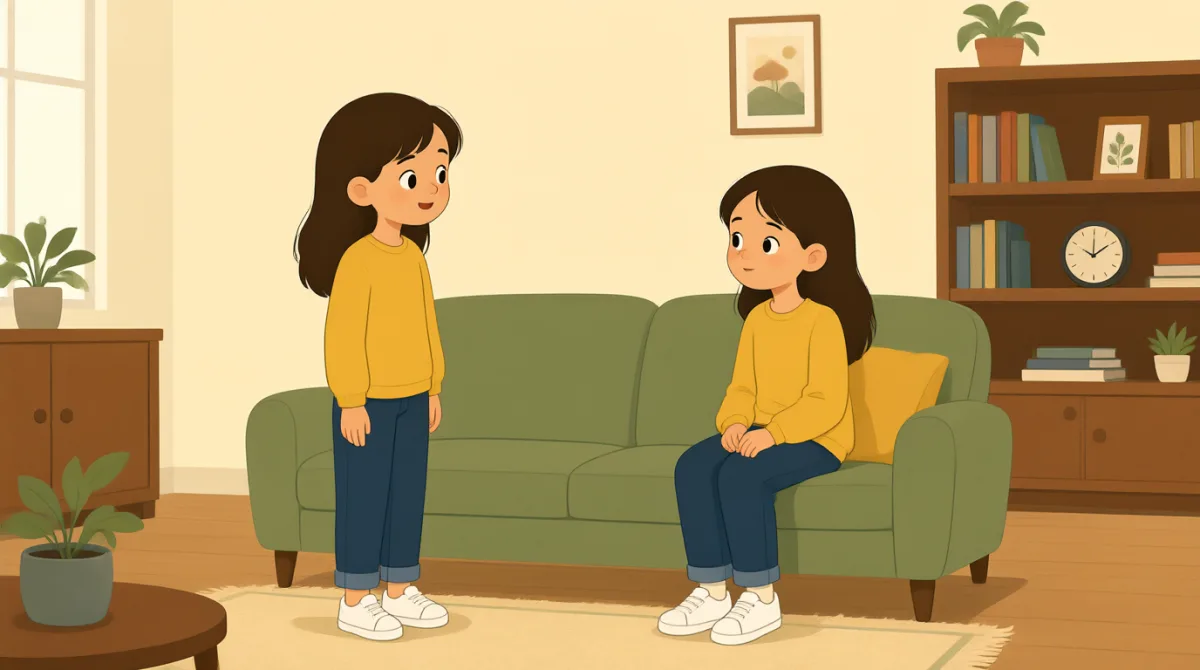

How do you feel today, Mia?
¿Cómo te sientes hoy, Mia?

I'm still tired, but a little better.
Todavía estoy cansada, pero un poco mejor.
I'm glad you're feeling a little better.
Me alegra que te sientas un poco mejor.
Thank you. I slept well last night.
Gracias. Anoche dormí bien.
Do you still have a fever?
¿Todavía tienes fiebre?
No, I don't. I just feel tired.
No. Solo me siento cansada.
Vocabulario8
- How do you feel today?¿Cómo te sientes hoy?
Ask this to find out how someone feels now. You can use it when greeting a friend who is sick.
Haz esta pregunta para saber cómo se siente alguien en este momento. Puedes usarla al saludar a una amiga que está enferma.
- still tiredtodavía cansada
This means the person continues to feel tired. Use “still” when something has not changed.
Esto significa que la persona sigue sintiéndose cansada. Usa “still” cuando algo no ha cambiado.
- a little betterun poco mejor
This means someone feels better, but not completely well. Use it to describe a small improvement.
Esto significa que alguien se siente mejor, pero todavía no está del todo bien. Úsalo para describir una pequeña mejoría.
- I'm gladme alegra
Say this when you are happy about something. Here, Emma is happy that Mia feels better.
Di esto cuando algo te hace feliz. En este caso, a Emma le alegra que Mia se sienta mejor.
- slept welldormí bien
This means someone had good sleep. You can say it when you feel rested after a night of sleep.
Esto significa que alguien durmió bien. Puedes decirlo cuando te sientes descansado después de dormir toda la noche.
- last nightanoche
This means the night before today. Use it to talk about something that happened then.
Esto significa la noche anterior a hoy. Úsalo para hablar de algo que ocurrió entonces.
- have a fevertener fiebre
This means your body temperature is high because you are sick. You can ask, “Do you have a fever?”
Esto significa que tienes la temperatura corporal alta porque estás enfermo. Puedes preguntar: “Do you have a fever?” (¿Tienes fiebre?).
- I just feel tired.Solo me siento cansada.
This means tiredness is the only problem the person has. Use “just” to show that there is nothing else.
Esto significa que el cansancio es el único problema que tiene la persona. Usa “just” para indicar que no hay nada más.
Frases clave8
- 1
How do you feel today, Mia?
¿Cómo te sientes hoy, Mia?
Use this to ask someone about their health or feelings today. You can change the name or leave it out.
Usa esta frase para preguntarle a alguien por su salud o cómo se siente hoy. Puedes cambiar el nombre o dejarlo fuera.
- 2
I'm still tired, but a little better.
Todavía estoy cansada, pero un poco mejor.
This is a simple way to say you are not fully well but are improving. You can use “I'm still [feeling], but a little better.”
Esta es una forma sencilla de decir que aún no estás del todo bien, pero estás mejorando. Puedes usar “I'm still [feeling], but a little better.” (Todavía me siento [de cierta manera], pero estoy un poco mejor).
- 3
I'm glad you're feeling a little better.
Me alegra que te sientas un poco mejor.
Use this to show that you are happy someone is improving. Change “a little better” to share what you are glad about.
Usa esta frase para mostrar que te alegra que alguien esté mejorando. Cambia “a little better” por aquello que te alegra.
- 4
Thank you.
Gracias.
Use this to respond politely when someone says something kind. It works in many everyday situations.
Usa esta frase para responder con amabilidad cuando alguien te dice algo bonito. Sirve en muchas situaciones cotidianas.
- 5
I slept well last night.
Anoche dormí bien.
Use this to say you had good sleep the night before. You can change “well” to describe how you slept.
Usa esta frase para decir que dormiste bien la noche anterior. Puedes cambiar “well” para describir cómo dormiste.
- 6
Do you still have a fever?
¿Todavía tienes fiebre?
Use this to ask whether someone continues to have a fever. Change “a fever” to ask about another symptom.
Usa esta frase para preguntar si alguien sigue teniendo fiebre. Cambia “a fever” por otro síntoma para preguntar por él.
- 7
No, I don't.
No.
This is a short answer to a question that starts with “Do you...?” You can replace “No” with “Yes” when needed.
Esta es una respuesta breve a una pregunta que empieza con “Do you...?” Puedes cambiar “No” por “Yes” cuando corresponda.
- 8
I just feel tired.
Solo me siento cansada.
Use this to explain that tiredness is your only symptom. Replace “tired” with another feeling or symptom.
Usa esta frase para explicar que el cansancio es tu único síntoma. Sustituye “tired” por otro estado de ánimo o síntoma.