Saying Where You Live
Sagen, wo man wohnt
Emma meets her new neighbor, Mia, and says where she lives. They talk about the area.
Emma trifft ihre neue Nachbarin Mia und erzählt ihr, wo sie wohnt. Sie sprechen über die Gegend.
Dialog8
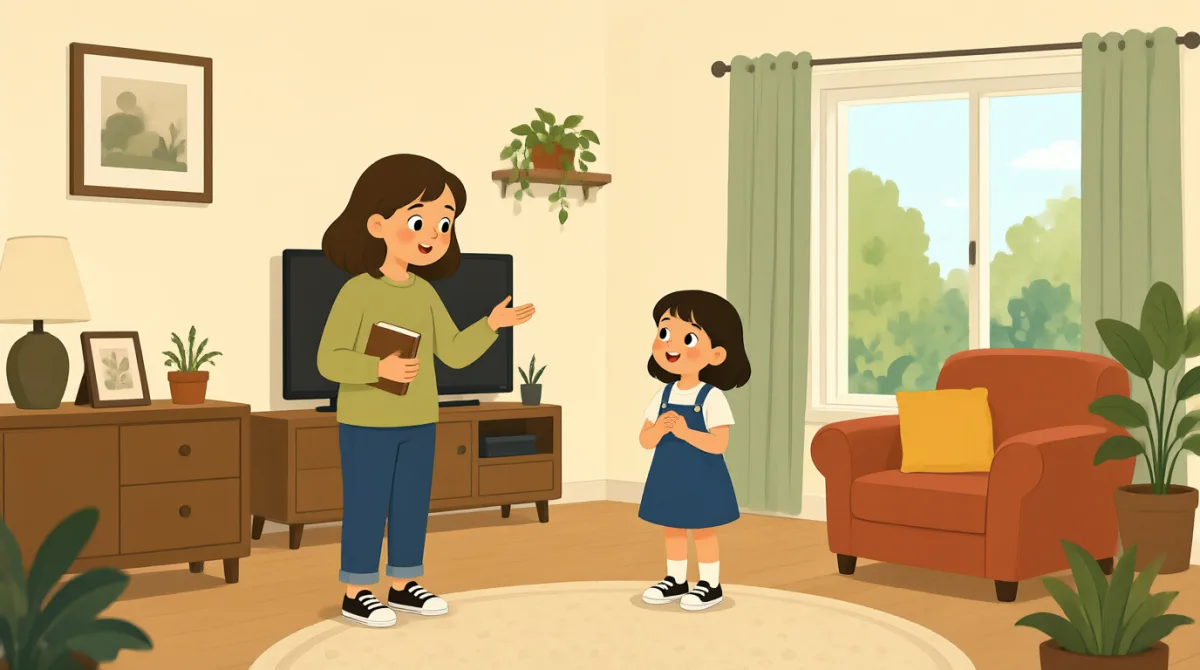

Hi, I’m Emma. I live in apartment two.
Hallo, ich bin Emma. Ich wohne in Wohnung zwei.

Hi, Emma. I’m Mia, your new neighbor.
Hallo, Emma. Ich bin Mia, deine neue Nachbarin.
Nice to meet you. Do you live here, too?
Schön, dich kennenzulernen. Wohnst du auch hier?
Yes. I live on the third floor.
Ja. Ich wohne im dritten Stock.
This is a nice area. It’s quiet and clean.
Das ist eine schöne Gegend. Sie ist ruhig und sauber.
Yes, and there’s a small park nearby.
Ja, und ganz in der Nähe gibt es einen kleinen Park.
That’s great! I like walking in the park.
Wie schön! Ich gehe gern im Park spazieren.
Me too. Welcome to the neighborhood, Emma!
Willkommen in der Nachbarschaft, Emma!
Wortschatz8
- neighborNachbarin
A neighbor is a person who lives near you. Mia is Emma’s new neighbor.
Eine Nachbarin ist eine Person, die in deiner Nähe wohnt. Mia ist Emmas neue Nachbarin.
- apartmentWohnung
An apartment is a home in a larger building. You can say which apartment you live in.
Eine Wohnung ist ein Zuhause in einem größeren Gebäude. Du kannst sagen, in welcher Wohnung du wohnst.
- third floordritter Stock
The third floor is the level above the second floor. Use this phrase to say where you live in a building.
Der dritte Stock ist die Etage über dem zweiten Stock. Mit diesem Ausdruck kannst du sagen, wo in einem Gebäude du wohnst.
- areaGegend
An area is a part of a town or city. You can use this word to talk about the place where you live.
Eine Gegend ist ein Teil einer Stadt oder eines Ortes. Mit diesem Wort kannst du über den Ort sprechen, an dem du wohnst.
- quietruhig
Quiet means there is not much noise. Use it to describe a peaceful place.
„Ruhig“ bedeutet, dass es nicht viel Lärm gibt. Damit kannst du einen friedlichen Ort beschreiben.
- cleansauber
Clean means not dirty. You can use it to describe a home or neighborhood.
„Sauber“ bedeutet, dass etwas nicht schmutzig ist. Damit kannst du ein Zuhause oder eine Nachbarschaft beschreiben.
- nearbyin der Nähe
Nearby means close to a place. Use it to say that something is not far away.
„In der Nähe“ bedeutet, dass etwas nicht weit entfernt ist. Mit diesem Ausdruck kannst du sagen, dass etwas ganz nah ist.
- neighborhoodNachbarschaft
A neighborhood is the area around your home. Use this word when talking about where you live.
Eine Nachbarschaft ist die Gegend rund um dein Zuhause. Verwende dieses Wort, wenn du darüber sprichst, wo du wohnst.
Wichtige Sätze8
- 1
I live in apartment two.
Ich wohne in Wohnung zwei.
This is a simple way to say which apartment is your home. You can replace “apartment two” with your apartment number.
So kannst du einfach sagen, in welcher Wohnung du wohnst. Du kannst „apartment two“ durch deine Wohnungsnummer ersetzen.
- 2
Do you live here, too?
Wohnst du auch hier?
Use this question to ask if someone lives in the same building or place. You can change “here” to a place name.
Mit dieser Frage fragst du, ob jemand im selben Gebäude oder am selben Ort wohnt. Du kannst „here“ durch den Namen eines Ortes ersetzen.
- 3
I live on the third floor.
Ich wohne im dritten Stock.
This sentence tells someone which floor your home is on. Replace “the third floor” with another floor.
Mit diesem Satz sagst du, in welchem Stockwerk deine Wohnung ist. Ersetze „the third floor“ durch ein anderes Stockwerk.
- 4
This is a nice area.
Das ist eine schöne Gegend.
Use this sentence to say that you like the place around your home. You can replace “nice” with another simple description.
Mit diesem Satz sagst du, dass dir die Gegend gefällt, in der du wohnst. Du kannst „nice“ durch eine andere einfache Beschreibung ersetzen.
- 5
It’s quiet and clean.
Sie ist ruhig und sauber.
This sentence gives two simple details about a place. You can use “It’s” with other words to describe your home or area.
Mit diesem Satz gibst du zwei einfache Beschreibungen eines Ortes. Du kannst „It’s“ mit anderen Wörtern verwenden, um dein Zuhause oder deine Gegend zu beschreiben.
- 6
There’s a small park nearby.
In der Nähe gibt es einen kleinen Park.
Use “There’s” to say that something is in the area. Replace “a small park” with another place or thing.
Verwende „There’s“, um zu sagen, dass es etwas in der Gegend gibt. Ersetze „a small park“ durch einen anderen Ort oder eine andere Sache.
- 7
I like walking in the park.
Ich gehe gern im Park spazieren.
This sentence tells someone what activity you enjoy. You can replace “walking” with another activity.
Mit diesem Satz sagst du jemandem, welche Aktivität dir Spaß macht. Du kannst „walking“ durch eine andere Aktivität ersetzen.
- 8
Welcome to the neighborhood, Emma!
Willkommen in der Nachbarschaft, Emma!
Use this friendly phrase to greet someone who has moved into your area. You can say the person’s name at the end.
Mit diesem freundlichen Ausdruck begrüßt du jemanden, der in deine Gegend gezogen ist. Den Namen der Person kannst du ans Ende setzen.