Finding Your Seat
Unseren Sitzplatz finden
Emma and Jack enter the theater and look for their seats. They check their tickets for the row and seat numbers.
Emma und Jack betreten den Kinosaal und suchen ihre Plätze. Sie schauen auf ihren Tickets nach Reihe und Sitzplatznummer.
Dialog7
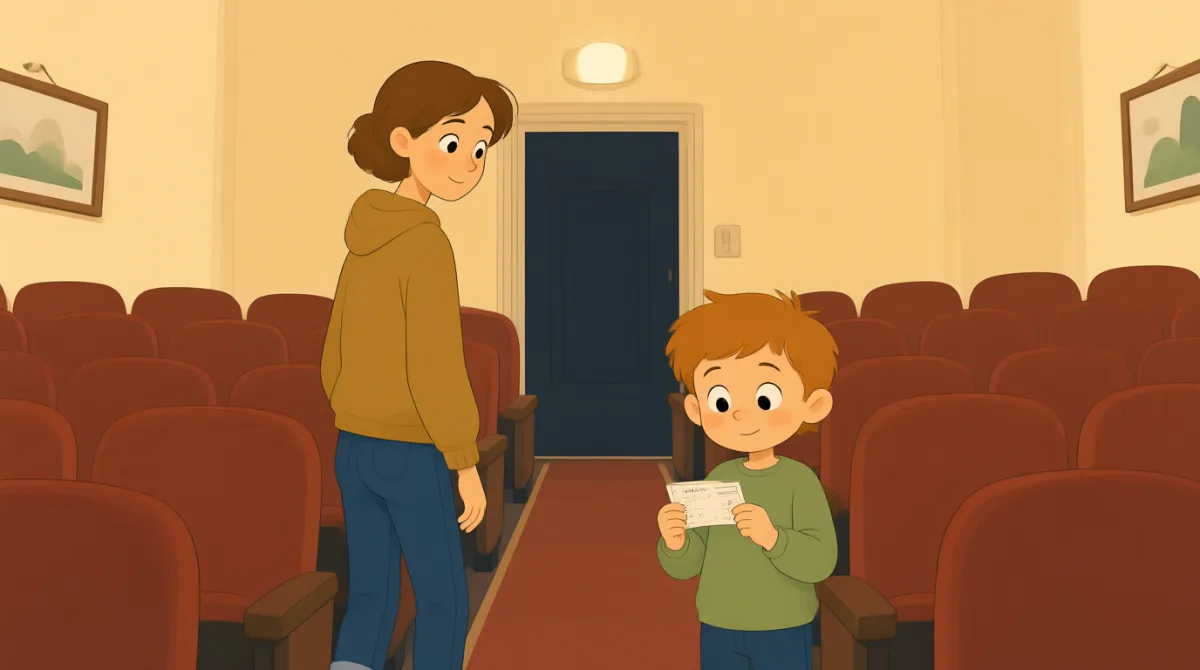

Our seats are in row B. Where is it?
Unsere Plätze sind in Reihe B. Wo ist die?

Let me check your tickets. Row B is over there.
Ich schau mal auf eure Tickets. Reihe B ist da drüben.
I see it. Are our seats numbers five and six?
Ich seh sie. Sind unsere Plätze die Nummern fünf und sechs?
Yes. Five is yours, and six is mine.
Ja. Die Fünf ist deiner, und die Sechs ist meiner.
Great! Can I sit here with my popcorn?
Super! Kann ich hier mit meinem Popcorn sitzen?
Sure. Keep your drink in the cup holder.
Klar. Stell dein Getränk in den Getränkehalter.
Thanks! I’m ready for the movie.
Danke! Ich bin bereit für den Film.
Wortschatz6
- row BReihe B
This means the theater row marked with the letter B. Use “row” with a letter or number to describe where seats are.
Damit ist die Kinoreihe gemeint, die mit dem Buchstaben B gekennzeichnet ist. Mit „row“ und einem Buchstaben oder einer Zahl beschreibst du, wo die Sitzplätze sind.
- Let me check your tickets.Ich schau mal auf eure Tickets.
Jack says he will look at the tickets to find the seat information. Use “Let me check” when you want to look at something.
Jack sagt, dass er auf die Tickets schauen will, um die Sitzplatzinformationen zu finden. „Let me check“ (Ich schau mal nach) kannst du sagen, wenn du dir etwas ansehen möchtest.
- over thereda drüben
This means in that place, away from the speaker. Use it to point out where something is.
Das bedeutet, an einem Ort dort, der weiter vom Sprecher entfernt ist. Damit kannst du zeigen, wo sich etwas befindet.
- Can I sit here?Kann ich hier sitzen?
Emma asks politely if she can sit in a place. Use “Can I” to ask for permission.
Emma fragt höflich, ob sie an einem bestimmten Platz sitzen darf. Mit „Can I“ fragst du um Erlaubnis.
- cup holderGetränkehalter
This is the place beside a theater seat where you can put a drink. You can say, “Put your drink in the cup holder.”
Das ist die Ablage neben einem Kinositz, in die du ein Getränk stellen kannst. Du kannst sagen: „Put your drink in the cup holder.“ (Stell dein Getränk in den Getränkehalter.)
- I’m ready for the movie.Ich bin bereit für den Film.
Emma says she is prepared to watch the movie. Use “I’m ready for” before an activity or event.
Emma sagt, dass sie bereit ist, den Film anzuschauen. Vor einer Aktivität oder einem Ereignis kannst du „I’m ready for“ (Ich bin bereit für) verwenden.
Wichtige Sätze8
- 1
Our seats are in row B.
Unsere Plätze sind in Reihe B.
This tells someone which row your seats are in. You can change the letter to give your own row, such as “Our seats are in row C.”
Damit sagst du jemandem, in welcher Reihe eure Plätze sind. Du kannst den Buchstaben ändern, zum Beispiel: „Our seats are in row C.“ (Unsere Plätze sind in Reihe C.)
- 2
Where is it?
Wo ist die?
This is a simple way to ask where something is. Use it when you are looking for a place or thing you have just mentioned.
So kannst du ganz einfach fragen, wo sich etwas befindet. Verwende den Satz, wenn du nach einem Ort oder einer Sache suchst, die du gerade erwähnt hast.
- 3
Let me check your tickets.
Ich schau mal auf eure Tickets.
This is useful when you want to look at tickets for information. You can also say, “Let me check the time” or “Let me check the address.”
Das ist nützlich, wenn du auf Tickets nach Informationen schauen möchtest. Du kannst auch sagen: „Let me check the time“ (Ich schau mal nach der Uhrzeit) oder „Let me check the address“ (Ich schau mal nach der Adresse).
- 4
Row B is over there.
Reihe B ist da drüben.
This sentence points out where a row is. You can replace “Row B” with another place, such as “The entrance is over there.”
Mit diesem Satz zeigst du, wo sich eine Reihe befindet. Du kannst „Row B“ durch einen anderen Ort ersetzen, zum Beispiel: „The entrance is over there.“ (Der Eingang ist da drüben.)
- 5
Are our seats numbers five and six?
Sind unsere Plätze die Nummern fünf und sechs?
This is a yes-or-no question to check seat numbers. Use “Are our seats numbers…” and add the two numbers you want to confirm.
Mit dieser Ja-oder-Nein-Frage überprüfst du die Sitzplatznummern. Verwende „Are our seats numbers…“ und ergänze die beiden Nummern, die du bestätigen möchtest.
- 6
Five is yours, and six is mine.
Die Fünf ist deiner, und die Sechs ist meiner.
This sentence tells two people which seats belong to them. Use “yours” and “mine” to show who owns or uses something.
Mit diesem Satz sagst du zwei Personen, welche Plätze ihnen gehören. Mit „yours“ und „mine“ zeigst du, wem etwas gehört oder wer etwas benutzt.
- 7
Keep your drink in the cup holder.
Stell dein Getränk in den Getränkehalter.
This is a simple instruction for where to put a drink. You can use “Keep your [thing] in the [place]” for other items and locations.
Das ist eine einfache Anweisung, wo man ein Getränk hinstellen soll. Für andere Dinge und Orte kannst du „Keep your [thing] in the [place]“ (Lass deine [Sache] in dem [Ort]) verwenden.
- 8
I’m ready for the movie.
Ich bin bereit für den Film.
This is a natural way to say you are prepared for an event. You can also say, “I’m ready for class” or “I’m ready for dinner.”
So sagst du ganz natürlich, dass du für ein Ereignis bereit bist. Du kannst auch sagen: „I’m ready for class“ (Ich bin bereit für den Unterricht) oder „I’m ready for dinner“ (Ich bin bereit fürs Abendessen).