Asking About Class Times
Nach den Unterrichtszeiten fragen
Emma asks when the class meets. Grace explains the days and times, and Emma checks that she understands.
Emma fragt, an welchen Tagen der Unterricht stattfindet. Grace erklärt die Tage und Uhrzeiten, und Emma vergewissert sich, dass sie alles richtig verstanden hat.
Dialog8
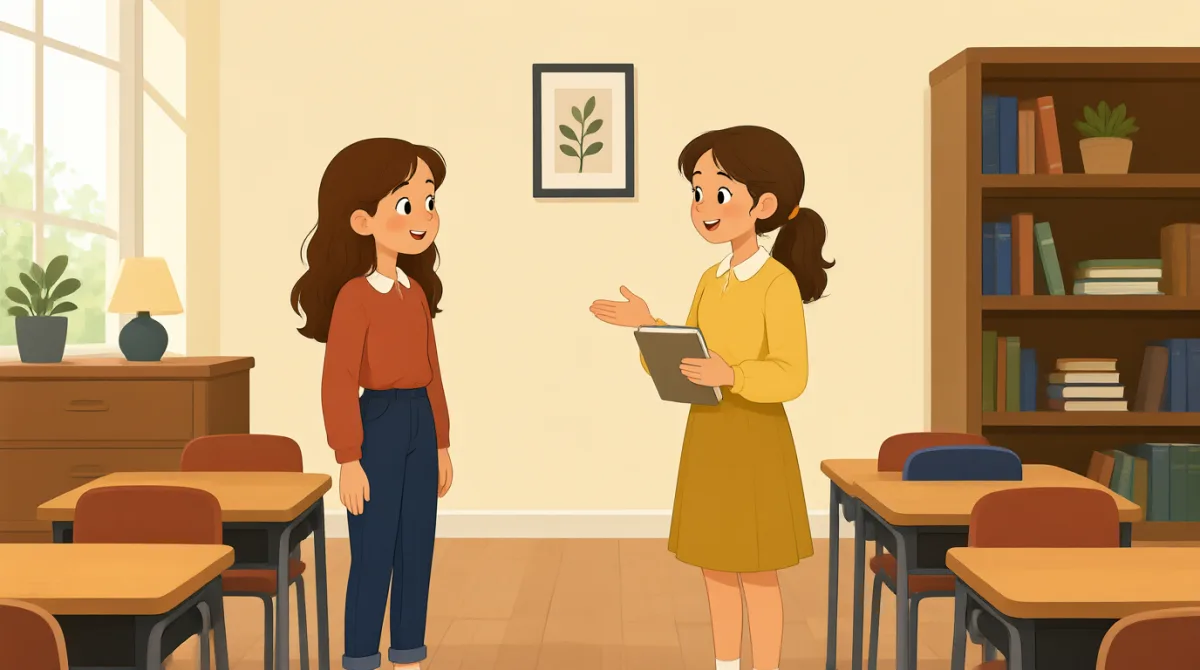

What days do we have class?
An welchen Tagen haben wir Unterricht?

We meet on Mondays and Wednesdays.
Wir haben montags und mittwochs Unterricht.
What time does class start?
Wann beginnt der Unterricht?
It starts at six in the evening.
Er beginnt um sechs Uhr abends.
And when does it end?
Und wann ist er zu Ende?
It ends at seven thirty.
Er endet um halb acht.
Mondays and Wednesdays, six to seven thirty. Right?
Montags und mittwochs, von sechs bis halb acht. Stimmt’s?
That’s right. See you in class!
Genau. Wir sehen uns im Unterricht!
Wortschatz8
- What daysWhat days: an welchen Tagen
Use this phrase to ask which days something happens. Here, Emma asks about the class schedule.
Mit dieser Wendung fragst du, an welchen Tagen etwas stattfindet. Hier fragt Emma nach dem Stundenplan.
- have classhave class: Unterricht haben
This means to take part in a class. You can say, “We have class on Friday.”
Das bedeutet, an einem Unterricht teilzunehmen. Du kannst zum Beispiel sagen: „We have class on Friday.“ (Wir haben am Freitag Unterricht.)
- meetmeet: sich treffen
Here, “meet” means to get together for class. You can say, “We meet on Tuesdays.”
Hier bedeutet „meet“, dass man zum Unterricht zusammenkommt. Du kannst zum Beispiel sagen: „We meet on Tuesdays.“ (Wir treffen uns dienstags.)
- on Mondays and Wednesdayson Mondays and Wednesdays: montags und mittwochs
This tells someone which days an event happens. Replace the days to talk about a different schedule.
Damit sagst du, an welchen Tagen etwas stattfindet. Ersetze die Tage, wenn du über einen anderen Stundenplan sprichst.
- What timeWhat time: um wie viel Uhr
Use this phrase to ask about a specific time. You can say, “What time does the movie start?”
Mit dieser Wendung fragst du nach einer genauen Uhrzeit. Du kannst zum Beispiel sagen: „What time does the movie start?“ (Um wie viel Uhr beginnt der Film?)
- in the eveningin the evening: abends
This means the later part of the day, after the afternoon. You can use it to say when something happens.
Das bedeutet am späteren Teil des Tages, nach dem Nachmittag. Du kannst damit sagen, wann etwas stattfindet.
- endsends: endet
This means finishes. You can ask, “When does the meeting end?”
Das bedeutet, dass etwas zu Ende geht. Du kannst fragen: „When does the meeting end?“ (Wann endet das Treffen?)
- That’s right.That’s right.: Genau. / Das stimmt.
Use this to confirm that something is correct. It is a short, natural reply.
Damit bestätigst du, dass etwas richtig ist. Das ist eine kurze, natürliche Antwort.
Wichtige Sätze8
- 1
What days do we have class?
An welchen Tagen haben wir Unterricht?
Use this to ask which days a class meets. You can replace “class” with another activity, such as “What days do we have practice?”
Mit „What days do we have class?“ fragst du, an welchen Tagen der Unterricht stattfindet. Du kannst „class“ durch eine andere Aktivität ersetzen, zum Beispiel: „What days do we have practice?“ (An welchen Tagen haben wir Training?)
- 2
We meet on Mondays and Wednesdays.
Wir haben montags und mittwochs Unterricht.
This gives the days when people get together. Replace the days with the correct ones for your schedule.
Mit „We meet on Mondays and Wednesdays.“ sagst du, an welchen Tagen sich Leute treffen. Ersetze die Tage durch die passenden für deinen Stundenplan.
- 3
What time does class start?
Wann beginnt der Unterricht?
Use this to ask when a class or event begins. You can replace “class” with another event, such as “What time does the movie start?”
Mit „What time does class start?“ fragst du, wann ein Unterricht oder eine Veranstaltung beginnt. Du kannst „class“ durch eine andere Veranstaltung ersetzen, zum Beispiel: „What time does the movie start?“ (Um wie viel Uhr beginnt der Film?)
- 4
It starts at six in the evening.
Er beginnt um sechs Uhr abends.
This tells someone the start time. Replace “six” with another time to give a different answer.
Mit „It starts at six in the evening.“ nennst du die Anfangszeit. Ersetze „six“ durch eine andere Uhrzeit, wenn du eine andere Antwort geben möchtest.
- 5
And when does it end?
Und wann ist er zu Ende?
Use this to ask when something finishes. “It” refers to the class or event you were just talking about.
Mit „And when does it end?“ fragst du, wann etwas aufhört. „It“ bezieht sich auf den Unterricht oder die Veranstaltung, über die ihr gerade gesprochen habt.
- 6
It ends at seven thirty.
Er endet um halb acht.
This gives the finish time. You can use the same pattern to say when a meeting, lesson, or event ends.
Mit „It ends at seven thirty.“ nennst du die Endzeit. Du kannst dasselbe Muster verwenden, um zu sagen, wann ein Treffen, eine Unterrichtsstunde oder eine Veranstaltung endet.
- 7
Mondays and Wednesdays, six to seven thirty. Right?
Montags und mittwochs, von sechs bis halb acht. Stimmt’s?
Use this to repeat the days and times and check that you understood correctly. You can repeat any schedule and add “Right?” to confirm it.
Mit „Mondays and Wednesdays, six to seven thirty. Right?“ wiederholst du die Tage und Uhrzeiten und prüfst, ob du alles richtig verstanden hast. Du kannst jeden Stundenplan wiederholen und „Right?“ anhängen, um dich zu vergewissern.
- 8
That’s right.
Genau.
Use this simple sentence to confirm that someone has understood correctly. It works well after a question such as “Right?”.
Mit „That’s right.“ bestätigst du kurz, dass jemand dich richtig verstanden hat. Die Wendung passt gut als Antwort auf eine Frage wie „Right?“.