Asking Where the Paint Is
Pytanie, gdzie jest farba
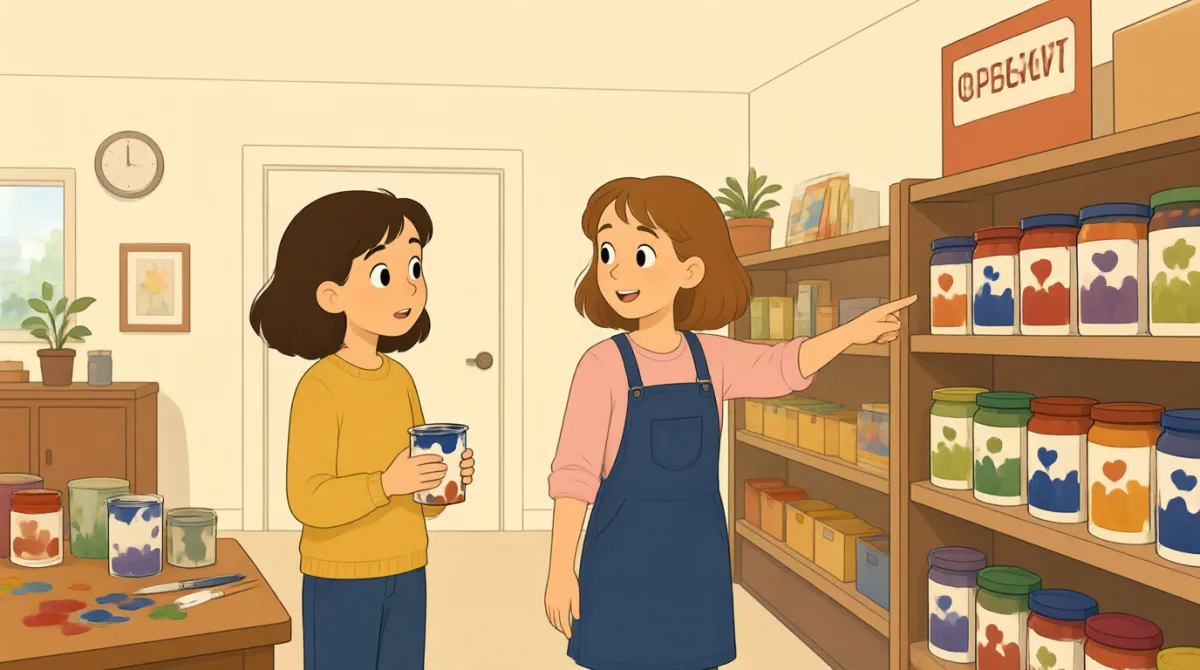
Emma asks Grace where the paint is. Grace points her to the paint section.
Emma pyta Grace, gdzie jest farba. Grace wskazuje jej dział z farbami.
Dialog7

Excuse me, where is the paint?
Przepraszam, gdzie jest farba?

It’s in aisle six, near the brushes.
W alejce szóstej, niedaleko pędzli.
Thanks. Is it easy to find?
Dziękuję. Łatwo ją znaleźć?
Yes. Look for the big paint cans.
Tak. Szukaj dużych puszek z farbą.
I need a small can, please.
Poproszę małą puszkę.
Small cans are on the lower shelf.
Małe puszki są na niższej półce.
Great, thank you for your help!
Świetnie, dziękuję za pomoc!
Słownictwo8
- Excuse mePrzepraszam
A polite way to get someone's attention before asking a question.
Uprzejmy sposób na zwrócenie czyjejś uwagi przed zadaniem pytania.
- where is the paint?gdzie jest farba?
Use this question to ask where something is in a store.
Tego pytania używa się, by zapytać, gdzie coś znajduje się w sklepie.
- aisle sixalejka szósta
An aisle is a passage between shelves. You can use this phrase to say where something is.
Alejka to przejście między półkami. Tego wyrażenia możesz użyć, by powiedzieć, gdzie coś się znajduje.
- near the brushesniedaleko pędzli
This tells someone that something is close to the brushes.
To informuje kogoś, że dana rzecz znajduje się blisko pędzli.
- easy to findłatwo znaleźć
Use this phrase to ask if something is simple to locate.
Tego wyrażenia używa się, by zapytać, czy łatwo coś zlokalizować.
- paint canspuszki z farbą
These are containers that hold paint. You can use this phrase to ask for or describe paint in a store.
To pojemniki na farbę. Tego wyrażenia możesz użyć, prosząc o farbę w sklepie lub ją opisując.
- lower shelfniższa półka
This means a shelf that is low down. Use it to describe where an item is.
Chodzi o półkę położoną nisko. Użyj tego wyrażenia, by opisać, gdzie znajduje się jakiś produkt.
- thank you for your helpdziękuję za pomoc
A polite way to thank someone after they help you.
Uprzejmy sposób, by podziękować komuś za pomoc.
Kluczowe zdania7
- 1
Excuse me, where is the paint?
Przepraszam, gdzie jest farba?
Use this polite question to ask where an item is. Replace “the paint” with another item, such as “the soap.”
Użyj tego uprzejmego pytania, by zapytać, gdzie znajduje się jakiś produkt. Zastąp “the paint” innym produktem, na przykład “the soap.”
- 2
It’s in aisle six, near the brushes.
Jest w alejce szóstej, niedaleko pędzli.
Use this sentence to tell someone where an item is. Replace “aisle six” and “the brushes” with the location and nearby items.
Użyj tego zdania, by powiedzieć komuś, gdzie znajduje się jakiś produkt. Zastąp “aisle six” i “the brushes” nazwą lokalizacji i pobliskich produktów.
- 3
Is it easy to find?
Łatwo to znaleźć?
Use this question to ask if something is simple to locate. Replace “it” with the item you are looking for.
Użyj tego pytania, by zapytać, czy łatwo coś zlokalizować. Zastąp “it” nazwą produktu, którego szukasz.
- 4
Yes. Look for the big paint cans.
Tak. Szukaj dużych puszek z farbą.
Use “Look for…” to tell someone what to search for. Replace “the big paint cans” with a helpful sign or item.
Użyj “Look for…”, by powiedzieć komuś, czego ma szukać. Zastąp “the big paint cans” przydatnym oznaczeniem lub produktem.
- 5
I need a small can, please.
Poproszę małą puszkę.
Use this sentence to ask for a particular size or type of item. Replace “a small can” with what you need.
Użyj tego zdania, by poprosić o produkt o określonym rozmiarze lub rodzaju. Zastąp “a small can” tym, czego potrzebujesz.
- 6
Small cans are on the lower shelf.
Małe puszki są na niższej półce.
Use this sentence to say where items are. Replace “Small cans” and “the lower shelf” with the item and its location.
Użyj tego zdania, by powiedzieć, gdzie znajdują się produkty. Zastąp “Small cans” i “the lower shelf” nazwą produktu i jego lokalizacją.
- 7
Great, thank you for your help!
Świetnie, dziękuję za pomoc!
Use this friendly sentence to thank someone who has helped you.
Użyj tego przyjaznego zdania, by podziękować komuś, kto ci pomógł.