Asking Where the Paint Is
Emma asks Grace where the paint is. Grace points her to the paint section.
Dialogue7
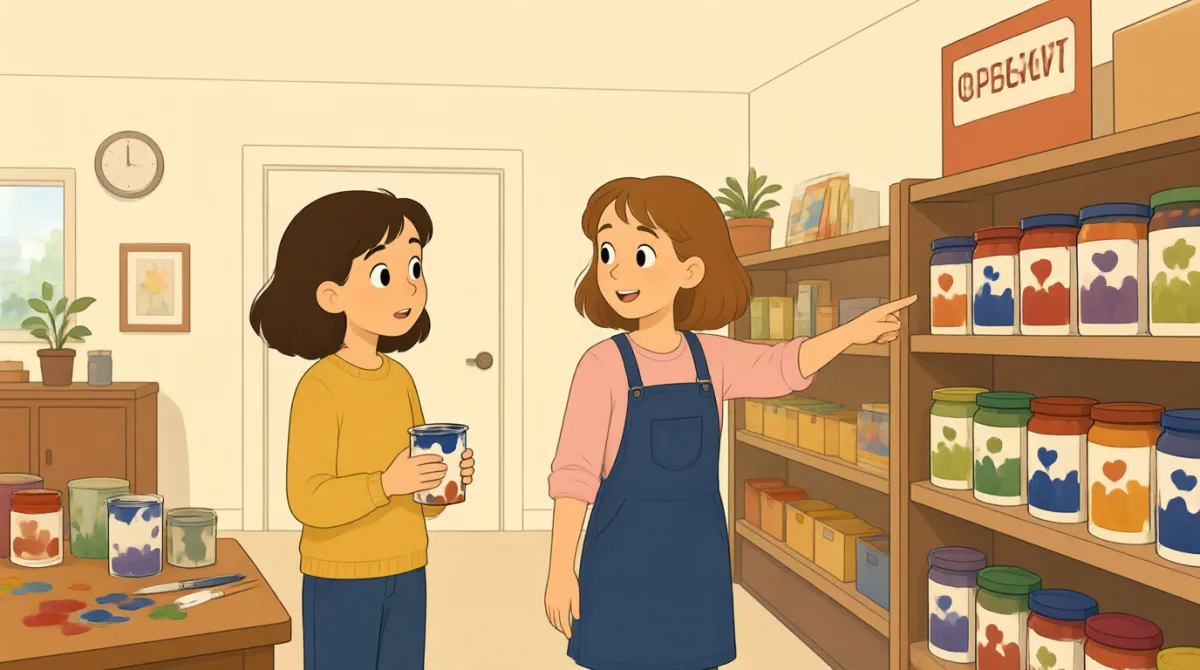

Excuse me, where is the paint?

It’s in aisle six, near the brushes.
Thanks. Is it easy to find?
Yes. Look for the big paint cans.
I need a small can, please.
Small cans are on the lower shelf.
Great, thank you for your help!
Vocabulary8
- Excuse me
A polite way to get someone's attention before asking a question.
- where is the paint?
Use this question to ask where something is in a store.
- aisle six
An aisle is a passage between shelves. You can use this phrase to say where something is.
- near the brushes
This tells someone that something is close to the brushes.
- easy to find
Use this phrase to ask if something is simple to locate.
- paint cans
These are containers that hold paint. You can use this phrase to ask for or describe paint in a store.
- lower shelf
This means a shelf that is low down. Use it to describe where an item is.
- thank you for your help
A polite way to thank someone after they help you.
Key Sentences7
- 1
Excuse me, where is the paint?
Use this polite question to ask where an item is. Replace “the paint” with another item, such as “the soap.”
- 2
It’s in aisle six, near the brushes.
Use this sentence to tell someone where an item is. Replace “aisle six” and “the brushes” with the location and nearby items.
- 3
Is it easy to find?
Use this question to ask if something is simple to locate. Replace “it” with the item you are looking for.
- 4
Yes. Look for the big paint cans.
Use “Look for…” to tell someone what to search for. Replace “the big paint cans” with a helpful sign or item.
- 5
I need a small can, please.
Use this sentence to ask for a particular size or type of item. Replace “a small can” with what you need.
- 6
Small cans are on the lower shelf.
Use this sentence to say where items are. Replace “Small cans” and “the lower shelf” with the item and its location.
- 7
Great, thank you for your help!
Use this friendly sentence to thank someone who has helped you.