Asking Where the Paint Is
询问油漆在哪里
Emma asks Grace where the paint is. Grace points her to the paint section.
艾玛询问格蕾丝油漆在哪里。格蕾丝告诉她油漆区的位置。
对话7
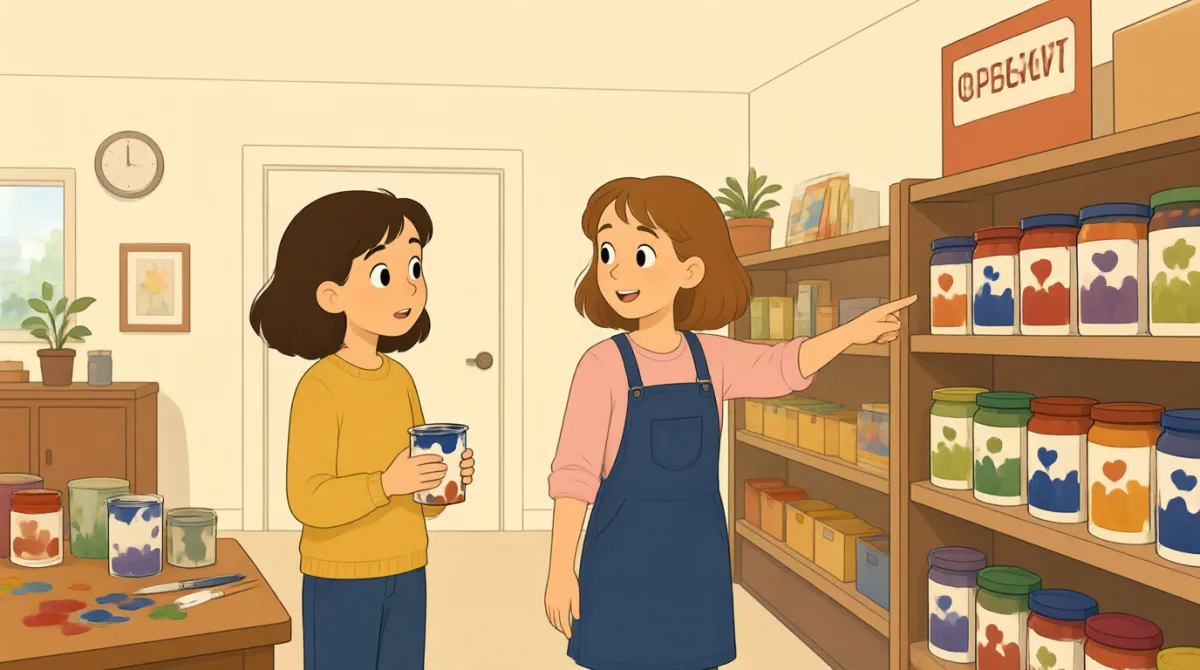

Excuse me, where is the paint?
请问,油漆在哪里?

It’s in aisle six, near the brushes.
在六号货架,靠近刷子那里。
Thanks. Is it easy to find?
谢谢。容易找吗?
Yes. Look for the big paint cans.
容易。找那些大油漆桶就行。
I need a small can, please.
我想要一小桶。
Small cans are on the lower shelf.
小桶在下面的架子上。
Great, thank you for your help!
太好了,谢谢你帮忙!
词汇8
- Excuse me劳驾
A polite way to get someone's attention before asking a question.
在提问前,用来礼貌地引起别人的注意。
- where is the paint?油漆在哪里?
Use this question to ask where something is in a store.
在商店里想问某样东西在哪里时,可以用这个问句。
- aisle six六号通道
An aisle is a passage between shelves. You can use this phrase to say where something is.
通道是货架之间的过道。你可以用这个短语说明某样东西在哪里。
- near the brushes在刷子附近
This tells someone that something is close to the brushes.
用这个短语告诉别人某样东西离刷子很近。
- easy to find容易找到
Use this phrase to ask if something is simple to locate.
可以用这个短语询问某样东西是否容易找到。
- paint cans油漆罐
These are containers that hold paint. You can use this phrase to ask for or describe paint in a store.
这是装油漆的容器。在商店里,你可以用这个短语询问或描述油漆。
- lower shelf较低的货架
This means a shelf that is low down. Use it to describe where an item is.
指位置较低的货架。可以用它来描述某件商品的位置。
- thank you for your help谢谢你的帮忙
A polite way to thank someone after they help you.
别人帮了你之后,用来礼貌地向对方道谢。
重点句子7
- 1
Excuse me, where is the paint?
劳驾,请问油漆在哪里?
Use this polite question to ask where an item is. Replace “the paint” with another item, such as “the soap.”
用这个礼貌的问句询问某件商品在哪里。可以把“the paint”换成其他商品,比如“the soap”。
- 2
It’s in aisle six, near the brushes.
在六号通道,靠近刷子的地方。
Use this sentence to tell someone where an item is. Replace “aisle six” and “the brushes” with the location and nearby items.
用这个句子告诉别人某件商品在哪里。可以把“aisle six”和“the brushes”换成具体位置和附近的物品。
- 3
Is it easy to find?
容易找到吗?
Use this question to ask if something is simple to locate. Replace “it” with the item you are looking for.
用这个问句询问某样东西是否容易找到。可以把“it”换成你要找的物品。
- 4
Yes. Look for the big paint cans.
是的。找那些大油漆罐就行。
Use “Look for…” to tell someone what to search for. Replace “the big paint cans” with a helpful sign or item.
用“Look for…”告诉别人要找什么。可以把“the big paint cans”换成有用的标志或物品。
- 5
I need a small can, please.
我需要一小罐,谢谢。
Use this sentence to ask for a particular size or type of item. Replace “a small can” with what you need.
用这个句子询问某件商品的特定尺寸或类型。可以把“a small can”换成你需要的东西。
- 6
Small cans are on the lower shelf.
小油漆罐在较低的货架上。
Use this sentence to say where items are. Replace “Small cans” and “the lower shelf” with the item and its location.
用这个句子说明商品在哪里。可以把“Small cans”和“the lower shelf”换成商品及其所在位置。
- 7
Great, thank you for your help!
太好了,谢谢你的帮忙!
Use this friendly sentence to thank someone who has helped you.
用这个友好的句子感谢帮助过你的人。