Asking Where the Paint Is
Preguntar dónde está la pintura
Emma asks Grace where the paint is. Grace points her to the paint section.
Emma le pregunta a Grace dónde está la pintura. Grace le indica la sección de pintura.
Diálogo7
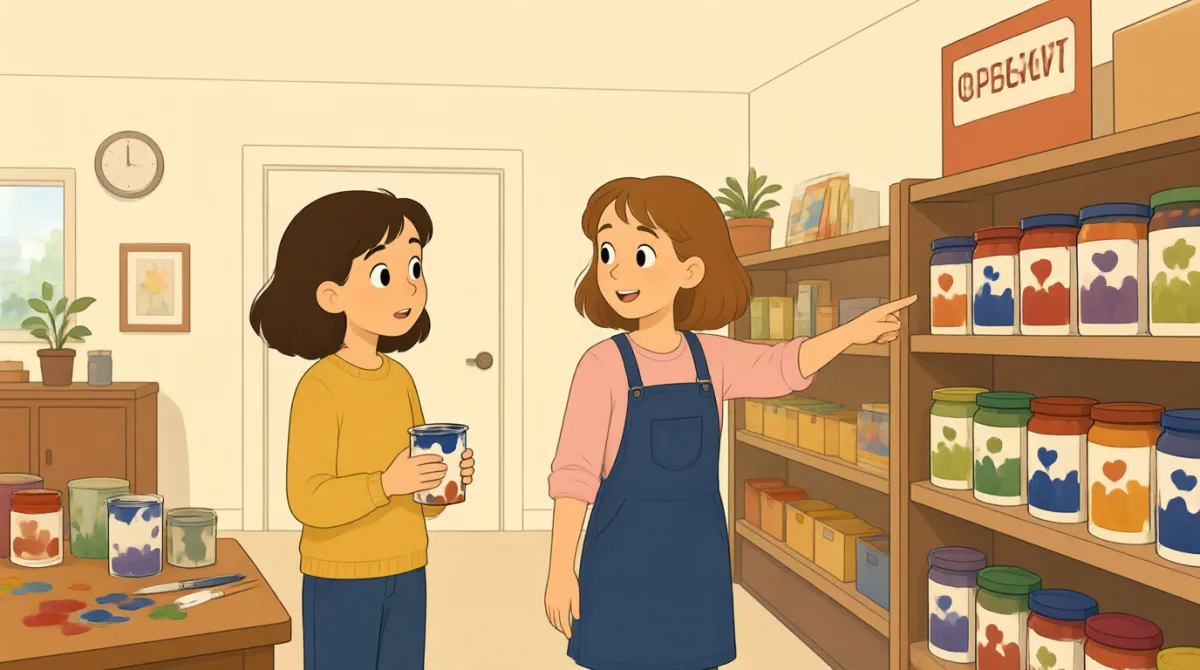

Excuse me, where is the paint?
Disculpe, ¿dónde está la pintura?

It’s in aisle six, near the brushes.
Está en el pasillo seis, cerca de las brochas.
Thanks. Is it easy to find?
Gracias. ¿Es fácil de encontrar?
Yes. Look for the big paint cans.
Sí. Busca las latas grandes de pintura.
I need a small can, please.
Necesito una lata pequeña, por favor.
Small cans are on the lower shelf.
Las latas pequeñas están en el estante de abajo.
Great, thank you for your help!
¡Genial, muchas gracias por su ayuda!
Vocabulario8
- Excuse meDisculpe
A polite way to get someone's attention before asking a question.
Una forma cortés de llamar la atención de alguien antes de hacerle una pregunta.
- where is the paint?¿dónde está la pintura?
Use this question to ask where something is in a store.
Usa esta pregunta para preguntar dónde está algo en una tienda.
- aisle sixpasillo seis
An aisle is a passage between shelves. You can use this phrase to say where something is.
Un pasillo es el espacio entre los estantes. Puedes usar esta expresión para decir dónde está algo.
- near the brushescerca de las brochas
This tells someone that something is close to the brushes.
Esto le indica a alguien que algo está cerca de las brochas.
- easy to findfácil de encontrar
Use this phrase to ask if something is simple to locate.
Usa esta expresión para preguntar si algo es fácil de localizar.
- paint canslatas de pintura
These are containers that hold paint. You can use this phrase to ask for or describe paint in a store.
Son recipientes que contienen pintura. Puedes usar esta expresión para pedir pintura o describirla en una tienda.
- lower shelfestante de abajo
This means a shelf that is low down. Use it to describe where an item is.
Se refiere a un estante que está a poca altura. Úsalo para describir dónde está un artículo.
- thank you for your helpmuchas gracias por su ayuda
A polite way to thank someone after they help you.
Una forma cortés de agradecerle a alguien después de que te ayuda.
Frases clave7
- 1
Excuse me, where is the paint?
Disculpe, ¿dónde está la pintura?
Use this polite question to ask where an item is. Replace “the paint” with another item, such as “the soap.”
Usa esta pregunta cortés para preguntar dónde está un artículo. Sustituye “the paint” por otro artículo, como “the soap”.
- 2
It’s in aisle six, near the brushes.
Está en el pasillo seis, cerca de las brochas.
Use this sentence to tell someone where an item is. Replace “aisle six” and “the brushes” with the location and nearby items.
Usa esta oración para decirle a alguien dónde está un artículo. Sustituye “aisle six” y “the brushes” por el lugar y los artículos que están cerca.
- 3
Is it easy to find?
¿Es fácil de encontrar?
Use this question to ask if something is simple to locate. Replace “it” with the item you are looking for.
Usa esta pregunta para preguntar si algo es fácil de localizar. Sustituye “it” por el artículo que estás buscando.
- 4
Yes. Look for the big paint cans.
Sí. Busca las latas grandes de pintura.
Use “Look for…” to tell someone what to search for. Replace “the big paint cans” with a helpful sign or item.
Usa “Look for…” para decirle a alguien qué debe buscar. Sustituye “the big paint cans” por un letrero o artículo que pueda servirle de referencia.
- 5
I need a small can, please.
Necesito una lata pequeña, por favor.
Use this sentence to ask for a particular size or type of item. Replace “a small can” with what you need.
Usa esta oración para pedir un artículo de un tamaño o tipo específico. Sustituye “a small can” por lo que necesitas.
- 6
Small cans are on the lower shelf.
Las latas pequeñas están en el estante de abajo.
Use this sentence to say where items are. Replace “Small cans” and “the lower shelf” with the item and its location.
Usa esta oración para decir dónde están los artículos. Sustituye “Small cans” y “the lower shelf” por el artículo y el lugar donde está.
- 7
Great, thank you for your help!
¡Genial, muchas gracias por su ayuda!
Use this friendly sentence to thank someone who has helped you.
Usa esta oración amable para agradecerle a alguien que te ha ayudado.