Asking Where the Paint Is
Hỏi quầy sơn ở đâu
Emma asks Grace where the paint is. Grace points her to the paint section.
Emma hỏi Grace sơn ở đâu. Grace chỉ cho cô ấy đến khu vực bán sơn.
Hội thoại7
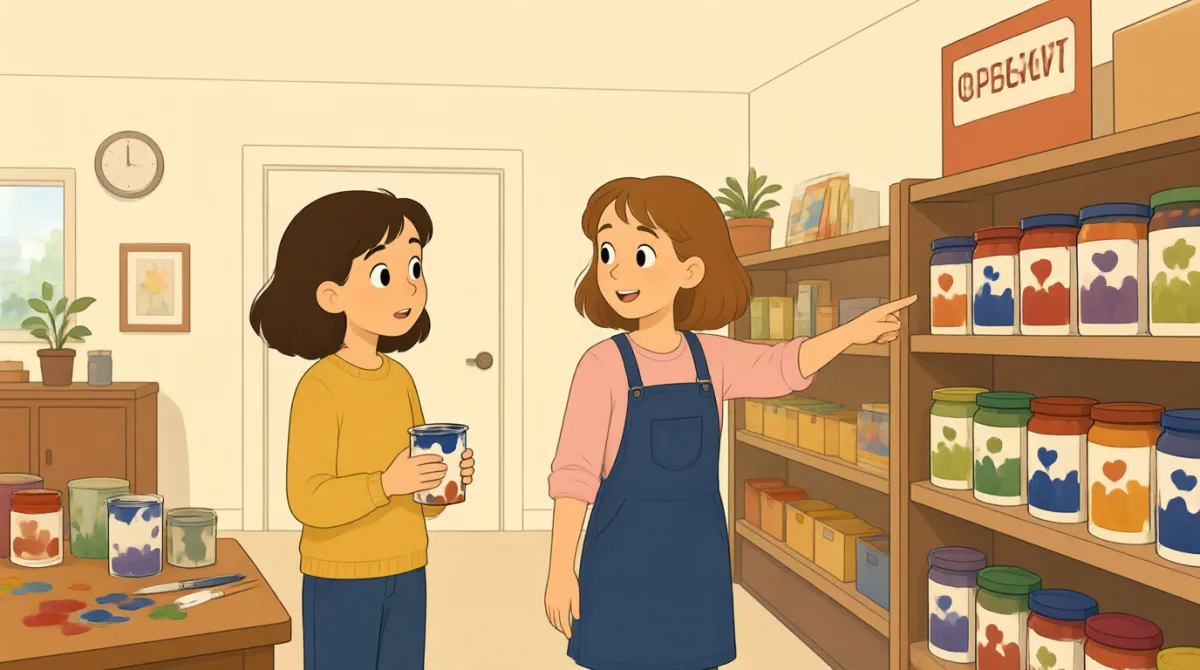

Excuse me, where is the paint?
Xin lỗi, sơn ở đâu vậy?

It’s in aisle six, near the brushes.
Ở lối đi số sáu, gần chỗ bán cọ.
Thanks. Is it easy to find?
Cảm ơn nhé. Có dễ tìm không?
Yes. Look for the big paint cans.
Có. Cứ tìm những thùng sơn lớn nhé.
I need a small can, please.
Cho tôi một thùng nhỏ nhé.
Small cans are on the lower shelf.
Thùng nhỏ ở trên kệ thấp hơn.
Great, thank you for your help!
Tuyệt, cảm ơn bạn đã giúp tôi!
Từ vựng8
- Excuse meXin lỗi
A polite way to get someone's attention before asking a question.
Cách nói lịch sự để thu hút sự chú ý của ai đó trước khi hỏi.
- where is the paint?sơn ở đâu?
Use this question to ask where something is in a store.
Dùng câu hỏi này để hỏi một món đồ nằm ở đâu trong cửa hàng.
- aisle sixlối đi số sáu
An aisle is a passage between shelves. You can use this phrase to say where something is.
Lối đi là khoảng trống giữa các kệ hàng. Bạn có thể dùng cụm này để nói một món đồ nằm ở đâu.
- near the brushesgần chỗ bán cọ
This tells someone that something is close to the brushes.
Cụm này cho biết một món đồ ở gần những chiếc cọ.
- easy to finddễ tìm
Use this phrase to ask if something is simple to locate.
Dùng cụm này để hỏi xem có dễ tìm thấy một món đồ hay không.
- paint cansthùng sơn
These are containers that hold paint. You can use this phrase to ask for or describe paint in a store.
Đây là những vật đựng sơn. Bạn có thể dùng cụm này để hỏi mua hoặc mô tả sơn trong cửa hàng.
- lower shelfkệ thấp hơn
This means a shelf that is low down. Use it to describe where an item is.
Cụm này chỉ chiếc kệ ở vị trí thấp. Dùng nó để mô tả món đồ nằm ở đâu.
- thank you for your helpcảm ơn bạn đã giúp tôi
A polite way to thank someone after they help you.
Cách nói lịch sự để cảm ơn ai đó sau khi họ giúp bạn.
Câu trọng tâm7
- 1
Excuse me, where is the paint?
Xin lỗi, sơn ở đâu vậy?
Use this polite question to ask where an item is. Replace “the paint” with another item, such as “the soap.”
Dùng câu hỏi lịch sự này để hỏi một món đồ ở đâu. Hãy thay “the paint” bằng món đồ khác, chẳng hạn như “the soap”.
- 2
It’s in aisle six, near the brushes.
Ở lối đi số sáu, gần chỗ bán cọ.
Use this sentence to tell someone where an item is. Replace “aisle six” and “the brushes” with the location and nearby items.
Dùng câu này để nói cho ai đó biết một món đồ ở đâu. Hãy thay “aisle six” và “the brushes” bằng địa điểm và những món đồ ở gần đó.
- 3
Is it easy to find?
Có dễ tìm không?
Use this question to ask if something is simple to locate. Replace “it” with the item you are looking for.
Dùng câu hỏi này để hỏi xem có dễ tìm thấy một món đồ hay không. Hãy thay “it” bằng món đồ bạn đang tìm.
- 4
Yes. Look for the big paint cans.
Có. Cứ tìm những thùng sơn lớn nhé.
Use “Look for…” to tell someone what to search for. Replace “the big paint cans” with a helpful sign or item.
Dùng “Look for…” để chỉ cho ai đó biết cần tìm gì. Hãy thay “the big paint cans” bằng một biển hiệu hoặc món đồ hữu ích để tìm.
- 5
I need a small can, please.
Cho tôi một thùng nhỏ nhé.
Use this sentence to ask for a particular size or type of item. Replace “a small can” with what you need.
Dùng câu này để yêu cầu một món đồ có kích cỡ hoặc loại cụ thể. Hãy thay “a small can” bằng thứ bạn cần.
- 6
Small cans are on the lower shelf.
Thùng nhỏ ở trên kệ thấp hơn.
Use this sentence to say where items are. Replace “Small cans” and “the lower shelf” with the item and its location.
Dùng câu này để nói các món đồ nằm ở đâu. Hãy thay “Small cans” và “the lower shelf” bằng món đồ và vị trí của nó.
- 7
Great, thank you for your help!
Tuyệt, cảm ơn bạn đã giúp tôi!
Use this friendly sentence to thank someone who has helped you.
Dùng câu thân thiện này để cảm ơn người vừa giúp bạn.