Going Home
Nach Hause gehen
Emma and Mia pack their things and leave the beach. They talk about the fun day and the bus ride home.
Emma und Mia packen ihre Sachen und verlassen den Strand. Sie sprechen über den schönen Tag und die Busfahrt nach Hause.
Dialog7
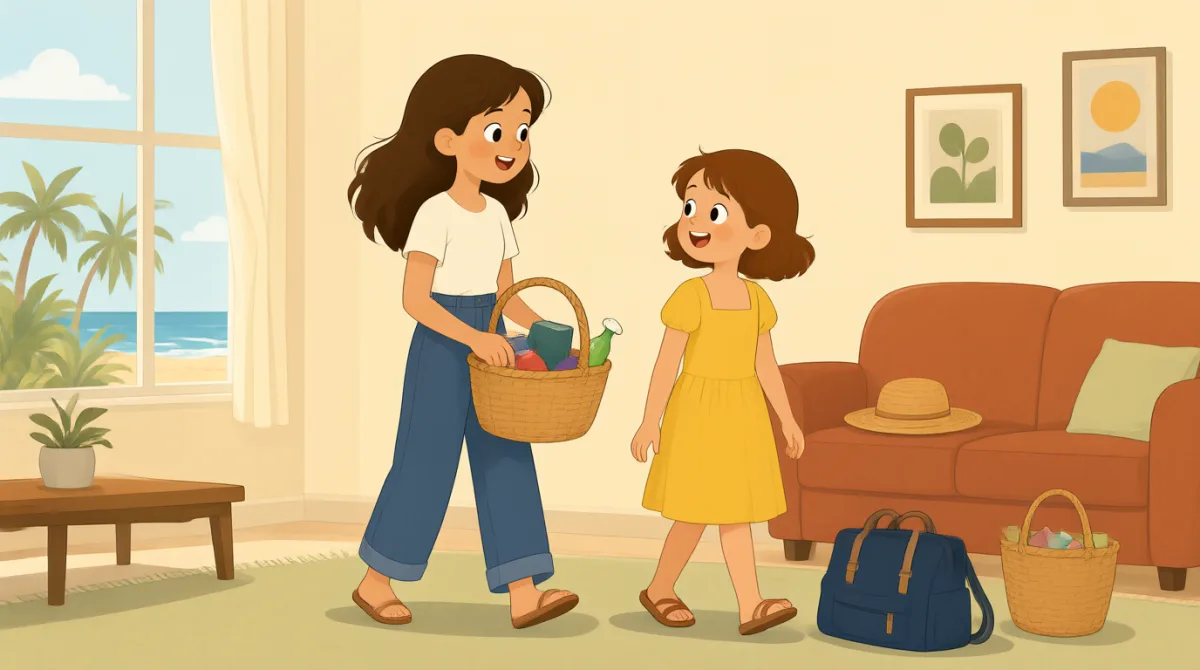

I have my towel and bag. Do you have everything?
Ich habe mein Handtuch und meine Tasche. Hast du alles?

Yes. I have my hat and water bottle.
Ja. Ich habe meinen Hut und meine Trinkflasche.
The beach was so much fun today.
Der Tag am Strand hat heute richtig Spaß gemacht.
Yes, but I am a little tired now.
Ja, aber ich bin jetzt ein bisschen müde.
Let's take the bus home. Is the stop nearby?
Lass uns mit dem Bus nach Hause fahren. Ist die Haltestelle in der Nähe?
Yes, it's just across the street.
Ja, sie ist gleich auf der anderen Straßenseite.
Great! I can't wait to sit down.
Super! Ich kann es kaum erwarten, mich hinzusetzen.
Wortschatz7
- towelHandtuch
A towel is a piece of cloth used to dry yourself. You can take it to the beach.
Ein „towel“ ist ein Stück Stoff, mit dem du dich abtrocknest. Du kannst es mit an den Strand nehmen.
- water bottleTrinkflasche
A water bottle holds water to drink. You can bring one with you.
In einer „water bottle“ ist Wasser zum Trinken. Du kannst eine mitnehmen.
- a little tiredein bisschen müde
This means slightly tired, but not very tired. Use it to describe how you feel.
„A little tired“ bedeutet, dass du leicht müde bist, aber nicht sehr. Damit kannst du beschreiben, wie du dich fühlst.
- take the busmit dem Bus fahren
This means to travel by bus. You can say, “I take the bus to school.”
„Take the bus“ bedeutet, mit dem Bus zu fahren. Du kannst sagen: „I take the bus to school.“ (Ich fahre mit dem Bus zur Schule.)
- nearbyin der Nähe
Nearby means close to where you are. You can ask if a place is nearby.
„Nearby“ bedeutet, dass etwas nicht weit von deinem Standort entfernt ist. Du kannst fragen, ob ein Ort in der Nähe ist.
- across the streetauf der anderen Straßenseite
This means on the other side of the street. You can use it to tell someone where a place is.
„Across the street“ bedeutet, dass etwas auf der anderen Seite der Straße liegt. Damit kannst du jemandem sagen, wo sich ein Ort befindet.
- sit downsich hinsetzen
Sit down means to move into a sitting position. You can say this when you want to rest.
„Sit down“ bedeutet, sich in eine sitzende Position zu begeben. Das kannst du sagen, wenn du dich ausruhen möchtest.
Wichtige Sätze8
- 1
I have my towel and bag.
Ich habe mein Handtuch und meine Tasche.
Use this sentence to say which things you have with you. You can replace “towel and bag” with other items.
Mit diesem Satz sagst du, welche Sachen du dabeihast. Du kannst „towel and bag“ durch andere Gegenstände ersetzen.
- 2
Do you have everything?
Hast du alles?
Use this question to check that someone has all their things. It is useful before leaving a place.
Mit dieser Frage prüfst du, ob jemand alle seine Sachen dabeihat. Sie ist praktisch, bevor man einen Ort verlässt.
- 3
The beach was so much fun today.
Der Tag am Strand hat heute richtig Spaß gemacht.
Use this sentence to say that an activity was very enjoyable. Replace “the beach” with another activity or place.
Mit diesem Satz sagst du, dass etwas sehr viel Spaß gemacht hat. Ersetze „the beach“ durch eine andere Aktivität oder einen anderen Ort.
- 4
I am a little tired now.
Ich bin jetzt ein bisschen müde.
Use this sentence to describe feeling slightly tired. You can replace “tired” with another feeling, such as “hungry.”
Mit diesem Satz beschreibst du, dass du leicht müde bist. Du kannst „tired“ durch ein anderes Gefühl ersetzen, zum Beispiel „hungry“.
- 5
Let's take the bus home.
Lass uns mit dem Bus nach Hause fahren.
Use “Let’s” to suggest doing something together. You can replace “take the bus” with another way to travel.
Mit „Let’s“ schlägst du vor, gemeinsam etwas zu tun. Du kannst „take the bus“ durch eine andere Art zu reisen ersetzen.
- 6
Is the stop nearby?
Ist die Haltestelle in der Nähe?
Use this question to ask if a stop or place is close. Replace “the stop” with another place.
Mit dieser Frage fragst du, ob eine Haltestelle oder ein anderer Ort in der Nähe ist. Ersetze „the stop“ durch einen anderen Ort.
- 7
Yes, it's just across the street.
Ja, sie ist gleich auf der anderen Straßenseite.
Use this sentence to explain that something is very close and on the other side of the street. Replace “it” with the place you mean.
Mit diesem Satz erklärst du, dass etwas ganz in der Nähe und auf der anderen Straßenseite ist. Ersetze „it“ durch den Ort, den du meinst.
- 8
I can't wait to sit down.
Ich kann es kaum erwarten, mich hinzusetzen.
Use “I can’t wait to” to show that you really want to do something soon. You can say, “I can’t wait to go home.”
Mit „I can’t wait to“ zeigst du, dass du etwas bald unbedingt tun möchtest. Du kannst sagen: „I can’t wait to go home.“