Finding the Plates
Encontrando os pratos
Emma looks for plates before getting food. Jack tells her where they are.
Emma procura pratos antes de se servir. Jack diz onde eles estão.
Diálogo6
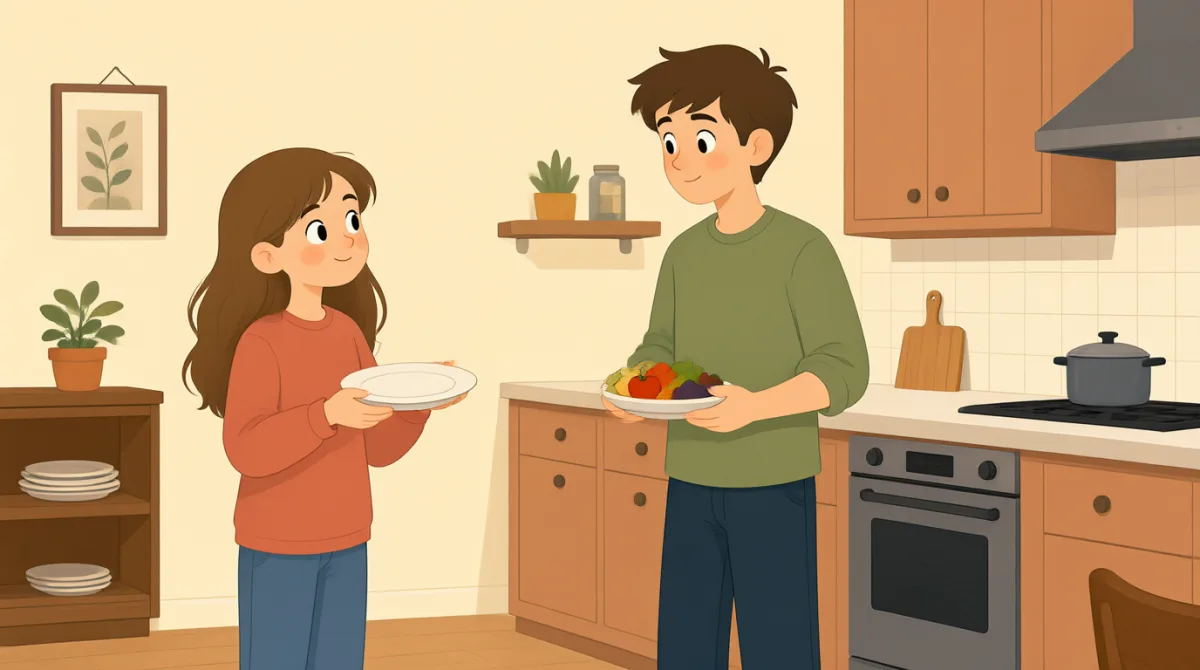

Jack, where are the plates?
Jack, onde estão os pratos?

They’re right here, by the food.
Estão bem aqui, perto da comida.
Oh, I see them. Are these clean?
Ah, estou vendo. Estes estão limpos?
Yes, they’re clean. Take one.
Sim, estão limpos. Pegue um.
Thanks. Where do I get a fork?
Obrigada. Onde pego um garfo?
The forks are next to the plates.
Os garfos estão ao lado dos pratos.
Vocabulário7
- platespratos
Flat dishes that you put food on. You need a plate before you get food at a buffet.
Louças planas onde você coloca a comida. Em um bufê, você precisa de um prato antes de se servir.
- right herebem aqui
This means something is very close to the speaker. You can use it to show where an item is.
Significa que algo está bem perto de quem está falando. Você pode usar essa expressão para indicar onde um objeto está.
- by the foodperto da comida
This means next to the food. Use “by” to say that something is near another thing.
Significa ao lado da comida. Use “by” para dizer que algo está perto de outra coisa.
- cleanlimpo
Not dirty. You can ask “Are these clean?” when you want to check plates or other items.
Que não está sujo. Você pode perguntar “Are these clean?” quando quiser conferir se os pratos ou outros objetos estão limpos.
- take onepegue um
This means choose and pick up one item. You can use it when someone says an item is ready for you to use.
Significa escolher e pegar um objeto. Você pode usar essa expressão quando alguém diz que um objeto está à sua disposição.
- forkgarfo
A tool you use to eat food. At a buffet, you can ask where to get a fork.
Utensílio usado para comer. Em um bufê, você pode perguntar onde pegar um garfo.
- next toao lado de
This means beside or very close to something. Use it to explain where an item is.
Significa ao lado ou bem perto de algo. Use essa expressão para explicar onde um objeto está.
Frases-chave8
- 1
Jack, where are the plates?
Jack, onde estão os pratos?
Use this simple question to ask where something is. Replace “the plates” with another item, such as “the forks.”
Use essa pergunta simples para saber onde algo está. Troque “the plates” por outro objeto, como “the forks”.
- 2
They’re right here, by the food.
Estão bem aqui, perto da comida.
This tells someone where something is. Use “They’re right here” for nearby things, and add a place after “by.”
Essa frase diz a alguém onde algo está. Use “They’re right here” para falar de coisas que estão perto e acrescente um lugar depois de “by”.
- 3
Oh, I see them.
Ah, estou vendo.
Say this when you find or notice something. You can change “them” to “it” for one thing.
Diga isso quando encontrar ou perceber algo. Você pode trocar “them” por “it” quando estiver falando de uma coisa só.
- 4
Are these clean?
Estes estão limpos?
Use this question to check if several things are clean. Say “Is this clean?” when asking about one thing.
Use essa pergunta para conferir se várias coisas estão limpas. Diga “Is this clean?” quando perguntar sobre uma coisa só.
- 5
Yes, they’re clean.
Sim, estão limpos.
This is a short way to say that several things are not dirty. You can change “they’re” to “it’s” for one thing.
Essa é uma forma curta de dizer que várias coisas não estão sujas. Você pode trocar “they’re” por “it’s” quando estiver falando de uma coisa só.
- 6
Take one.
Pegue um.
Use this short phrase to tell someone to pick up one item. You can say it when offering plates, cups, or other things.
Use essa expressão curta para dizer a alguém que pegue um objeto. Você pode dizê-la ao oferecer pratos, copos ou outras coisas.
- 7
Thanks.
Obrigada.
This is a simple way to thank someone. Use it when someone helps you or gives you something.
Essa é uma forma simples de agradecer. Use-a quando alguém ajudar você ou lhe der alguma coisa.
- 8
The forks are next to the plates.
Os garfos estão ao lado dos pratos.
This sentence explains where something is. Replace “the forks” and “the plates” with other items to give directions.
Essa frase explica onde algo está. Troque “the forks” e “the plates” por outros objetos para indicar onde eles estão.