Finding the Plates
Szukanie talerzy
Emma looks for plates before getting food. Jack tells her where they are.
Emma szuka talerzy, zanim nałoży sobie jedzenie. Jack mówi jej, gdzie są.
Dialog6
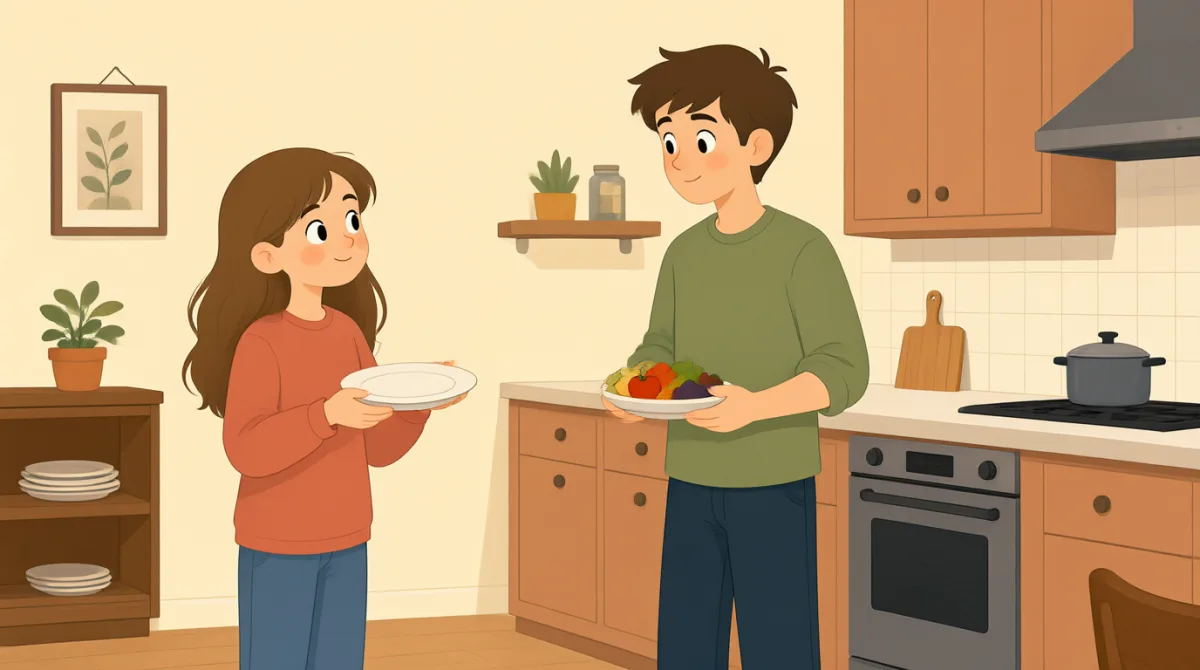

Jack, where are the plates?
Jack, gdzie są talerze?

They’re right here, by the food.
Są właśnie tutaj, przy jedzeniu.
Oh, I see them. Are these clean?
O, widzę je. Te są czyste?
Yes, they’re clean. Take one.
Tak, są czyste. Weź jeden.
Thanks. Where do I get a fork?
Dzięki. A skąd wziąć widelec?
The forks are next to the plates.
Wid elce są obok talerzy.
Słownictwo7
- platestalerze
Flat dishes that you put food on. You need a plate before you get food at a buffet.
Płaskie naczynia, na które nakłada się jedzenie. W bufecie potrzebujesz talerza, zanim nałożysz sobie jedzenie.
- right herewłaśnie tutaj
This means something is very close to the speaker. You can use it to show where an item is.
To znaczy, że coś znajduje się bardzo blisko mówiącej osoby. Możesz tak wskazać, gdzie leży jakiś przedmiot.
- by the foodprzy jedzeniu
This means next to the food. Use “by” to say that something is near another thing.
To znaczy obok jedzenia. Użyj “by”, żeby powiedzieć, że coś znajduje się blisko czegoś innego.
- cleanczysty
Not dirty. You can ask “Are these clean?” when you want to check plates or other items.
Niebrudny. Możesz zapytać “Are these clean?”, gdy chcesz sprawdzić, czy talerze lub inne przedmioty są czyste.
- take oneweź jeden
This means choose and pick up one item. You can use it when someone says an item is ready for you to use.
To znaczy wybrać i wziąć jeden przedmiot. Możesz tak powiedzieć, gdy ktoś informuje, że jakiś przedmiot jest gotowy do użycia.
- forkwidelec
A tool you use to eat food. At a buffet, you can ask where to get a fork.
Sztuciec, którym je się jedzenie. W bufecie możesz zapytać, skąd wziąć widelec.
- next toobok
This means beside or very close to something. Use it to explain where an item is.
To znaczy przy czymś albo bardzo blisko czegoś. Użyj tego wyrażenia, żeby powiedzieć, gdzie znajduje się jakiś przedmiot.
Kluczowe zdania8
- 1
Jack, where are the plates?
Jack, gdzie są talerze?
Use this simple question to ask where something is. Replace “the plates” with another item, such as “the forks.”
Użyj tego prostego pytania, żeby zapytać, gdzie coś jest. Zastąp “the plates” innym przedmiotem, na przykład “the forks.”
- 2
They’re right here, by the food.
Są właśnie tutaj, przy jedzeniu.
This tells someone where something is. Use “They’re right here” for nearby things, and add a place after “by.”
Tym zdaniem mówisz komuś, gdzie coś jest. Użyj “They’re right here” w odniesieniu do rzeczy znajdujących się blisko, a po “by” dodaj miejsce.
- 3
Oh, I see them.
O, widzę je.
Say this when you find or notice something. You can change “them” to “it” for one thing.
Powiedz tak, gdy coś znajdziesz lub zauważysz. Możesz zastąpić “them” słowem “it”, gdy chodzi o jedną rzecz.
- 4
Are these clean?
Te są czyste?
Use this question to check if several things are clean. Say “Is this clean?” when asking about one thing.
Użyj tego pytania, żeby sprawdzić, czy kilka rzeczy jest czystych. Gdy pytasz o jedną rzecz, powiedz “Is this clean?”.
- 5
Yes, they’re clean.
Tak, są czyste.
This is a short way to say that several things are not dirty. You can change “they’re” to “it’s” for one thing.
To krótki sposób, by powiedzieć, że kilka rzeczy nie jest brudnych. Gdy chodzi o jedną rzecz, możesz zastąpić “they’re” słowami “it’s”.
- 6
Take one.
Weź jeden.
Use this short phrase to tell someone to pick up one item. You can say it when offering plates, cups, or other things.
Użyj tego krótkiego zwrotu, żeby powiedzieć komuś, by wziął jeden przedmiot. Możesz tak powiedzieć, gdy oferujesz komuś talerze, kubki lub inne rzeczy.
- 7
Thanks.
Dzięki.
This is a simple way to thank someone. Use it when someone helps you or gives you something.
To prosty sposób, żeby komuś podziękować. Użyj go, gdy ktoś ci pomaga albo coś ci daje.
- 8
The forks are next to the plates.
Widelce są obok talerzy.
This sentence explains where something is. Replace “the forks” and “the plates” with other items to give directions.
Tym zdaniem wyjaśniasz, gdzie coś się znajduje. Zastąp “the forks” i “the plates” innymi przedmiotami, żeby wskazać drogę.