Finding the Plates
Tìm đĩa
Emma looks for plates before getting food. Jack tells her where they are.
Emma tìm đĩa trước khi lấy thức ăn. Jack chỉ cho cô ấy chỗ để đĩa.
Hội thoại6
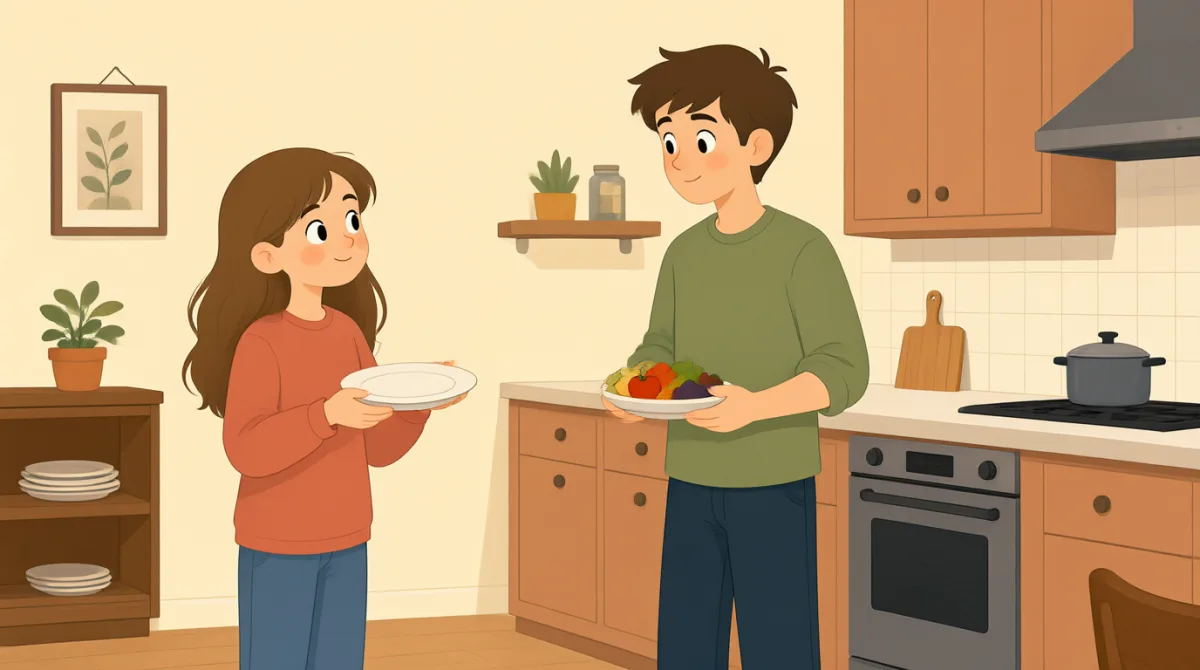

Jack, where are the plates?
Jack, đĩa ở đâu vậy?

They’re right here, by the food.
Ngay đây này, cạnh chỗ để đồ ăn.
Oh, I see them. Are these clean?
Ồ, thấy rồi. Mấy cái này sạch không?
Yes, they’re clean. Take one.
Ừ, sạch đấy. Lấy một cái đi.
Thanks. Where do I get a fork?
Cảm ơn nhé. Mình lấy nĩa ở đâu?
The forks are next to the plates.
Nĩa ở cạnh đĩa.
Từ vựng7
- platesđĩa
Flat dishes that you put food on. You need a plate before you get food at a buffet.
Đồ dùng phẳng để đựng thức ăn. Khi ăn buffet, bạn cần lấy đĩa trước khi lấy đồ ăn.
- right herengay đây
This means something is very close to the speaker. You can use it to show where an item is.
Cụm này có nghĩa là thứ gì đó ở rất gần người nói. Bạn có thể dùng cụm này để chỉ vị trí của một món đồ.
- by the foodcạnh chỗ để đồ ăn
This means next to the food. Use “by” to say that something is near another thing.
Cụm này có nghĩa là ở cạnh đồ ăn. Dùng “by” để nói một thứ ở gần một thứ khác.
- cleansạch
Not dirty. You can ask “Are these clean?” when you want to check plates or other items.
Không bẩn. Bạn có thể hỏi “Are these clean?” khi muốn kiểm tra đĩa hoặc những món đồ khác.
- take onelấy một cái
This means choose and pick up one item. You can use it when someone says an item is ready for you to use.
Cụm này có nghĩa là chọn và cầm lấy một món đồ. Bạn có thể dùng cụm này khi ai đó nói một món đồ đã sẵn sàng để bạn dùng.
- forknĩa
A tool you use to eat food. At a buffet, you can ask where to get a fork.
Dụng cụ dùng để ăn. Khi ăn buffet, bạn có thể hỏi lấy nĩa ở đâu.
- next tocạnh
This means beside or very close to something. Use it to explain where an item is.
Cụm này có nghĩa là ở bên cạnh hoặc rất gần thứ gì đó. Dùng cụm này để nói vị trí của một món đồ.
Câu trọng tâm8
- 1
Jack, where are the plates?
Jack, đĩa ở đâu vậy?
Use this simple question to ask where something is. Replace “the plates” with another item, such as “the forks.”
Dùng câu hỏi đơn giản này để hỏi một thứ ở đâu. Thay “the plates” bằng một món đồ khác, chẳng hạn như “the forks.”
- 2
They’re right here, by the food.
Chúng ở ngay đây, cạnh chỗ để đồ ăn.
This tells someone where something is. Use “They’re right here” for nearby things, and add a place after “by.”
Câu này cho ai đó biết một thứ ở đâu. Dùng “They’re right here” khi nói về những thứ ở gần, rồi thêm địa điểm sau “by.”
- 3
Oh, I see them.
Ồ, thấy chúng rồi.
Say this when you find or notice something. You can change “them” to “it” for one thing.
Nói câu này khi bạn tìm thấy hoặc nhìn thấy thứ gì đó. Bạn có thể đổi “them” thành “it” khi nói về một món đồ.
- 4
Are these clean?
Mấy cái này sạch không?
Use this question to check if several things are clean. Say “Is this clean?” when asking about one thing.
Dùng câu hỏi này để kiểm tra xem nhiều thứ có sạch không. Hỏi “Is this clean?” khi nói về một món đồ.
- 5
Yes, they’re clean.
Ừ, chúng sạch đấy.
This is a short way to say that several things are not dirty. You can change “they’re” to “it’s” for one thing.
Đây là cách nói ngắn gọn rằng nhiều thứ không bị bẩn. Bạn có thể đổi “they’re” thành “it’s” khi nói về một món đồ.
- 6
Take one.
Lấy một cái đi.
Use this short phrase to tell someone to pick up one item. You can say it when offering plates, cups, or other things.
Dùng cụm ngắn này để bảo ai đó cầm lấy một món đồ. Bạn có thể nói câu này khi mời họ lấy đĩa, cốc hoặc những thứ khác.
- 7
Thanks.
Cảm ơn nhé.
This is a simple way to thank someone. Use it when someone helps you or gives you something.
Đây là cách đơn giản để cảm ơn ai đó. Dùng câu này khi ai đó giúp bạn hoặc đưa cho bạn thứ gì đó.
- 8
The forks are next to the plates.
Nĩa ở cạnh đĩa.
This sentence explains where something is. Replace “the forks” and “the plates” with other items to give directions.
Câu này giải thích một thứ ở đâu. Thay “the forks” và “the plates” bằng những món đồ khác để chỉ đường.