Paying
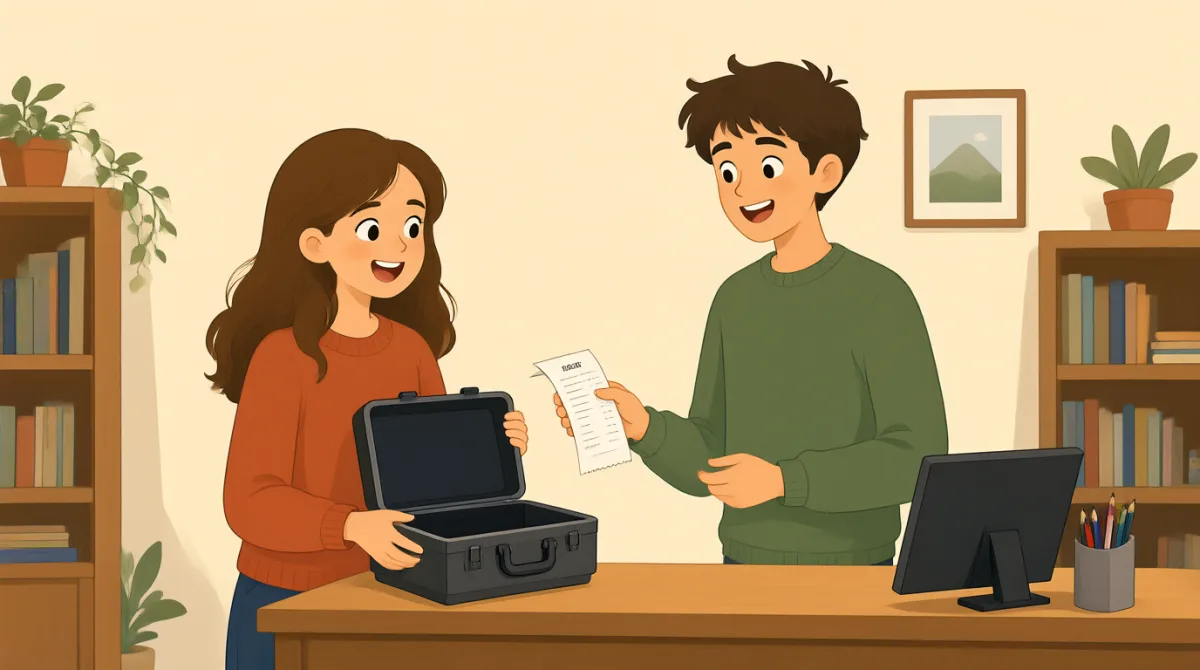
Emma pays for the case and screen protector. Jack gives her the receipt.
Dialogue7

I’ll pay for the case and screen protector.

That’s twenty dollars, please.
Can I pay by card?
Sure. Please tap your card here.
Okay. Is it done?
Yes. Here’s your receipt.
Thanks! Have a nice day.
Vocabulary6
- pay for
To give money for something you are buying. You can say, “I’ll pay for the case.”
- by card
Using a bank card to pay instead of cash. Ask, “Can I pay by card?”
- tap your card
Touch your card to the payment machine to pay. This is a common way to pay by card.
- Is it done?
A simple way to ask if something is finished. You can use it while waiting for a payment to go through.
- receipt
A paper or digital note that shows what you paid for. Keep your receipt after you buy something.
- Have a nice day.
A friendly phrase to say goodbye. You can use it at a shop or at the end of a conversation.
Key Sentences8
- 1
I’ll pay for the case and screen protector.
Use this sentence to say what you will pay for. You can replace the items with other things, such as “I’ll pay for the book.”
- 2
That’s twenty dollars, please.
A shop worker can use this to tell you the total price. Replace “twenty dollars” with the amount you need to pay.
- 3
Can I pay by card?
Use this question to ask if you can pay with a card. You can also replace “by card” with “in cash.”
- 4
Sure.
This is a friendly way to say yes. You can use it to agree to a simple request.
- 5
Please tap your card here.
A shop worker can say this to show you how to pay with a contactless card. You can use “Please” to make an instruction polite.
- 6
Okay.
Use this short word to show that you understand or agree. It is common in everyday conversations.
- 7
Is it done?
Use this question to check if a payment or task is finished. You can also say it when you are waiting for something.
- 8
Yes. Here’s your receipt.
A shop worker can use this to confirm the payment and give you proof of purchase. “Here’s your…” is a useful way to hand something to someone.