Paying
Bezahlen
Emma pays for the case and screen protector. Jack gives her the receipt.
Emma bezahlt die Handyhülle und die Displayschutzfolie. Jack gibt ihr den Kassenbon.
Dialog7
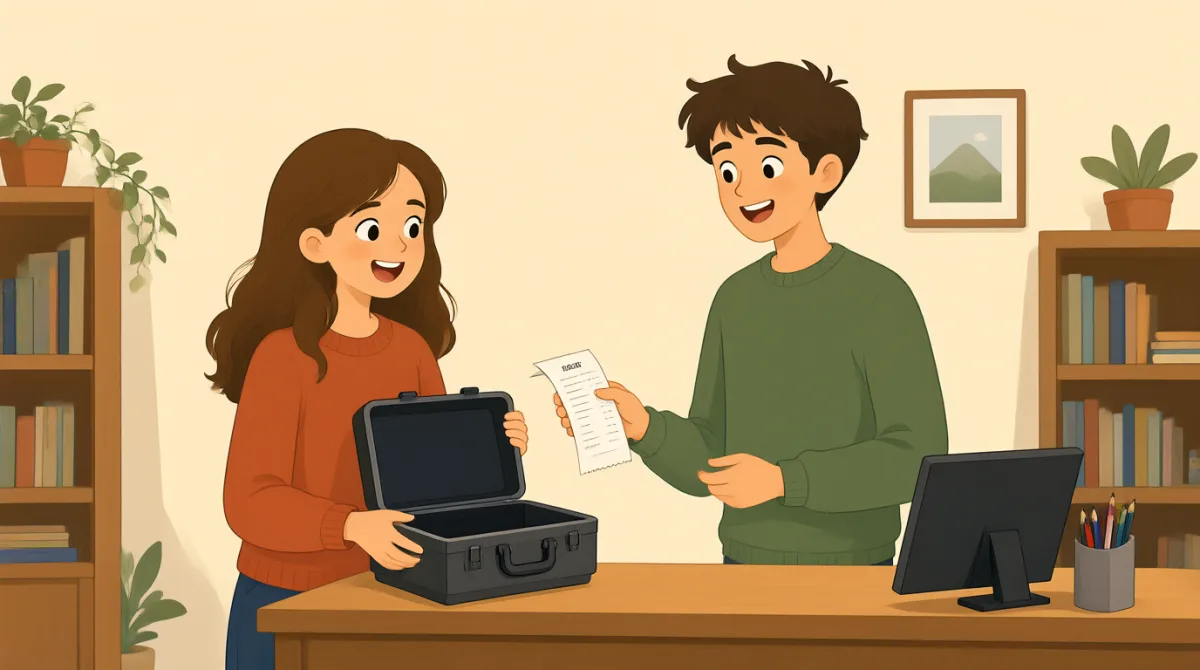

I’ll pay for the case and screen protector.
Ich bezahle die Handyhülle und die Displayschutzfolie.

That’s twenty dollars, please.
Das macht dann zwanzig Dollar, bitte.
Can I pay by card?
Kann ich mit Karte bezahlen?
Sure. Please tap your card here.
Natürlich. Halten Sie Ihre Karte bitte hier hin.
Okay. Is it done?
Okay. Ist es fertig?
Yes. Here’s your receipt.
Ja. Hier ist Ihr Kassenbon.
Thanks! Have a nice day.
Danke! Einen schönen Tag noch.
Wortschatz6
- pay forbezahlen
To give money for something you are buying. You can say, “I’ll pay for the case.”
Geld für etwas geben, das du kaufst. Du kannst sagen: „I’ll pay for the case.“ (Ich bezahle die Handyhülle.)
- by cardmit Karte
Using a bank card to pay instead of cash. Ask, “Can I pay by card?”
Mit einer Bankkarte bezahlen, anstatt Bargeld zu verwenden. Frag: „Can I pay by card?“ (Kann ich mit Karte bezahlen?)
- tap your carddie Karte hinhalten
Touch your card to the payment machine to pay. This is a common way to pay by card.
Halte deine Karte an das Bezahlterminal, um zu bezahlen. Das ist eine gängige Art, mit Karte zu bezahlen.
- Is it done?Ist es fertig?
A simple way to ask if something is finished. You can use it while waiting for a payment to go through.
Eine einfache Frage, um zu erfahren, ob etwas abgeschlossen ist. Du kannst sie stellen, während du darauf wartest, dass eine Zahlung durchgeht.
- receiptder Kassenbon
A paper or digital note that shows what you paid for. Keep your receipt after you buy something.
Ein Beleg auf Papier oder digital, auf dem steht, wofür du bezahlt hast. Heb deinen Kassenbon auf, nachdem du etwas gekauft hast.
- Have a nice day.Einen schönen Tag noch.
A friendly phrase to say goodbye. You can use it at a shop or at the end of a conversation.
Eine freundliche Abschiedsformel. Du kannst sie im Geschäft oder am Ende eines Gesprächs verwenden.
Wichtige Sätze8
- 1
I’ll pay for the case and screen protector.
Ich bezahle die Handyhülle und die Displayschutzfolie.
Use this sentence to say what you will pay for. You can replace the items with other things, such as “I’ll pay for the book.”
Mit diesem Satz sagst du, wofür du bezahlen wirst. Du kannst die Dinge durch andere ersetzen, zum Beispiel: „I’ll pay for the book.“ (Ich bezahle das Buch.)
- 2
That’s twenty dollars, please.
Das macht dann zwanzig Dollar, bitte.
A shop worker can use this to tell you the total price. Replace “twenty dollars” with the amount you need to pay.
Eine Person im Geschäft kann dir damit den Gesamtpreis nennen. Ersetze „twenty dollars“ durch den Betrag, den du bezahlen musst.
- 3
Can I pay by card?
Kann ich mit Karte bezahlen?
Use this question to ask if you can pay with a card. You can also replace “by card” with “in cash.”
Mit dieser Frage erkundigst du dich, ob du mit Karte bezahlen kannst. Du kannst „by card“ auch durch „in cash“ ersetzen.
- 4
Sure.
Natürlich.
This is a friendly way to say yes. You can use it to agree to a simple request.
So kannst du freundlich Ja sagen. Du kannst es verwenden, um einer einfachen Bitte zuzustimmen.
- 5
Please tap your card here.
Halten Sie Ihre Karte bitte hier hin.
A shop worker can say this to show you how to pay with a contactless card. You can use “Please” to make an instruction polite.
Eine Person im Geschäft kann das sagen, um dir zu zeigen, wie du mit einer kontaktlosen Karte bezahlst. Mit „Please“ kannst du eine Anweisung höflich formulieren.
- 6
Okay.
Okay.
Use this short word to show that you understand or agree. It is common in everyday conversations.
Mit diesem kurzen Wort zeigst du, dass du etwas verstanden hast oder einverstanden bist. Es kommt in alltäglichen Gesprächen häufig vor.
- 7
Is it done?
Ist es fertig?
Use this question to check if a payment or task is finished. You can also say it when you are waiting for something.
Mit dieser Frage erkundigst du dich, ob eine Zahlung oder eine Aufgabe abgeschlossen ist. Du kannst sie auch stellen, wenn du auf etwas wartest.
- 8
Yes. Here’s your receipt.
Ja. Hier ist Ihr Kassenbon.
A shop worker can use this to confirm the payment and give you proof of purchase. “Here’s your…” is a useful way to hand something to someone.
Eine Person im Geschäft kann damit die Zahlung bestätigen und dir einen Kaufbeleg geben. „Here’s your…“ ist eine praktische Wendung, wenn du jemandem etwas überreichst.