Asking Where the Bins Are
ゴミ箱の場所を尋ねる
Emma asks Grace where the bins are in their building. Grace shows her the way.
エマがグレースに、建物の中のゴミ箱がどこにあるか尋ねます。グレースが道順を教えてくれます。
会話7
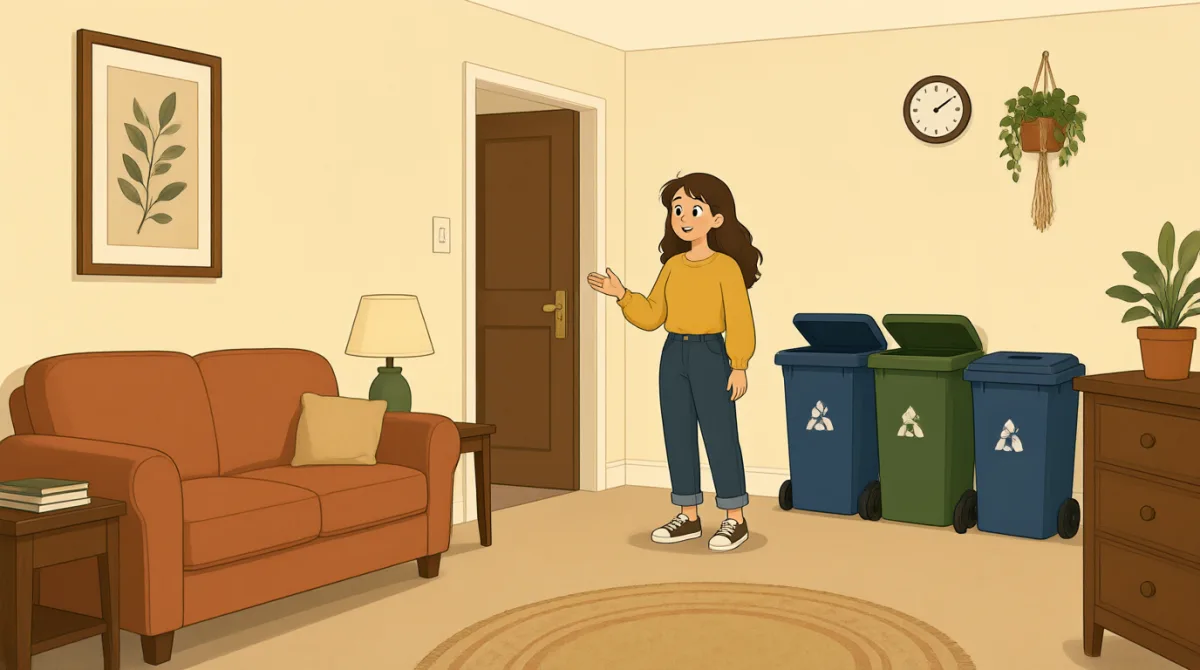

Hi, Grace. Where are the trash bins?
やあ、グレース。ゴミ箱はどこにあるの?

They’re downstairs, next to the back door.
下の階だよ。裏口の隣。
How do I get there?
どうやって行けばいい?
Go down the stairs, then turn left.
階段を下りて、それから左に曲がって。
Are the bins outside?
ゴミ箱は外にあるの?
Yes. They’re just outside the back door.
うん。裏口を出てすぐのところだよ。
Great. Thanks for showing me!
よかった。案内してくれてありがとう!
語彙8
- trash binsゴミ箱
Containers for trash. You can ask where they are.
ゴミを入れる容器のことです。どこにあるか尋ねるときに使えます。
- downstairs下の階に
On a lower floor. Use it to say where something is.
より低い階にあることを表します。何かの場所を伝えるときに使います。
- next to〜の隣に
Beside something. Use it to describe where a place or thing is.
何かのすぐそばという意味です。場所や物の位置を説明するときに使います。
- back door裏口
A door at the back of a building. It can help someone find a place.
建物の裏側にあるドアのことです。場所を見つけてもらう手がかりになります。
- get thereそこへ行く
Go to a place. Use it to ask how to reach somewhere.
ある場所へ行くことです。どこかへの行き方を尋ねるときに使えます。
- turn left左に曲がる
Move in the direction on your left. Use it to give directions.
左の方向へ進むことです。道順を伝えるときに使います。
- outside外に
Not inside a building. Use it to say where something is.
建物の中ではない場所を表します。物がどこにあるか伝えるときに使います。
- showing me案内してくれて
Helping me find or see something. Use it to thank someone for their help.
何かを見つけたり見たりするのを手伝ってくれることです。助けてくれた人にお礼を言うときに使えます。
重要な文8
- 1
Where are the trash bins?
ゴミ箱はどこにあるの?
Use this to ask where the trash containers are. You can replace “trash bins” with another place or thing.
ゴミ箱がどこにあるか尋ねる表現です。“trash bins”を別の場所や物に置き換えて使えます。
- 2
They’re downstairs, next to the back door.
下の階だよ。裏口の隣。
This gives a location using two simple details. Use “They’re [place], next to [thing]” to help someone find something.
2つの簡単な情報を使って場所を伝えています。“They’re [場所], next to [物]”の形で、何かの場所を教えられます。
- 3
How do I get there?
どうやって行けばいい?
Use this to ask for directions to a place. You can say it after someone tells you where something is.
ある場所への道順を尋ねる表現です。何かの場所を教えてもらったあとに使えます。
- 4
Go down the stairs, then turn left.
階段を下りて、それから左に曲がって。
This gives two simple directions in order. Use “Go [direction], then turn [left/right]” to guide someone.
順番に2つの道順を伝えています。“Go [方向], then turn [left/right]”の形で、相手を案内できます。
- 5
Are the bins outside?
ゴミ箱は外にあるの?
Use this yes-or-no question to check where something is. Replace “the bins” with another place or thing.
何かの場所を確認する、はい・いいえで答えられる質問です。“the bins”を別の場所や物に置き換えて使えます。
- 6
Yes.
うん。
This is a short way to answer yes to a question. You can add more information after it, as Grace does in the dialogue.
質問に「はい」と短く答える表現です。グレースのように、このあとに詳しい情報を続けることもできます。
- 7
They’re just outside the back door.
裏口を出てすぐのところだよ。
This gives a clear location. Use “They’re just outside [place]” to say something is very near a door or building.
場所をはっきり伝える表現です。“They’re just outside [場所]”を使うと、何かがドアや建物のすぐ外にあると言えます。
- 8
Great. Thanks for showing me!
よかった。案内してくれてありがとう!
Use this to thank someone who helped you find something. You can change “showing me” to another -ing action, such as “helping me.”
何かを見つけるのを手伝ってくれた人にお礼を言う表現です。“showing me”を“helping me”のような別の動詞の-ing形に変えることもできます。