Asking Where the Bins Are
Emma asks Grace where the bins are in their building. Grace shows her the way.
Dialogue7
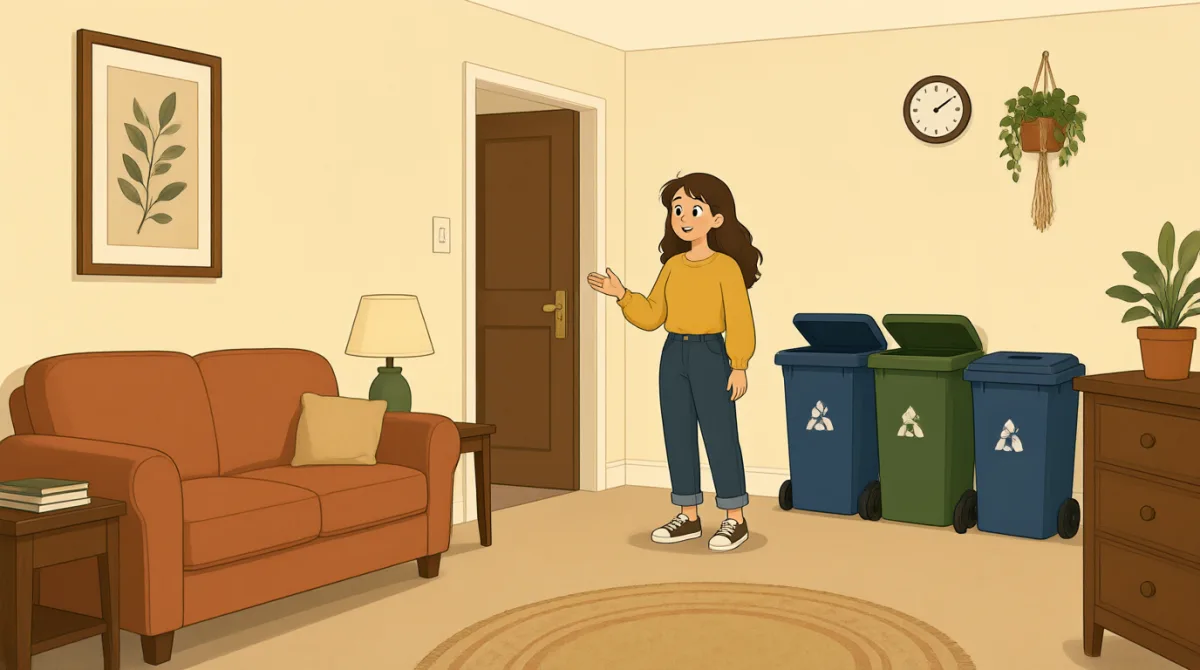

Hi, Grace. Where are the trash bins?

They’re downstairs, next to the back door.
How do I get there?
Go down the stairs, then turn left.
Are the bins outside?
Yes. They’re just outside the back door.
Great. Thanks for showing me!
Vocabulary8
- trash bins
Containers for trash. You can ask where they are.
- downstairs
On a lower floor. Use it to say where something is.
- next to
Beside something. Use it to describe where a place or thing is.
- back door
A door at the back of a building. It can help someone find a place.
- get there
Go to a place. Use it to ask how to reach somewhere.
- turn left
Move in the direction on your left. Use it to give directions.
- outside
Not inside a building. Use it to say where something is.
- showing me
Helping me find or see something. Use it to thank someone for their help.
Key Sentences8
- 1
Where are the trash bins?
Use this to ask where the trash containers are. You can replace “trash bins” with another place or thing.
- 2
They’re downstairs, next to the back door.
This gives a location using two simple details. Use “They’re [place], next to [thing]” to help someone find something.
- 3
How do I get there?
Use this to ask for directions to a place. You can say it after someone tells you where something is.
- 4
Go down the stairs, then turn left.
This gives two simple directions in order. Use “Go [direction], then turn [left/right]” to guide someone.
- 5
Are the bins outside?
Use this yes-or-no question to check where something is. Replace “the bins” with another place or thing.
- 6
Yes.
This is a short way to answer yes to a question. You can add more information after it, as Grace does in the dialogue.
- 7
They’re just outside the back door.
This gives a clear location. Use “They’re just outside [place]” to say something is very near a door or building.
- 8
Great. Thanks for showing me!
Use this to thank someone who helped you find something. You can change “showing me” to another -ing action, such as “helping me.”