Asking Where the Bins Are
询问垃圾桶在哪里
Emma asks Grace where the bins are in their building. Grace shows her the way.
Emma问Grace大楼里的垃圾桶在哪里。Grace给她指路。
对话7
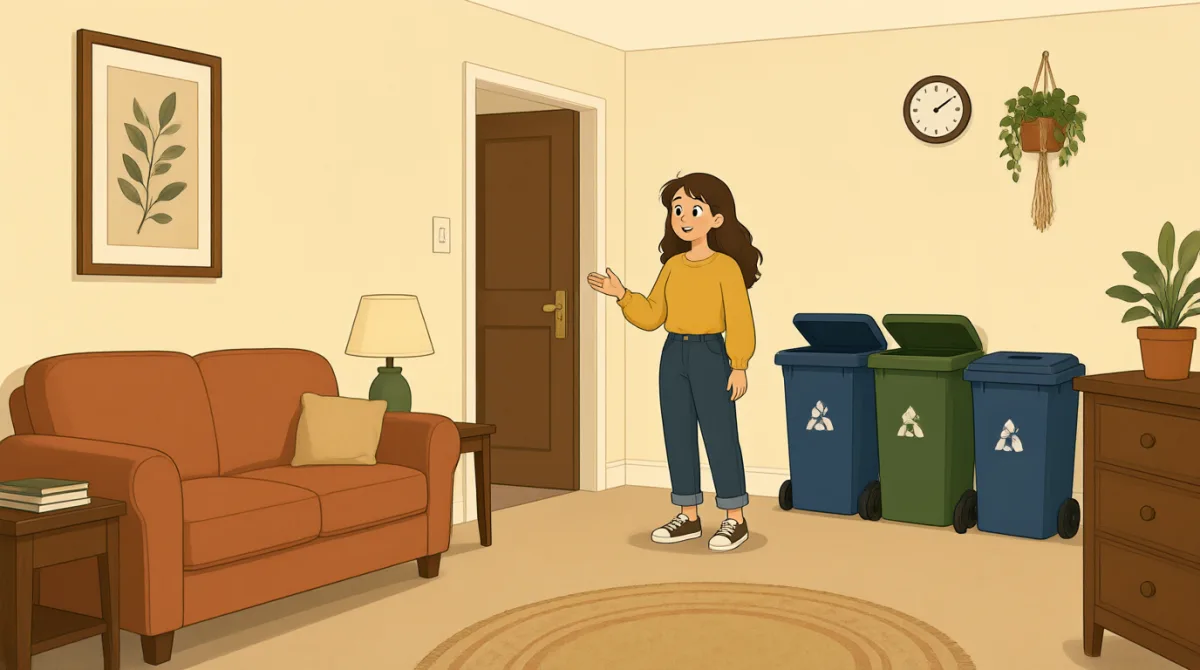

Hi, Grace. Where are the trash bins?
嗨,格蕾丝。垃圾桶在哪里?

They’re downstairs, next to the back door.
它们在楼下,后门旁边。
How do I get there?
我怎么去那里?
Go down the stairs, then turn left.
下楼梯,然后向左拐。
Are the bins outside?
垃圾桶在外面吗?
Yes. They’re just outside the back door.
是的,就在后门外面。
Great. Thanks for showing me!
太好了。谢谢你带我过去!
词汇8
- trash bins垃圾桶
Containers for trash. You can ask where they are.
装垃圾的容器。你可以问它们在哪里。
- downstairs楼下
On a lower floor. Use it to say where something is.
在较低的楼层。可以用它来说明某物在哪里。
- next to在……旁边
Beside something. Use it to describe where a place or thing is.
在某物的旁边。可以用它来说明某个地方或东西的位置。
- back door后门
A door at the back of a building. It can help someone find a place.
建筑物后面的门。可以用它帮助别人找到地方。
- get there到那里
Go to a place. Use it to ask how to reach somewhere.
前往某个地方。可以用它来问怎么到达某处。
- turn left向左拐
Move in the direction on your left. Use it to give directions.
朝左边的方向走。可以用它来指路。
- outside外面
Not inside a building. Use it to say where something is.
不在建筑物里面。可以用它来说明某物在哪里。
- showing me带我去看
Helping me find or see something. Use it to thank someone for their help.
帮我找到或看到某样东西。可以用它来感谢对方的帮助。
重点句子8
- 1
Where are the trash bins?
垃圾桶在哪里?
Use this to ask where the trash containers are. You can replace “trash bins” with another place or thing.
用这句话询问垃圾桶在哪里。你可以把“trash bins”换成其他地点或东西。
- 2
They’re downstairs, next to the back door.
它们在楼下,后门旁边。
This gives a location using two simple details. Use “They’re [place], next to [thing]” to help someone find something.
这句话用两个简单的信息说明位置。你可以用“They’re [place], next to [thing]”来帮助别人找到某样东西。
- 3
How do I get there?
我怎么去那里?
Use this to ask for directions to a place. You can say it after someone tells you where something is.
用这句话询问怎么去某个地方。别人告诉你某样东西在哪里之后,你可以这样问。
- 4
Go down the stairs, then turn left.
下楼梯,然后向左拐。
This gives two simple directions in order. Use “Go [direction], then turn [left/right]” to guide someone.
这句话按顺序给出两个简单的指路步骤。你可以用“Go [direction], then turn [left/right]”来给别人指路。
- 5
Are the bins outside?
垃圾桶在外面吗?
Use this yes-or-no question to check where something is. Replace “the bins” with another place or thing.
用这个一般疑问句确认某样东西在哪里。你可以把“the bins”换成其他地点或东西。
- 6
Yes.
是的。
This is a short way to answer yes to a question. You can add more information after it, as Grace does in the dialogue.
这是肯定回答的简短说法。你可以像对话中的Grace那样,在后面补充更多信息。
- 7
They’re just outside the back door.
它们就在后门外面。
This gives a clear location. Use “They’re just outside [place]” to say something is very near a door or building.
这句话清楚地说明了位置。你可以用“They’re just outside [place]”来表示某物就在门或建筑物外面。
- 8
Great. Thanks for showing me!
太好了。谢谢你带我过去!
Use this to thank someone who helped you find something. You can change “showing me” to another -ing action, such as “helping me.”
用这句话感谢帮助你找东西的人。你可以把“showing me”换成其他以-ing结尾的动作,比如“helping me”。