Asking Where the Bins Are
ถามว่าถังขยะอยู่ที่ไหน
Emma asks Grace where the bins are in their building. Grace shows her the way.
เอ็มมาถามเกรซว่าถังขยะในอาคารอยู่ที่ไหน เกรซบอกทางให้เธอ
บทสนทนา7
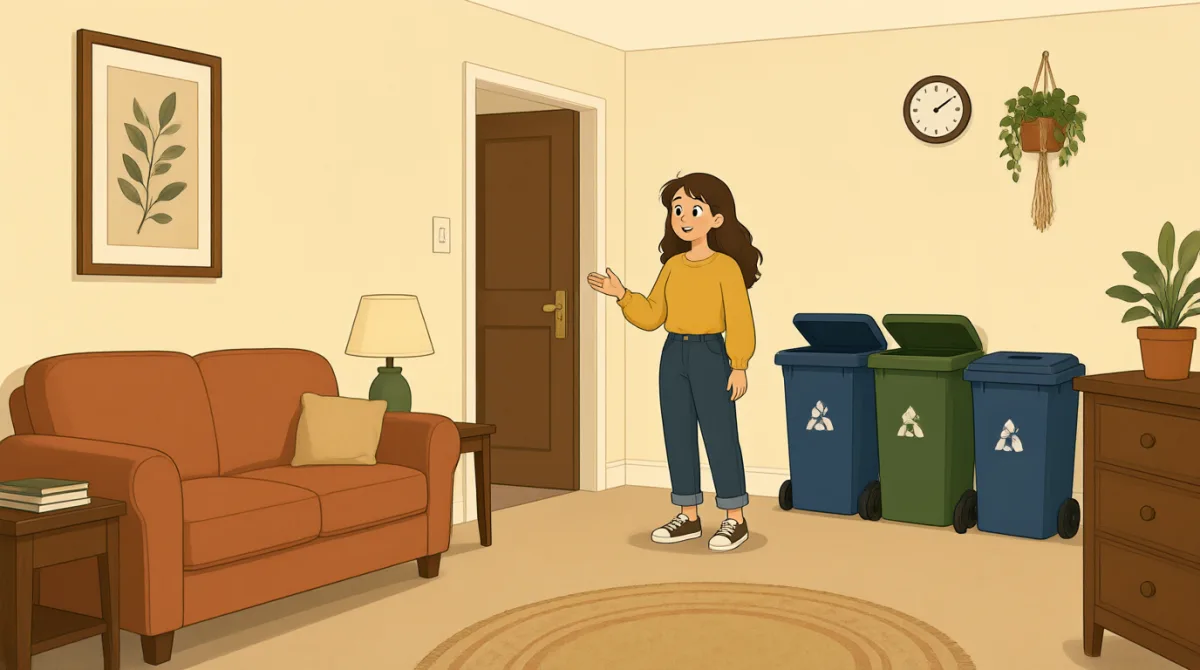

Hi, Grace. Where are the trash bins?
หวัดดี เกรซ ถังขยะอยู่ไหนเหรอ

They’re downstairs, next to the back door.
อยู่ชั้นล่าง ข้างประตูหลังน่ะ
How do I get there?
ไปทางนั้นยังไงเหรอ
Go down the stairs, then turn left.
ลงบันไดไป แล้วเลี้ยวซ้าย
Are the bins outside?
ถังขยะอยู่ข้างนอกเหรอ
Yes. They’re just outside the back door.
ใช่ อยู่ถัดออกไปจากประตูหลังนิดเดียว
Great. Thanks for showing me!
เยี่ยมเลย ขอบใจที่พาไปนะ!
คำศัพท์8
- trash binsถังขยะ
Containers for trash. You can ask where they are.
ภาชนะสำหรับใส่ขยะ ใช้ถามได้ว่าถังขยะอยู่ที่ไหน
- downstairsชั้นล่าง
On a lower floor. Use it to say where something is.
อยู่บนชั้นที่ต่ำกว่า ใช้บอกตำแหน่งของสิ่งต่าง ๆ
- next toข้าง ๆ
Beside something. Use it to describe where a place or thing is.
อยู่ติดกับสิ่งใดสิ่งหนึ่ง ใช้บอกตำแหน่งของสถานที่หรือสิ่งของ
- back doorประตูหลัง
A door at the back of a building. It can help someone find a place.
ประตูที่อยู่ด้านหลังของอาคาร ใช้เป็นจุดสังเกตเพื่อช่วยบอกทางได้
- get thereไปถึงที่นั่น
Go to a place. Use it to ask how to reach somewhere.
เดินทางไปยังสถานที่หนึ่ง ใช้ถามว่าจะไปถึงที่นั่นได้อย่างไร
- turn leftเลี้ยวซ้าย
Move in the direction on your left. Use it to give directions.
เปลี่ยนทิศทางไปทางซ้าย ใช้บอกทาง
- outsideข้างนอก
Not inside a building. Use it to say where something is.
ไม่ได้อยู่ภายในอาคาร ใช้บอกว่าสิ่งของอยู่ตรงไหน
- showing meพาไปดู
Helping me find or see something. Use it to thank someone for their help.
ช่วยพาไปหาหรือไปดูบางสิ่ง ใช้ขอบคุณคนที่ช่วยเหลือเรา
ประโยคสำคัญ8
- 1
Where are the trash bins?
ถังขยะอยู่ที่ไหน
Use this to ask where the trash containers are. You can replace “trash bins” with another place or thing.
ใช้ถามว่าถังขยะอยู่ที่ไหน คุณเปลี่ยน “trash bins” เป็นสถานที่หรือสิ่งของอื่นได้
- 2
They’re downstairs, next to the back door.
อยู่ชั้นล่าง ข้างประตูหลัง
This gives a location using two simple details. Use “They’re [place], next to [thing]” to help someone find something.
ประโยคนี้บอกตำแหน่งโดยให้รายละเอียดง่าย ๆ สองอย่าง ใช้รูปแบบ “They’re [place], next to [thing]” เพื่อช่วยบอกตำแหน่งของสิ่งของให้คนอื่น
- 3
How do I get there?
ไปทางนั้นยังไง
Use this to ask for directions to a place. You can say it after someone tells you where something is.
ใช้ถามทางไปยังสถานที่หนึ่ง พูดประโยคนี้ได้หลังจากมีคนบอกว่าสิ่งนั้นอยู่ที่ไหน
- 4
Go down the stairs, then turn left.
ลงบันไดไป แล้วเลี้ยวซ้าย
This gives two simple directions in order. Use “Go [direction], then turn [left/right]” to guide someone.
ประโยคนี้บอกทิศทางง่าย ๆ สองขั้นตอนตามลำดับ ใช้รูปแบบ “Go [direction], then turn [left/right]” เพื่อบอกทางให้คนอื่น
- 5
Are the bins outside?
ถังขยะอยู่ข้างนอกเหรอ
Use this yes-or-no question to check where something is. Replace “the bins” with another place or thing.
ใช้คำถามแบบตอบใช่หรือไม่ใช่เพื่อตรวจสอบว่าสิ่งหนึ่งอยู่ที่ไหน เปลี่ยน “the bins” เป็นสถานที่หรือสิ่งของอื่นได้
- 6
Yes.
ใช่
This is a short way to answer yes to a question. You can add more information after it, as Grace does in the dialogue.
เป็นคำตอบสั้น ๆ เพื่อบอกว่าใช่ คุณจะพูดข้อมูลเพิ่มเติมต่อจากคำนี้ก็ได้ เหมือนที่เกรซทำในบทสนทนา
- 7
They’re just outside the back door.
อยู่ถัดออกไปจากประตูหลังนิดเดียว
This gives a clear location. Use “They’re just outside [place]” to say something is very near a door or building.
ประโยคนี้บอกตำแหน่งอย่างชัดเจน ใช้รูปแบบ “They’re just outside [place]” เพื่อบอกว่าสิ่งนั้นอยู่ใกล้ประตูหรืออาคารมาก
- 8
Great. Thanks for showing me!
เยี่ยมเลย ขอบใจที่พาไปนะ!
Use this to thank someone who helped you find something. You can change “showing me” to another -ing action, such as “helping me.”
ใช้ขอบคุณคนที่ช่วยพาคุณไปหาบางสิ่ง คุณเปลี่ยน “showing me” เป็นคำกริยาเติม -ing อย่างอื่นได้ เช่น “helping me.”