Looking in the Living Room
Cherchons dans le salon
Emma and Mia look around the living room. They check the table and the chair.
Emma et Mia fouillent le salon. Elles vérifient la table et la chaise.
Dialogue7
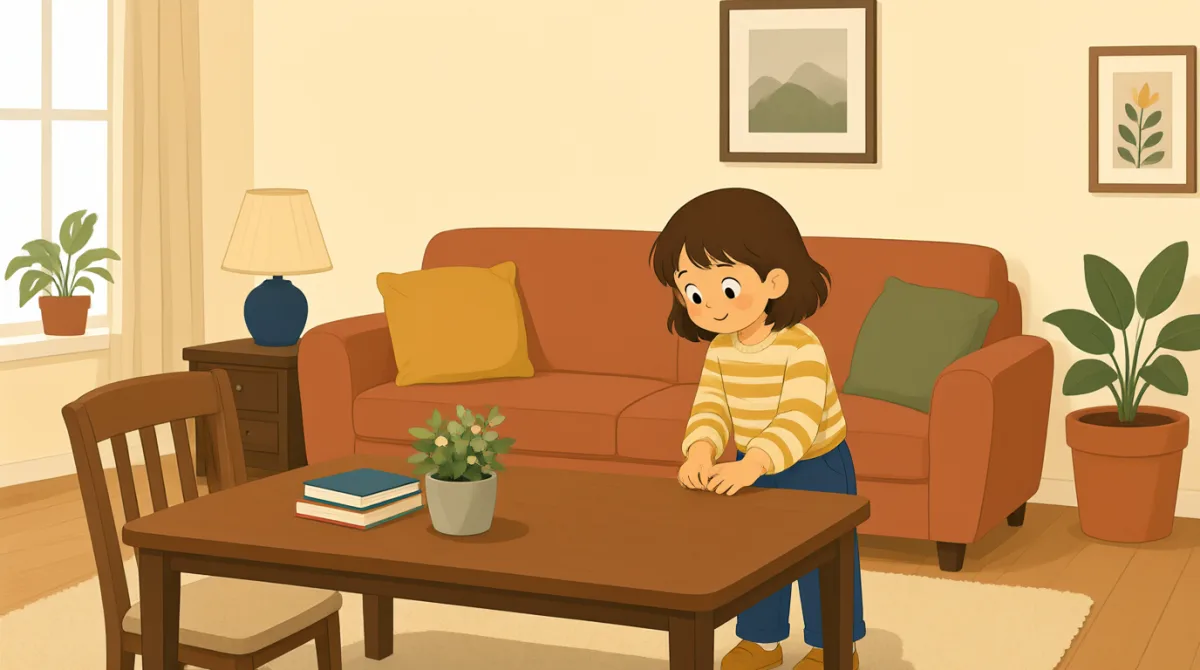

Can you help me look in the living room?
Tu peux m’aider à chercher dans le salon ?

Sure. Where did you last see them?
Bien sûr. Où est-ce que tu les as vues pour la dernière fois ?
I think they were on the table.
Je crois qu’elles étaient sur la table.
The table is empty. Check the chair.
La table est vide. Regarde sur la chaise.
I see a book on the chair, but no keys.
Je vois un livre sur la chaise, mais pas de clés.
Look next to the table. Do you see them?
Regarde à côté de la table. Tu les vois ?
No, I don't. Let's look by the sofa.
Non, je ne les vois pas. Cherchons près du canapé.
Vocabulaire6
- look in the living roomchercher dans le salon
To search inside the living room. Use this phrase to say where you want to look for something.
« look in the living room » signifie chercher à l’intérieur du salon. Utilise cette expression pour dire où tu veux chercher quelque chose.
- last seevoir pour la dernière fois
To remember the most recent time or place you saw something. Ask, “Where did you last see it?” when looking for a lost item.
« last see » signifie se rappeler le moment ou l’endroit le plus récent où l’on a vu quelque chose. Quand tu cherches un objet perdu, demande : “Where did you last see it?” (Où l’as-tu vu pour la dernière fois ?)
- on the tablesur la table
This means on top of the table. Use “on” to say where something is.
« on the table » signifie sur le dessus de la table. Utilise “on” pour indiquer où se trouve quelque chose.
- emptyvide
There is nothing on or inside a place. Here, there are no keys on the table.
« empty » signifie qu’il n’y a rien sur un endroit ou à l’intérieur. Ici, il n’y a pas de clés sur la table.
- next to the tableà côté de la table
This means beside the table. Use “next to” to describe where something is.
« next to the table » signifie à côté de la table. Utilise “next to” pour indiquer où se trouve quelque chose.
- by the sofaprès du canapé
This means near the sofa. Use “by” to say that something is close to a place or object.
« by the sofa » signifie près du canapé. Utilise “by” pour dire que quelque chose se trouve près d’un endroit ou d’un objet.
Phrases clés8
- 1
Can you help me look in the living room?
Tu peux m’aider à chercher dans le salon ?
Use this question to ask someone to help you search a place. You can replace “the living room” with another place.
Utilise cette question pour demander à quelqu’un de t’aider à chercher dans un endroit. Tu peux remplacer “the living room” par un autre endroit.
- 2
Where did you last see them?
Où est-ce que tu les as vues pour la dernière fois ?
Use this question to ask where someone saw something most recently. Replace “them” with the item you are looking for.
Utilise cette question pour demander où quelqu’un a vu quelque chose le plus récemment. Remplace “them” par l’objet que tu cherches.
- 3
I think they were on the table.
Je crois qu’elles étaient sur la table.
Use this sentence to say where you think something was. “I think” shows that you are not completely sure.
Utilise cette phrase pour dire où tu penses que quelque chose se trouvait. “I think” montre que tu n’en es pas complètement sûr.
- 4
The table is empty.
La table est vide.
Use this simple sentence to say that nothing is on the table. You can replace “the table” with another place.
Utilise cette phrase simple pour dire qu’il n’y a rien sur la table. Tu peux remplacer “the table” par un autre endroit.
- 5
Check the chair.
Regarde sur la chaise.
Use this short instruction to tell someone to look at or search a place. Replace “the chair” with another place or object.
Utilise cette instruction courte pour demander à quelqu’un de regarder ou de fouiller à un endroit. Remplace “the chair” par un autre endroit ou objet.
- 6
I see a book on the chair, but no keys.
Je vois un livre sur la chaise, mais pas de clés.
Use this sentence to say what you can see and what is missing. You can change the objects to describe what you find.
Utilise cette phrase pour dire ce que tu vois et ce qui manque. Tu peux changer les objets pour décrire ce que tu trouves.
- 7
Do you see them?
Tu les vois ?
Use this question to ask if someone can see the things you are looking for. Replace “them” with a person or object.
Utilise cette question pour demander si quelqu’un voit les choses que tu cherches. Remplace “them” par une personne ou un objet.
- 8
Let's look by the sofa.
Cherchons près du canapé.
Use “Let's” to suggest doing something together. Replace “by the sofa” with another place to suggest where to search.
Utilise “Let's” pour proposer de faire quelque chose ensemble. Remplace “by the sofa” par un autre endroit pour suggérer où chercher.