Hang the Clothes to Dry
Étendre le linge pour le faire sécher
After the wash, Emma and Jack take the clothes out. They hang them on a drying rack.
Après le lavage, Emma et Jack sortent le linge. Ils l’étendent sur un étendoir.
Dialogue8
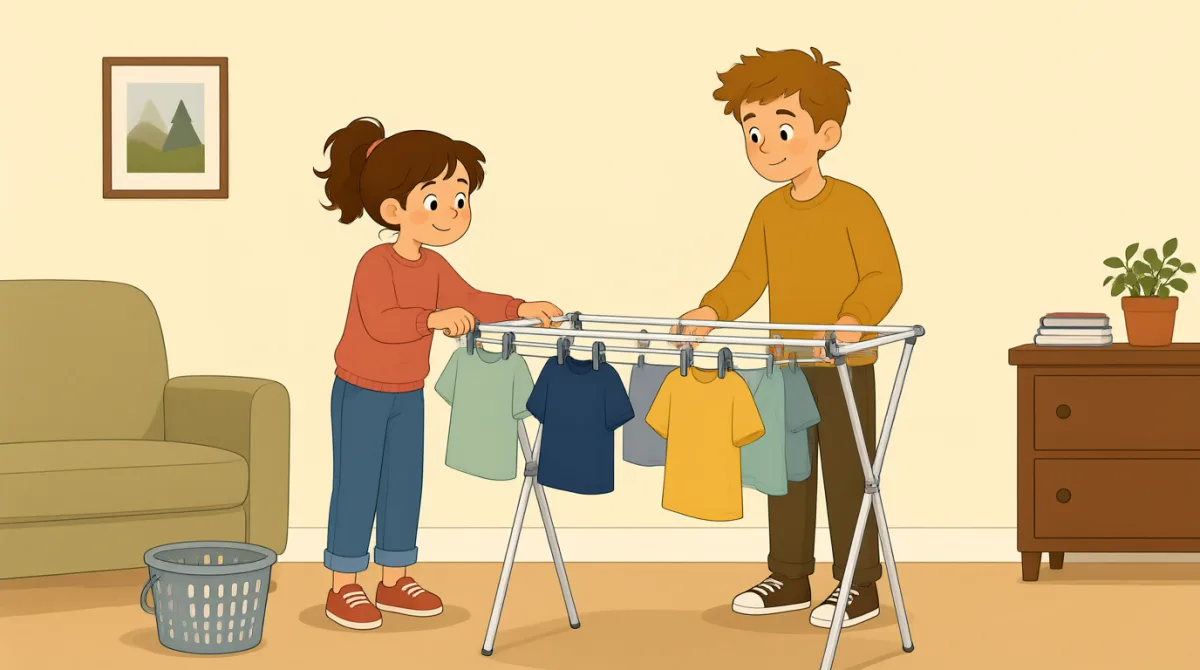

The wash is done. Let’s take out the clothes.
La machine a fini. Sortons le linge.

Okay. This shirt is still wet.
D’accord. Cette chemise est encore mouillée.
That’s okay. We can hang it up.
Ce n’est pas grave. On peut l’étendre.
Where is the drying rack?
Il est où, l’étendoir ?
It’s by the window. I’ll get it.
Il est près de la fenêtre. Je vais le chercher.
Thanks. I’ll hang up these shirts.
Merci. Je vais étendre ces chemises.
Great. I’ll hang the towels here.
Super. Je vais étendre les serviettes ici.
There’s room for everything!
Il y a de la place pour tout !
Vocabulaire8
- The wash is done.La machine a fini.
This means the washing machine has finished washing the clothes. You can say it when a task is finished.
Cela signifie que la machine à laver a fini de laver le linge. Tu peux le dire quand une tâche est terminée.
- take out the clothessortir le linge
This means to remove the clothes from the washing machine. You can use “take out” when removing something from a place.
Cela signifie retirer le linge de la machine à laver. Tu peux utiliser “take out” pour dire qu’on retire quelque chose d’un endroit.
- wetmouillé
“Wet” means covered with water or not dry. Clothes are wet after washing.
“Wet” signifie couvert d’eau ou pas sec. Le linge est mouillé après le lavage.
- hang it upl’étendre
This means to put something on a hook or rack so it can dry. You can also say “hang up” when putting away a coat.
Cela signifie mettre quelque chose sur un crochet ou un étendoir pour le faire sécher. Tu peux aussi dire “hang up” pour parler d’un manteau qu’on range en le suspendant.
- drying rackétendoir
A drying rack is a frame where you hang wet clothes to dry. It is useful when you do not use a dryer.
Un étendoir est une structure sur laquelle on suspend le linge mouillé pour le faire sécher. C’est pratique quand on n’utilise pas de sèche-linge.
- by the windowprès de la fenêtre
This means next to or near the window. Use “by” to say where something is.
Cela signifie à côté de la fenêtre ou pas loin. Utilise “by” pour indiquer où se trouve quelque chose.
- hang up these shirtsétendre ces chemises
This means to put these shirts on a rack or hanger so they can dry. You can use “hang up” with other clothes, too.
Cela signifie mettre ces chemises sur un étendoir ou un cintre pour les faire sécher. Tu peux aussi utiliser “hang up” avec d’autres vêtements.
- There’s room for everything!Il y a de la place pour tout !
This means there is enough space for all the things. You can say it when a place has enough space.
Cela signifie qu’il y a assez d’espace pour toutes les choses. Tu peux le dire quand un endroit est assez grand pour tout accueillir.
Phrases clés8
- 1
The wash is done.
La machine a fini.
This is a simple way to say the washing has finished. You can reuse “___ is done” when a task is complete.
C’est une façon simple de dire que le lavage est terminé. Tu peux réutiliser “___ is done” quand une tâche est terminée.
- 2
Let’s take out the clothes.
Sortons le linge.
Use “Let’s” to suggest doing something together. You can change “the clothes” to another thing you need to remove.
Utilise “Let’s” pour proposer de faire quelque chose ensemble. Tu peux remplacer “the clothes” par une autre chose que tu dois sortir.
- 3
This shirt is still wet.
Cette chemise est encore mouillée.
This sentence describes the condition of a shirt. You can replace “shirt” with another item and “wet” with a different description.
Cette phrase décrit l’état d’une chemise. Tu peux remplacer “shirt” par un autre vêtement et “wet” par une autre description.
- 4
We can hang it up.
On peut l’étendre.
This says that hanging something up is possible. You can use “We can” to suggest an action.
Cette phrase dit qu’il est possible d’étendre quelque chose. Tu peux utiliser “We can” pour proposer une action.
- 5
Where is the drying rack?
Il est où, l’étendoir ?
This is a useful question for asking where something is. Replace “the drying rack” with the thing you are looking for.
C’est une question pratique pour demander où se trouve quelque chose. Remplace “the drying rack” par l’objet que tu cherches.
- 6
I’ll get it.
Je vais le chercher.
This is a short way to offer to go and bring something. You can use it when someone needs an item.
C’est une façon courte de proposer d’aller chercher quelque chose et de l’apporter. Tu peux l’utiliser quand quelqu’un a besoin d’un objet.
- 7
I’ll hang up these shirts.
Je vais étendre ces chemises.
This says what you will do next. You can replace “these shirts” with another item or task.
Cette phrase indique ce que tu vas faire ensuite. Tu peux remplacer “these shirts” par un autre objet ou une autre tâche.
- 8
There’s room for everything!
Il y a de la place pour tout !
Use this to say that there is enough space for all the things. You can use “There’s room for ___” to talk about space.
Utilise cette phrase pour dire qu’il y a assez de place pour toutes les choses. Tu peux utiliser “There’s room for ___” pour parler de l’espace disponible.