Hang the Clothes to Dry
Powiesić ubrania do wyschnięcia
After the wash, Emma and Jack take the clothes out. They hang them on a drying rack.
Po praniu Emma i Jack wyjmują ubrania z pralki. Wieszają je na suszarce.
Dialog8
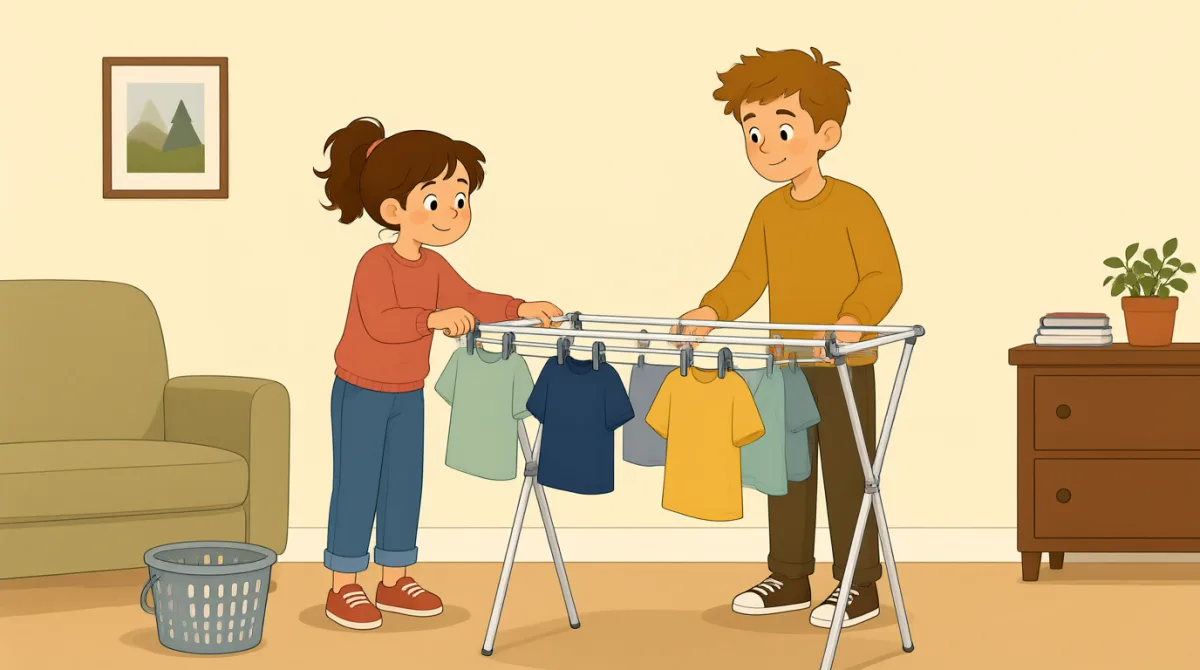

The wash is done. Let’s take out the clothes.
Pranie skończone. Wyjmijmy ubrania.

Okay. This shirt is still wet.
Dobra. Ta koszula jest jeszcze mokra.
That’s okay. We can hang it up.
Nic nie szkodzi. Możemy ją powiesić.
Where is the drying rack?
Gdzie jest suszarka?
It’s by the window. I’ll get it.
Przy oknie. Zaraz ją przyniosę.
Thanks. I’ll hang up these shirts.
Dzięki. Powieszę te koszule.
Great. I’ll hang the towels here.
Super. Powieszę tutaj ręczniki.
There’s room for everything!
Jest miejsce na wszystko!
Słownictwo8
- The wash is done.Pranie skończone.
This means the washing machine has finished washing the clothes. You can say it when a task is finished.
To znaczy, że pralka skończyła prać ubrania. Możesz tak powiedzieć, gdy jakieś zadanie jest już wykonane.
- take out the clotheswyjąć ubrania
This means to remove the clothes from the washing machine. You can use “take out” when removing something from a place.
To znaczy wyjąć ubrania z pralki. „Take out” możesz powiedzieć, gdy wyjmujesz coś z jakiegoś miejsca.
- wetmokry
“Wet” means covered with water or not dry. Clothes are wet after washing.
„Wet” znaczy pokryty wodą albo niewysuszony. Ubrania są mokre po praniu.
- hang it uppowiesić
This means to put something on a hook or rack so it can dry. You can also say “hang up” when putting away a coat.
To znaczy powiesić coś na haczyku albo suszarce, żeby wyschło. „Hang up” możesz też powiedzieć, gdy odwieszasz płaszcz.
- drying racksuszarka na pranie
A drying rack is a frame where you hang wet clothes to dry. It is useful when you do not use a dryer.
„Drying rack” to stojak, na którym wiesza się mokre ubrania, żeby wyschły. Przydaje się, gdy nie używasz suszarki bębnowej.
- by the windowprzy oknie
This means next to or near the window. Use “by” to say where something is.
To znaczy obok okna albo niedaleko niego. Użyj „by”, żeby powiedzieć, gdzie coś się znajduje.
- hang up these shirtspowiesić te koszule
This means to put these shirts on a rack or hanger so they can dry. You can use “hang up” with other clothes, too.
To znaczy powiesić te koszule na suszarce albo wieszakach, żeby wyschły. „Hang up” możesz też łączyć z nazwami innych ubrań.
- There’s room for everything!Jest miejsce na wszystko!
This means there is enough space for all the things. You can say it when a place has enough space.
To znaczy, że jest dość miejsca na wszystkie rzeczy. Możesz tak powiedzieć, gdy gdzieś jest wystarczająco dużo miejsca.
Kluczowe zdania8
- 1
The wash is done.
Pranie skończone.
This is a simple way to say the washing has finished. You can reuse “___ is done” when a task is complete.
To prosty sposób, by powiedzieć, że pranie się skończyło. Możesz użyć wzoru „___ is done”, gdy jakieś zadanie jest zakończone.
- 2
Let’s take out the clothes.
Wyjmijmy ubrania.
Use “Let’s” to suggest doing something together. You can change “the clothes” to another thing you need to remove.
Użyj „Let’s”, żeby zaproponować wspólne zrobienie czegoś. Możesz zastąpić „the clothes” inną rzeczą, którą trzeba wyjąć.
- 3
This shirt is still wet.
Ta koszula jest jeszcze mokra.
This sentence describes the condition of a shirt. You can replace “shirt” with another item and “wet” with a different description.
To zdanie opisuje stan koszuli. Możesz zastąpić „shirt” inną rzeczą, a „wet” innym określeniem.
- 4
We can hang it up.
Możemy ją powiesić.
This says that hanging something up is possible. You can use “We can” to suggest an action.
To zdanie mówi, że można coś powiesić. Możesz użyć „We can”, by zaproponować jakieś działanie.
- 5
Where is the drying rack?
Gdzie jest suszarka na pranie?
This is a useful question for asking where something is. Replace “the drying rack” with the thing you are looking for.
To przydatne pytanie, gdy chcesz dowiedzieć się, gdzie coś jest. Zastąp „the drying rack” rzeczą, której szukasz.
- 6
I’ll get it.
Zaraz ją przyniosę.
This is a short way to offer to go and bring something. You can use it when someone needs an item.
To krótki sposób, by zaoferować, że pójdziesz po coś i to przyniesiesz. Możesz tak powiedzieć, gdy komuś czegoś potrzeba.
- 7
I’ll hang up these shirts.
Powieszę te koszule.
This says what you will do next. You can replace “these shirts” with another item or task.
To zdanie mówi, co zrobisz za chwilę. Możesz zastąpić „these shirts” inną rzeczą albo czynnością.
- 8
There’s room for everything!
Jest miejsce na wszystko!
Use this to say that there is enough space for all the things. You can use “There’s room for ___” to talk about space.
Użyj tego zdania, by powiedzieć, że jest dość miejsca na wszystkie rzeczy. Możesz użyć wzoru „There’s room for ___”, gdy mówisz o ilości miejsca.