Hang the Clothes to Dry
Die Wäsche zum Trocknen aufhängen
After the wash, Emma and Jack take the clothes out. They hang them on a drying rack.
Nach dem Waschen nehmen Emma und Jack die Wäsche heraus. Sie hängen sie auf einen Wäscheständer.
Dialog8
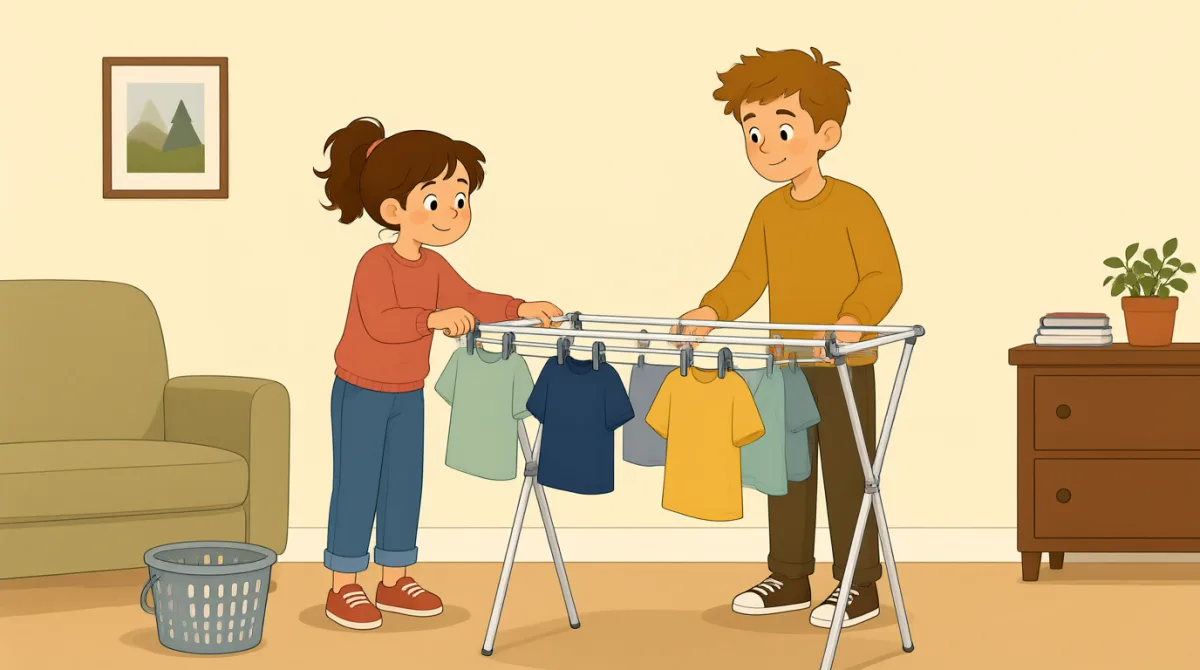

The wash is done. Let’s take out the clothes.
Die Wäsche ist fertig. Lass uns die Sachen rausholen.

Okay. This shirt is still wet.
Okay. Dieses Hemd ist noch nass.
That’s okay. We can hang it up.
Macht nichts. Wir können es aufhängen.
Where is the drying rack?
Wo ist der Wäscheständer?
It’s by the window. I’ll get it.
Er steht am Fenster. Ich hole ihn.
Thanks. I’ll hang up these shirts.
Danke. Ich hänge diese Hemden auf.
Great. I’ll hang the towels here.
Super. Ich hänge die Handtücher hier auf.
There’s room for everything!
Hier ist Platz für alles!
Wortschatz8
- The wash is done.Die Wäsche ist fertig.
This means the washing machine has finished washing the clothes. You can say it when a task is finished.
Das bedeutet, dass die Waschmaschine mit dem Waschen der Wäsche fertig ist. Das kannst du sagen, wenn eine Aufgabe erledigt ist.
- take out the clothesdie Wäsche herausholen
This means to remove the clothes from the washing machine. You can use “take out” when removing something from a place.
Das bedeutet, die Wäsche aus der Waschmaschine zu nehmen. „take out“ kannst du verwenden, wenn du etwas aus einem Ort herausnimmst.
- wetnass
“Wet” means covered with water or not dry. Clothes are wet after washing.
„Wet“ bedeutet, dass etwas mit Wasser bedeckt oder nicht trocken ist. Wäsche ist nach dem Waschen nass.
- hang it upes aufhängen
This means to put something on a hook or rack so it can dry. You can also say “hang up” when putting away a coat.
Das bedeutet, etwas an einen Haken oder auf einen Wäscheständer zu hängen, damit es trocknen kann. „hang up“ kannst du auch sagen, wenn du einen Mantel weghängst.
- drying rackder Wäscheständer
A drying rack is a frame where you hang wet clothes to dry. It is useful when you do not use a dryer.
Ein Wäscheständer ist ein Gestell, auf das du nasse Wäsche zum Trocknen hängst. Er ist praktisch, wenn du keinen Trockner benutzt.
- by the windowam Fenster
This means next to or near the window. Use “by” to say where something is.
Das bedeutet, dass etwas neben oder in der Nähe des Fensters ist. Mit „by“ sagst du, wo sich etwas befindet.
- hang up these shirtsdiese Hemden aufhängen
This means to put these shirts on a rack or hanger so they can dry. You can use “hang up” with other clothes, too.
Das bedeutet, diese Hemden auf einen Wäscheständer oder Bügel zu hängen, damit sie trocknen können. „hang up“ kannst du auch mit anderen Kleidungsstücken verwenden.
- There’s room for everything!Hier ist Platz für alles!
This means there is enough space for all the things. You can say it when a place has enough space.
Das bedeutet, dass genug Platz für alle Sachen da ist. Das kannst du sagen, wenn irgendwo genug Platz ist.
Wichtige Sätze8
- 1
The wash is done.
Die Wäsche ist fertig.
This is a simple way to say the washing has finished. You can reuse “___ is done” when a task is complete.
So kannst du einfach sagen, dass das Waschen abgeschlossen ist. „___ is done“ kannst du auch für andere Aufgaben verwenden, wenn sie erledigt sind.
- 2
Let’s take out the clothes.
Lass uns die Wäsche herausholen.
Use “Let’s” to suggest doing something together. You can change “the clothes” to another thing you need to remove.
Mit „Let’s“ schlägst du vor, etwas gemeinsam zu tun. Du kannst „the clothes“ durch etwas anderes ersetzen, das du herausholen musst.
- 3
This shirt is still wet.
Dieses Hemd ist noch nass.
This sentence describes the condition of a shirt. You can replace “shirt” with another item and “wet” with a different description.
Dieser Satz beschreibt den Zustand eines Hemdes. Du kannst „shirt“ durch ein anderes Kleidungsstück und „wet“ durch eine andere Beschreibung ersetzen.
- 4
We can hang it up.
Wir können es aufhängen.
This says that hanging something up is possible. You can use “We can” to suggest an action.
Damit sagst du, dass es möglich ist, etwas aufzuhängen. Mit „We can“ kannst du eine Handlung vorschlagen.
- 5
Where is the drying rack?
Wo ist der Wäscheständer?
This is a useful question for asking where something is. Replace “the drying rack” with the thing you are looking for.
Mit dieser nützlichen Frage kannst du fragen, wo sich etwas befindet. Ersetze „the drying rack“ durch den Gegenstand, den du suchst.
- 6
I’ll get it.
Ich hole ihn.
This is a short way to offer to go and bring something. You can use it when someone needs an item.
So kannst du kurz anbieten, etwas zu holen und mitzubringen. Das kannst du sagen, wenn jemand etwas braucht.
- 7
I’ll hang up these shirts.
Ich hänge diese Hemden auf.
This says what you will do next. You can replace “these shirts” with another item or task.
Damit sagst du, was du als Nächstes tun wirst. Du kannst „these shirts“ durch einen anderen Gegenstand oder eine andere Aufgabe ersetzen.
- 8
There’s room for everything!
Hier ist Platz für alles!
Use this to say that there is enough space for all the things. You can use “There’s room for ___” to talk about space.
Damit sagst du, dass genug Platz für alle Sachen da ist. Mit „There’s room for ___“ kannst du über Platz sprechen.