Finding a Good Spot
Einen schönen Platz finden
Emma and Jack look for a nice place to sit in the park. They find a spot under a tree.
Emma und Jack suchen im Park einen schönen Platz zum Sitzen. Sie finden einen Platz unter einem Baum.
Dialog7
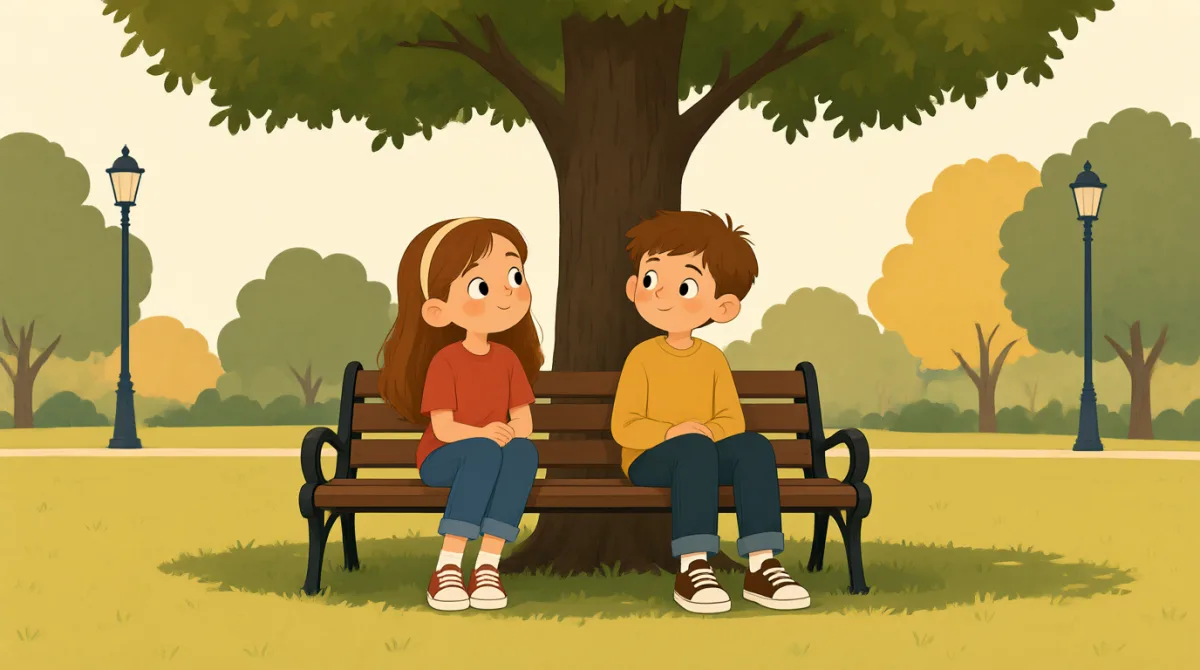

Where should we sit, Jack?
Wo sollen wir sitzen, Jack?

Let’s find a nice spot.
Lass uns einen schönen Platz suchen.
That spot looks nice. Is it free?
Der Platz sieht schön aus. Ist er frei?
Yes, it’s free. But it’s very sunny.
Ja, er ist frei. Aber dort ist es sehr sonnig.
I see a big tree over there.
Ich sehe da drüben einen großen Baum.
Good idea. Let’s sit under it.
Gute Idee. Lass uns darunter sitzen.
It’s cool and quiet here.
Hier ist es kühl und ruhig.
Wortschatz7
- a nice spotein schöner Platz
A pleasant place to sit. You can say, “Let’s find a nice spot” when you want to choose a good place.
Ein angenehmer Platz zum Sitzen. Du kannst „Let’s find a nice spot“ (Lass uns einen schönen Platz suchen) sagen, wenn du einen guten Platz aussuchen möchtest.
- freefrei
Available for someone to use. Ask “Is it free?” to check whether a seat or place is available.
Verfügbar, sodass jemand den Platz nutzen kann. Frag „Is it free?“ (Ist der Platz frei?), um herauszufinden, ob ein Sitzplatz oder ein anderer Platz noch frei ist.
- sunnysonnig
Bright with a lot of sunlight. You can use this word to describe the weather or a place in the sun.
Hell und mit viel Sonnenschein. Mit diesem Wort kannst du das Wetter oder einen Platz in der Sonne beschreiben.
- over thereda drüben
A phrase for pointing to a place that is not close to you. For example, “The café is over there.”
Eine Wendung, mit der du auf einen Ort zeigst, der nicht in deiner Nähe ist. Zum Beispiel: „The café is over there.“ (Das Café ist da drüben.)
- Good idea.Gute Idee.
A simple way to say that you like someone’s suggestion. You can also say, “That’s a good idea.”
Eine einfache Möglichkeit zu sagen, dass dir der Vorschlag von jemandem gefällt. Du kannst auch sagen: „That’s a good idea.“ (Das ist eine gute Idee.)
- under itdarunter
In this dialogue, it means in the space below the tree. Use “under” to say that something is below another thing.
In diesem Dialog bedeutet es: im Bereich unter dem Baum. Verwende „under“, wenn du sagen möchtest, dass sich etwas unter einer anderen Sache befindet.
- cool and quietkühl und ruhig
“Cool” means not warm, and “quiet” means with little noise. These words describe a comfortable place to sit.
„Cool“ bedeutet nicht warm und „quiet“ bedeutet, dass es kaum Geräusche gibt. Mit diesen Wörtern beschreibst du einen angenehmen Platz zum Sitzen.
Wichtige Sätze8
- 1
Where should we sit, Jack?
Wo sollen wir sitzen, Jack?
Use this question to ask someone to help choose a place to sit. You can replace “sit” with another activity, such as “Where should we eat?”
Mit dieser Frage bittest du jemanden, dir bei der Wahl eines Sitzplatzes zu helfen. Du kannst „sit“ durch eine andere Aktivität ersetzen, zum Beispiel: „Where should we eat?“ (Wo sollen wir essen?)
- 2
Let’s find a nice spot.
Lass uns einen schönen Platz suchen.
Use “Let’s” to suggest doing something together. You can say, “Let’s find a table” or “Let’s find a place to rest.”
Mit „Let’s“ schlägst du vor, etwas gemeinsam zu tun. Du kannst sagen: „Let’s find a table“ (Lass uns einen Tisch suchen) oder „Let’s find a place to rest.“ (Lass uns einen Platz zum Ausruhen suchen.)
- 3
That spot looks nice.
Der Platz sieht schön aus.
Use this sentence to say that a place seems pleasant. Replace “spot” with a place, such as “That park looks nice.”
Mit diesem Satz sagst du, dass ein Ort angenehm wirkt. Ersetze „spot“ durch einen Ort, zum Beispiel: „That park looks nice.“ (Der Park sieht schön aus.)
- 4
Is it free?
Ist er frei?
Ask this to check whether a place or seat is available. You can also ask, “Is this chair free?”
Damit fragst du, ob ein Platz oder Sitzplatz verfügbar ist. Du kannst auch fragen: „Is this chair free?“ (Ist dieser Stuhl frei?)
- 5
I see a big tree over there.
Ich sehe da drüben einen großen Baum.
Use “I see” to point out something you notice. Replace “a big tree” with another thing, such as “a bench.”
Mit „I see“ machst du auf etwas aufmerksam, das dir aufgefallen ist. Ersetze „a big tree“ durch eine andere Sache, zum Beispiel: „a bench“ (eine Bank).
- 6
Good idea.
Gute Idee.
Use this short phrase to agree with a suggestion. It is a friendly, natural response in everyday conversation.
Mit dieser kurzen Wendung stimmst du einem Vorschlag zu. Sie ist eine freundliche und natürliche Antwort im Alltag.
- 7
Let’s sit under it.
Lass uns darunter sitzen.
Use this sentence to suggest sitting below or beneath something. Replace “it” with the thing you mean, such as “the tree.”
Mit diesem Satz schlägst du vor, unter etwas zu sitzen. Ersetze „it“ durch die Sache, die du meinst, zum Beispiel: „the tree“ (der Baum).
- 8
It’s cool and quiet here.
Hier ist es kühl und ruhig.
Use this sentence to describe a comfortable place. Replace “cool and quiet” with other describing words, such as “warm and sunny.”
Mit diesem Satz beschreibst du einen angenehmen Ort. Ersetze „cool and quiet“ durch andere beschreibende Wörter, zum Beispiel: „warm and sunny“ (warm und sonnig).