Asking Someone to Speak Slowly on the Phone
Jemanden am Telefon bitten, langsamer zu sprechen
Emma cannot follow David on the phone and asks him to speak more slowly and repeat the key details.
Emma versteht David am Telefon nicht und bittet ihn, langsamer zu sprechen und die wichtigsten Details zu wiederholen.
Dialog7
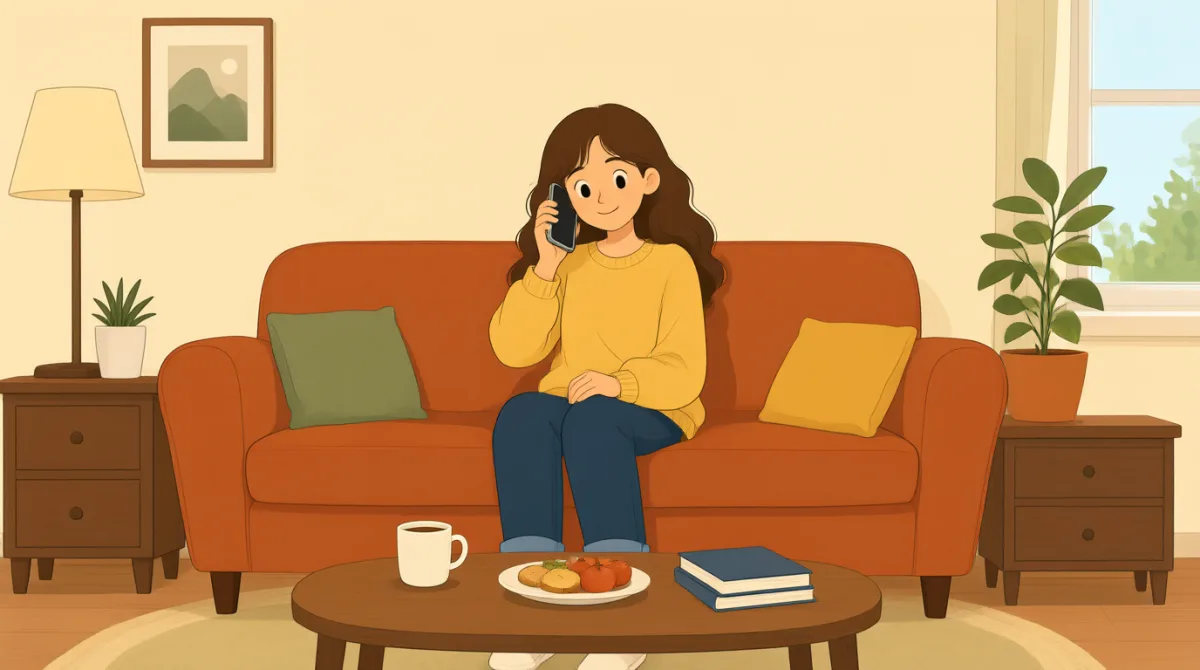

Hi, David. I can’t hear you well.
Hallo, David. Ich kann dich nicht gut hören.

Sorry. I’m on a busy street.
Entschuldige. Ich bin auf einer belebten Straße.
Can you speak more slowly, please?
Kannst du bitte langsamer sprechen?
Sure. Your meeting is at two.
Klar. Dein Meeting ist um zwei.
Sorry, can you repeat the time?
Entschuldige, kannst du die Uhrzeit wiederholen?
It’s at two o’clock, today.
Es ist heute um zwei Uhr.
Thanks. Two o’clock today. I understand.
Danke. Heute um zwei Uhr. Jetzt verstehe ich.
Wortschatz7
- I can’t hear you well.Ich kann dich nicht gut hören.
Use this when someone’s voice is not clear on a call. You can say it before asking them to speak more slowly.
Das kannst du sagen, wenn jemand am Telefon nicht klar zu hören ist. Du kannst es sagen, bevor du die Person bittest, langsamer zu sprechen.
- busy streetbelebte Straße
A busy street has a lot of people or traffic. Noise from a busy street can make a phone call hard to hear.
Auf einer belebten Straße sind viele Menschen oder Fahrzeuge unterwegs. Der Lärm kann es schwierig machen, beim Telefonieren alles zu hören.
- speak more slowlylangsamer sprechen
Use this phrase to ask someone to talk at a slower speed. You can add “please” to make the request polite.
Mit dieser Wendung bittest du jemanden, langsamer zu sprechen. Mit „please“ machst du die Bitte höflicher.
- Sure.Klar.
This is a friendly way to agree to a request. You can use it before doing what someone asks.
So kannst du freundlich einer Bitte zustimmen. Du kannst es sagen, bevor du tust, worum dich jemand gebeten hat.
- repeat the timedie Uhrzeit wiederholen
Use this phrase when you want someone to say the time again. It is helpful when you miss an important detail.
Mit dieser Wendung bittest du jemanden, die Uhrzeit noch einmal zu sagen. Das ist hilfreich, wenn du ein wichtiges Detail nicht verstanden hast.
- at two o’clockum zwei Uhr
This tells someone the exact time of an event. You can use “at” before a clock time.
Damit nennst du die genaue Uhrzeit eines Ereignisses. Im Englischen steht „at“ vor einer Uhrzeit.
- I understand.Ich verstehe.
Use this to show that you now know or understand the information. You can repeat the key detail before saying it.
Damit zeigst du, dass du die Information jetzt verstanden hast. Du kannst das wichtigste Detail wiederholen, bevor du es sagst.
Wichtige Sätze8
- 1
I can’t hear you well.
Ich kann dich nicht gut hören.
Use this to explain that someone’s voice is unclear. You can add a reason, such as “because it’s noisy here.”
Das kannst du sagen, wenn du jemanden nicht klar hörst. Du kannst einen Grund ergänzen, zum Beispiel „because it’s noisy here“.
- 2
Can you speak more slowly, please?
Kannst du bitte langsamer sprechen?
This is a polite way to ask someone to slow down. You can use “Can you…?” to make other simple requests.
Das ist eine höfliche Art, jemanden zu bitten, langsamer zu sprechen. Mit „Can you…?“ kannst du auch andere einfache Bitten formulieren.
- 3
Your meeting is at two.
Dein Meeting ist um zwei.
This gives someone a meeting time. You can replace “two” with another time or event detail.
Damit nennst du jemandem die Uhrzeit eines Meetings. Du kannst „two“ durch eine andere Uhrzeit oder ein anderes Ereignisdetail ersetzen.
- 4
Sorry, can you repeat the time?
Entschuldige, kannst du die Uhrzeit wiederholen?
Use this to ask someone to say the time again. You can replace “the time” with another detail, such as “the address.”
Damit bittest du jemanden, die Uhrzeit noch einmal zu sagen. Du kannst „the time“ durch ein anderes Detail ersetzen, zum Beispiel durch „the address“.
- 5
It’s at two o’clock, today.
Es ist heute um zwei Uhr.
This repeats the time and says which day the event is. You can use “It’s at…” to give an event’s time.
Damit wiederholst du die Uhrzeit und sagst, an welchem Tag das Ereignis stattfindet. Mit „It’s at…“ kannst du die Uhrzeit eines Ereignisses nennen.
- 6
Thanks.
Danke.
This is a simple way to show that you are grateful. Use it after someone helps you.
Das ist eine einfache Art, dich zu bedanken. Sag es, nachdem dir jemand geholfen hat.
- 7
Two o’clock today.
Heute um zwei Uhr.
Repeating the key details helps confirm that you heard them correctly. You can repeat a time and day in the same way.
Wenn du die wichtigsten Details wiederholst, kannst du bestätigen, dass du sie richtig verstanden hast. Eine Uhrzeit und einen Tag kannst du auf dieselbe Weise wiederholen.
- 8
I understand.
Ich verstehe.
Use this to let someone know that the information is clear now. You can say it after they repeat or explain something.
Damit zeigst du jemandem, dass die Information jetzt klar ist. Du kannst es sagen, nachdem jemand etwas wiederholt oder erklärt hat.