Asking Someone to Speak Slowly on the Phone
Emma cannot follow David on the phone and asks him to speak more slowly and repeat the key details.
Dialogue7
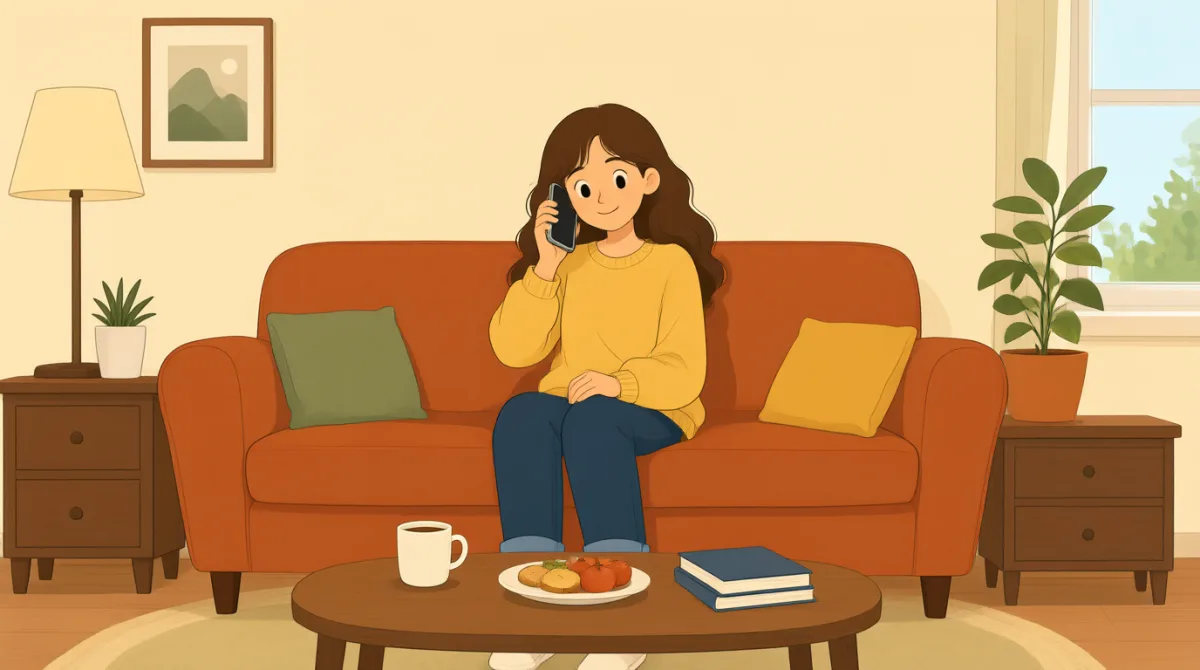

Hi, David. I can’t hear you well.

Sorry. I’m on a busy street.
Can you speak more slowly, please?
Sure. Your meeting is at two.
Sorry, can you repeat the time?
It’s at two o’clock, today.
Thanks. Two o’clock today. I understand.
Vocabulary7
- I can’t hear you well.
Use this when someone’s voice is not clear on a call. You can say it before asking them to speak more slowly.
- busy street
A busy street has a lot of people or traffic. Noise from a busy street can make a phone call hard to hear.
- speak more slowly
Use this phrase to ask someone to talk at a slower speed. You can add “please” to make the request polite.
- Sure.
This is a friendly way to agree to a request. You can use it before doing what someone asks.
- repeat the time
Use this phrase when you want someone to say the time again. It is helpful when you miss an important detail.
- at two o’clock
This tells someone the exact time of an event. You can use “at” before a clock time.
- I understand.
Use this to show that you now know or understand the information. You can repeat the key detail before saying it.
Key Sentences8
- 1
I can’t hear you well.
Use this to explain that someone’s voice is unclear. You can add a reason, such as “because it’s noisy here.”
- 2
Can you speak more slowly, please?
This is a polite way to ask someone to slow down. You can use “Can you…?” to make other simple requests.
- 3
Your meeting is at two.
This gives someone a meeting time. You can replace “two” with another time or event detail.
- 4
Sorry, can you repeat the time?
Use this to ask someone to say the time again. You can replace “the time” with another detail, such as “the address.”
- 5
It’s at two o’clock, today.
This repeats the time and says which day the event is. You can use “It’s at…” to give an event’s time.
- 6
Thanks.
This is a simple way to show that you are grateful. Use it after someone helps you.
- 7
Two o’clock today.
Repeating the key details helps confirm that you heard them correctly. You can repeat a time and day in the same way.
- 8
I understand.
Use this to let someone know that the information is clear now. You can say it after they repeat or explain something.